Historic development: Afghanistan’s disappearing box cameras

1 / 3
In this photo taken on October 13, 2021, Afghan photographer Haji Mirzaman (R) stands next to his homemade wooden box camera. (AFP)
2 / 3
Afghan photographer Haji Mirzaman shows a processed photograph taken with his homemade wooden box camera, known as a "kamra-e-faoree", at a photography shop in Kabul. (AFP)
3 / 3
Afghan photographer Haji Mirzaman poses for a picture next to his camera at his home in Kabul. (AFP)
Short Url
Updated 20 November 2021
Follow

Historic development: Afghanistan’s disappearing box cameras

  • The golden age of box cameras in Afghanistan came when compulsory national service was introduced in the 1950s, meaning thousands of recruits needed photos for military identity cards

KABUL: Haji Mirzaman was just a teenager when he started taking photos using a homemade wooden box camera in his cousin's studio in downtown Kabul.
He took black-and-white portraits of people for passports, identity cards and other documents using his "magic box" on a sidewalk, producing prints in a couple of minutes.
Now in his 70s, he says the instant camera -- or "kamra-e-faoree" as it is known in Dari -- has survived wars, invasions and a Taliban ban on photography, but is now in danger of disappearing because of digital technology.
"These cameras are retired now," he told AFP at his small house in Kabul as he set up the box on its wooden tripod.
"I am just keeping this last remaining camera."
The box is both camera and darkroom, and to show how it works Mirzaman put photographic paper and developing liquid inside the device in preparation for a shot.
He then briefly removed the lens cover and instantly created a negative.
Reaching inside the box through a light-proof funnel, he processed the negative and then developed a print.
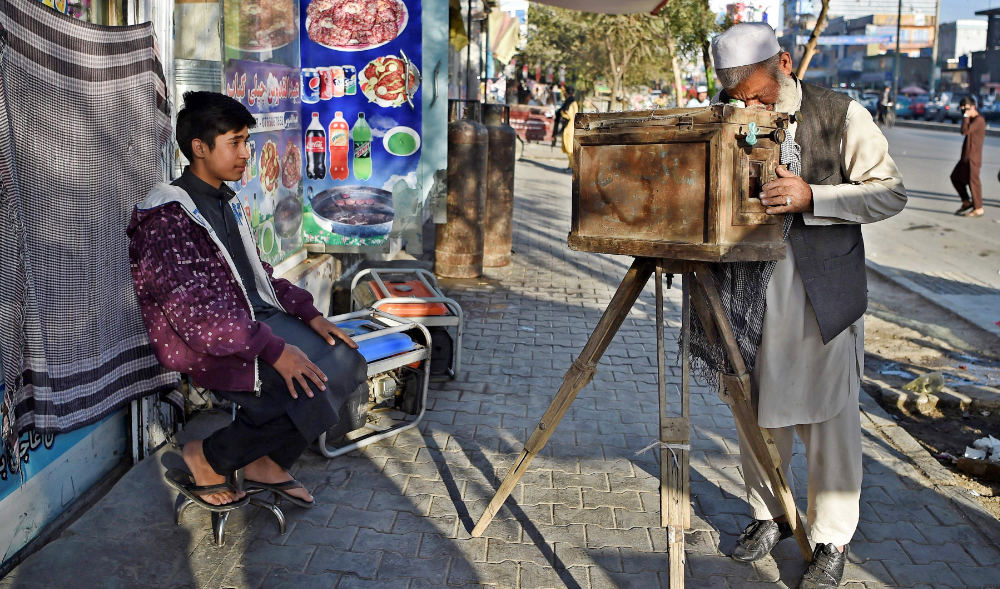


Afghan photographer Haji Mirzaman (R) takes a portrait of a boy with his homemade wooden box camera known as a "kamra-e-faoree" on a sidewalk in Kabul. (AFP)

In a few minutes, the photo was ready.
"Nowadays, photographers all use digital cameras... fewer and fewer people know how this camera works," he said.

The boxes were made by local carpenters, he said, but the lenses were imported.
The golden age of box cameras in Afghanistan came when compulsory national service was introduced in the 1950s, meaning thousands of recruits needed photos for military identity cards.
The Taliban, who ruled Afghanistan from 1996 to 2001 and forbade images of people, allowed Mirzaman to take official photos with his box camera.
After the group's ouster, the machines thrived again when millions of students returned to schools and ID cards were made compulsory.
Since their return to power in August, the hardline Islamists have made no public declaration on taking pictures -- and young fighters are frequently seen snapping photos of each other, or selfies, with their mobile phones.
Mirzaman has taught all four of his sons photography, but none now uses box cameras.
The family's last remaining kamra-e-faoree is now on display outside their studio -- a striking reminder of Afghanistan's photographic history.


Cambodia takes back looted historic artifacts handled by British art dealer

Updated 28 February 2026
Follow

Cambodia takes back looted historic artifacts handled by British art dealer

  • The objects were returned under a 2020 agreement between the Ministry of Culture and Fine Arts and the family of the late Douglas Latchford, a British art collector and dealer who allegedly had the items smuggled out of Cambodia

PHNOM PENH, Cambodia: Cambodian officials on Friday received more than six dozen historic artifacts described as part of the country’s cultural heritage that had been looted during decades of war and instability.
At a ceremony attended by Deputy Prime Minister Hun Many, the 74 items were unveiled at the National Museum in Phnom Penh after their repatriation from the United Kingdom.
The objects were returned under a 2020 agreement between the Ministry of Culture and Fine Arts and the family of the late Douglas Latchford, a British art collector and dealer who allegedly had the items smuggled out of Cambodia.
“This substantial restitution represents one of the most important returns of Khmer cultural heritage in recent years, following major repatriations in 2021 and 2023 from the same collection,” the Culture Ministry said in a statement. “It marks a significant step forward in Cambodia’s continued efforts to recover, preserve, and restore its ancestral legacy for future generations.”
The artifacts were described as dating from the pre-Angkorian period through the height of the Angkor Empire, including “monumental sandstone sculptures, refined bronze works, and significant ritual objects.” The Angkor Empire, which extended from the ninth to the 15th century, is best known for the Angkor Wat archaeological site, the nation’s biggest tourist attraction.
Latchford was a prominent antiquities dealer who allegedly orchestrated an operation to sell looted Cambodian sculptures on the international market.
From 1970 to the 1980s, during Cambodia’s civil wars and the communist Khmer Rouge ‘s brutal reign, organized looting networks sent artifacts to Latchford, who then sold them to Western collectors, dealers, and institutions. These pieces were often physically damaged, having been pried off temple walls or other structures by the looters.
Latchford was indicted in a New York federal court in 2019 on charges including wire fraud and conspiracy. He died in 2020, aged 88, before he could be extradited to face charges.
Cambodia, like neighboring Thailand, has benefited from a trend in recent decades involving the repatriation of art and archaeological treasures. These include ancient Asian artworks as well as pieces lost or stolen during turmoil in places such as Syria, Iraq and Nazi-occupied Europe. New York’s Metropolitan Museum of Art is one of the prominent institutions that has been returning illegally smuggled art, including to Cambodia.
“The ancient artifacts created and preserved by our ancestors are now being returned to Cambodia, bringing warmth and joy, following the country’s return to peace,” said Hun Many, who is the younger brother of Prime Minister Hun Manet.