KARACHI: Pakistan’s top trade and commerce official said on Wednesday his country would import liquified petroleum gas (LPG) from Iran in exchange of rice under a barter arrangement endorsed by the two countries.
Earlier this month, Pakistan and Iran held the 9th Joint Trade Committee (JTC) meeting in Tehran and resolved to take bilateral trade to $5 billion by 2023.
It is pertinent to mention that Iran faces sanctions imposed by the United States, making it difficult for global and regional countries to broaden and deepen their trade ties with the administration in Tehran.
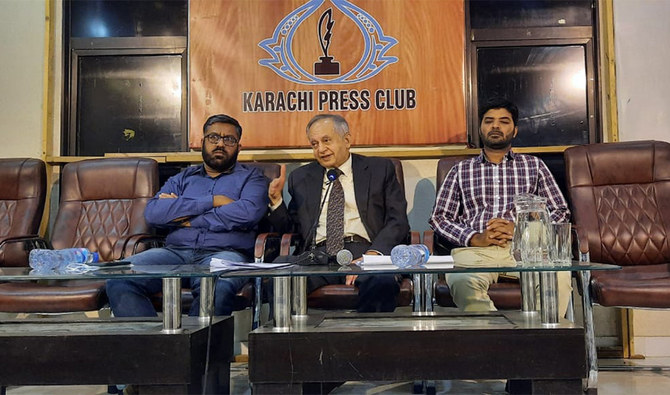
“When we went to Iran what we talked about was the barter trade,” said the prime minister’s adviser on commerce Abdul Razak Dawood while addressing a news conference at the Karachi Press Club. “Almost all pieces of the jigsaw have been put in place.”
“We will export rice to Iran and import LPG from there … It is purely a barter deal … They [Iran] have agreed in principle and we have signed it [the memorandum of understanding],” he said, adding the barter trade would begin within a month or two.
Responding to a question about the implications of trading with Iran when the Middle Eastern state was under US sanctions, Dawood said it was a private arrangement.
“It is ... between the chamber of Quetta and the chamber of Zahedan,” he said while referring to the memorandum of understanding signed by the representative bodies of the business community in the two countries under the JTC.
Pakistan’s top trade and commerce official said the two chambers were taking the initiative and the governments were not getting involved.
“It is the private sector from this side and the private sector from that side who are doing this and that is okay. You can’t do it through banking as no bank would extend its hand,” he explained.
However, a former Pakistani ambassador to the United States said the administration in Washington was likely to view the deal as a violation of its economic embargo on Iran.
“The US has opposed barter deals with Iran and deemed them a violation of sanctions in effect,” said Husain Haqqani, who currently works with Hudson Institute in Washington DC. “Pakistan would have to be prepared for negative American reaction on any large-scale barter arrangement with Iran.”
Dawood also noted the country’s exports were increasing by 30 percent, adding that more growth could still be achieved by adopting product and geographical diversification.
“To achieve the export target, connectivity with Central Asian countries through Silk Route Reconnect Policy and Look Africa Policy have been formulated and implemented,” he said.
“In the coming week, we are going to Lagos, Nigeria, to tap the western side of Africa with 115 businessmen to hold a country exhibition,” he informed. “So far, around 1,300 B2B meetings have been arranged for the three-day event.”
Asked about the glacial pace of the China-Pakistan Economic Corridor (CPEC), he said the direction of the project under the joint economic development framework would change after the completion of power and infrastructure projects.
“Now we need the Chinese support with industries and agriculture,” he said, adding: “Going from one direction to other does not mean that CPEC is becoming less functional.”
The adviser said the corridor project was still very import for Pakistan, though he acknowledged that more Chinese firms should be brought to the country’s strategic sectors.
“The Chinese companies are mainly making investment in local market,” Dawood said, “but the real game is to bring them to Pakistan to enhance our exports. In that area, only two or three Chinese companies have arrived.”


![]()

Pakistan to trade rice for LPG under barter arrangement with Iran – PM’s commerce adviser
Short Url
https://arab.news/mb4st
Pakistan to trade rice for LPG under barter arrangement with Iran – PM’s commerce adviser
- The trade will be carried out by the private sectors of the two countries since Iran faces tough US sanctions
- A former Pakistani ambassador to the United States says Washington is likely to view the deal as a violation of its economic embargo on Tehran
Latest updates


© 2026 SAUDI RESEARCH & PUBLISHING COMPANY, All Rights Reserved And subject to Terms of Use Agreement.