

KSRelief, WFP to provide food aid to vulnerable groups in Pakistan

A KSRelief worker delivers food assistance to a family in Punjab on May 5, 2020. (SPA)
Short Url
Updated 17 November 2021
Follow

KSRelief, WFP to provide food aid to vulnerable groups in Pakistan

  • Efforts will cover Pakistan’s northern regions, reaching over 66,000 people
  • Assistance focuses on children with acute malnutrition and pregnant and nursing women

ISLAMABAD: King Salman Humanitarian Aid and Relief Center (KSRelief) and the UN World Food Program (WFP) have signed an agreement to provide nutritional assistance to vulnerable groups in Pakistan, the Saudi Press Agency (SPA) reported on Tuesday.
KSrelief supervisor general Dr. Abdullah bin Abdulaziz Al-Rabeeah and WFP executive director David Beasley signed the cooperation agreement on the sidelines of a WFP executive board session in Rome.
The efforts will focus on 14 areas in the country’s northern regions, reaching over 66,000 people.
“The agreement includes life-saving nutritional support in cases of emergency for children diagnosed with acute malnutrition, and pregnant and nursing women in endangered regions in Khyber Pakhtunkhwa Region and Azad Jammu Kashmir Region in Pakistan,” the SPA reported.
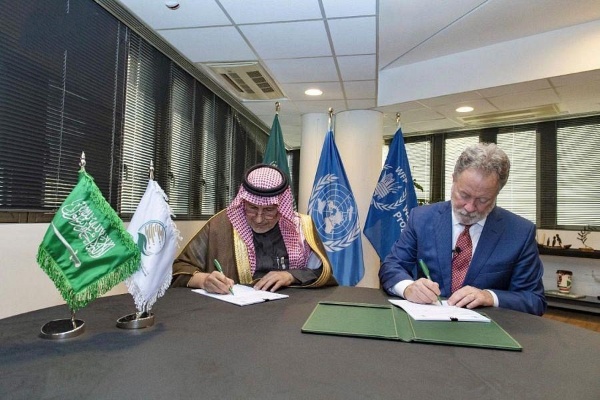


Advisor at the Royal Court and Supervisor General of KSrelief Dr. Abdullah bin Abdulaziz Al Rabeeah (L) and Executive Director of the World Food Program David Beasley (R) sign agreement of food aid for Pakistan and Syria in Rome on Nov 16, 2021. (SPA)

The assistance seeks to “increase opportunities to receive treatment foods to guarantee comprehensive nutritional services that can save the lives of children under five years old, pregnant and nursing women in 14 priority regions in Pakistan, enhance the capability of checking up and treating malnutrition in health care facilities and at the local community level.”
It will also focus on increasing access to information related to nutrition and public health.
The Saudi-based international agency provides humanitarian and development support to millions of beneficiaries in more than 49 countries. Pakistan is the fifth-largest recipient of assistance and received more than $120 million in aid since 2005.


Pakistan Air Force conducts ‘Exercise Golden Eagle’ to test combat readiness, agility

Updated 10 February 2026
Follow

Pakistan Air Force conducts ‘Exercise Golden Eagle’ to test combat readiness, agility

  • The exercise follows an intense, four-day Pakistan-India military conflict in May 2025
  • It focused on AI-enabled operations integrating disruptive technologies, military says

ISLAMABAD: The Pakistan Air Force (PAF) has conducted “Exercise Golden Eagle” that successfully validated its combat readiness and operational agility through synchronized employment of the PAF’s complete combat potential, the Pakistani military said on Tuesday.

It comes months after Pakistan’s four-day military conflict with India in May, with Islamabad claiming victory in the standoff after the PAF claimed to have shot down at least six Indian fighter aircraft, including the French-made Rafale. New Delhi acknowledged some losses but did not specify a number.

The exercise was conducted on a Two-Force construct, focusing on AI-enabled, net-centric operations while integrating indigenous niche, disruptive and smart technologies in line with evolving regional security dynamics, according to the Inter-Services Public Relations (ISPR), the Pakistani military’s media wing.

Operating within a robust Integrated Air Defense System, friendly forces shaped the battlespace through seamless fusion of kinetic operations with cyber, space and electro-magnetic spectrum operations.

“The kinetic phase featured First-Shoot, First-Kill swing-role combat aircraft equipped with long-range BVR air-to-air missiles, extended-range stand-off weapons and precision strike capabilities, supported by Airborne Early Warning & Control platforms and Air-to-Air Refuelers,” the ISPR said in a statement.

“A key highlight of the exercise was Manned–Unmanned Teaming, with deep-reach killer drones and loitering munitions operating in a highly contested, congested and degraded environment, validating PAF’s capability to conduct high-tempo operations in modern warfare.”

In recent months, many countries have stepped up defense engagement with Pakistan, while delegations from multiple nations have proposed learning from the PAF’s multi-domain air warfare capabilities that officials say were successfully employed during the May conflict.

“The successful conduct of Exercise Golden Eagle reaffirms Pakistan Air Force’s unwavering commitment to maintaining a high state of operational preparedness, leveraging indigenous innovation and effectively countering emerging and future security challenges,” the ISPR added.