

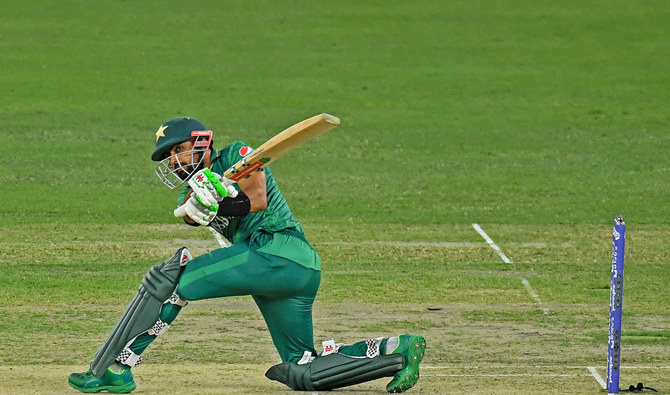
ICC names Babar Azam captain of 'Most Valuable Team' of T20 World Cup 2021

Pakistan's captain Babar Azam plays a shot during the ICC men’s Twenty20 World Cup semi-final match against Australia at the Dubai International Cricket Stadium, UAE, on November 11, 2021. (AFP)
Short Url
Updated 15 November 2021
Follow

ICC names Babar Azam captain of 'Most Valuable Team' of T20 World Cup 2021

  • The line-up includes players from Pakistan, Australia, New Zealand, England, Sri Lanka, South Africa
  • Left-arm destructive Pakistani pacer Shaheen Shah Afridi takes place as the 12th man of the squad

ISLAMABAD: The International Cricket Council (ICC) on Monday released the "Official ICC Men’s T20 World Cup Upstox Most Valuable Team of the Tournament," selecting Babar Azam as its captain. 

The team of the tournament included players from World Cup-winning Australia, runners-up New Zealand, semi-finalists England and Pakistan as well as Sri Lanka and South Africa. 

Opening batter David Warner, leg-spinner Adam Zampa and seamer Josh Hazlewood all made the cut for Australia after helping steer their side to first ever ICC Men’s T20 World Cup title. 

Pakistan’s Babar Azam secured the most coveted spot of captain, while left-handed destructive pacer Shaheen Shah Afridi was selected as the 12th man of the squad. 

England ace Jos Buttler, New Zealand left-armer Trent Boult and Sri Lanka star Wanindu Hasaranga – the tournament’s leading wicket-taker – were also part of the line-up.  

No Indian cricketer could make it to the ICC's team of the tournament. 

The side was pulled together by a selection panel comprising commentators, former international players and journalists, including Ian Bishop (convenor), Natalie Germanos, Shane Watson, Lawrence Booth and Shahid Hashmi. 

The team of the ICC Men’s T20 World Cup 2021 (in batting order)


  • David Warner (Australia) – 289 runs at 48.16 
  • Jos Buttler (wk) (England) – 269 runs at 89.66, five dismissals 
  • Babar Azam (Captain, Pakistan) – 303 runs at 60.60 
  • Charith Asalanka (Sri Lanka) – 231 runs at 46.20 
  • Aiden Markram (South Africa) – 162 runs at 54.00 
  • Moeen Ali (England) – 92 runs at strike rate of 131.42, seven wickets at 11 
  • Wanindu Hasaranga (Sri Lanka) – 16 wickets at 9.75 
  • Adam Zampa (Australia) – 13 wickets at 12.07 
  • Josh Hazlewood (Australia) – 11 wickets at 15.90 
  • Trent Boult (New Zealand) – 13 wickets at 13.30 
  • Anrich Nortje (South Africa) – nine wickets at 11.55 
  • Shaheen Afridi – seven wickets at 24.14 

"Captaining the side at No.3 is Pakistan skipper Babar, who was the only batter to break the 300-run barrier throughout the duration of the competition," the ICC said of the Pakistan skipper. 

"His 68 not out against old rivals India powered Pakistan to a memorable 10-wicket victory, while three further half-centuries in the Super 12 stages helped book his team’s slot in the semi-final against Australia. And while they were unable to battle past Aaron Finch’s outfit, Babar helped himself to 39 in the first innings to finish his campaign in typically consistent fashion." 

Taking his place as 12th man was Pakistan prodigy Shaheen Afridi, who started his tournament in style with a blistering new-ball spell against old foes India, the ICC said. 

"Afridi, 21, removed the talismanic top three trio of Rohit Sharma, KL Rahul and captain Virat Kohli to end with figures of three for 31 and lay the foundations for a memorable victory," it said. 

"The left-arm pacer finished the tournament with seven wickets at 24.14 and will no doubt continue to star at multiple more ICC World Cup events throughout an exciting future career."


Pakistan says responding to Afghan ‘offensive operations’ after border fire as tensions escalate

Updated 26 February 2026
Follow

Pakistan says responding to Afghan ‘offensive operations’ after border fire as tensions escalate

  • Afghan Taliban spokesperson says “large-scale offensive operations” launched against Pakistani military bases
  • Pakistan says Afghan forces opened “unprovoked” fire across multiple sectors along shared border

ISLAMABAD: Afghanistan’s Taliban authorities said on Thursday they had launched “large-scale offensive operations” against Pakistani military bases and installations, prompting Pakistan to say its forces were responding to what it described as unprovoked fire along the shared border.

The escalation follows Islamabad’s weekend airstrikes targeting what it said were Tehreek-e-Taliban Pakistan (TTP) and Daesh militant camps inside Afghanistan in response to a wave of recent bombings and attacks in Pakistan. Islamabad said the strikes killed over 100 militants, while Kabul said dozens of civilians were killed and condemned the attacks as a violation of its sovereignty.

In a post on social media platform X, Afghan government spokesperson Zabihullah Mujahid said Afghanistan had launched “large-scale offensive operations” in response to repeated violations by the Pakistani military.


Pakistan’s Ministry of Information said Afghan forces had initiated hostilities along multiple points of the frontier.

“Afghan Taliban regime unprovoked action along the Pakistan–Afghanistan border given an immediate, and effective response,” the ministry said in a statement.

The statement said Pakistani forces were targeting Taliban positions in the Chitral, Khyber, Mohmand, Kurram and Bajaur sectors, claiming heavy Afghan casualties and the destruction of multiple posts and equipment. It added that Pakistan would take all necessary measures to safeguard its territorial integrity and the security of its citizens.


Separately, security officials said Pakistani forces had carried out counterattacks in several border sectors.

“Pakistan’s security forces are giving a befitting reply to the unprovoked Afghan aggression with full force,” a security official said, declining to be named. 

“The Pakistani security forces’ counter-attack destroyed Taliban’s hideouts and the Khawarij fled,” they added, referring to TTP militants. 

The claims from both sides could not be independently verified.

Cross-border violence has intensified in recent weeks, with Pakistan blaming a surge in suicide bombings and militant attacks on militants it says are based in Afghanistan. Kabul denies providing safe havens to anti-Pakistan militant groups.

The clashes mark the third major escalation between the neighbors in less than a year. Similar Pakistani strikes last year triggered weeklong clashes before Qatar, Türkiye and other regional actors mediated a ceasefire in October.

The 2,600-kilometer (1,600-mile) frontier, a key trade and transit corridor linking Pakistan to landlocked Afghanistan and onward to Central Asia, has faced repeated closures amid tensions, disrupting commerce and humanitarian movement. Trade between the two nations has remained closed since October 2025.