

ICC names Babar Azam captain of 'Most Valuable Team' of T20 World Cup 2021

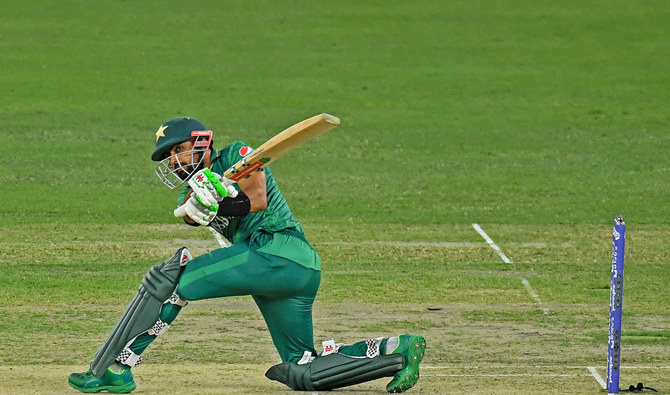
Pakistan's captain Babar Azam plays a shot during the ICC men’s Twenty20 World Cup semi-final match against Australia at the Dubai International Cricket Stadium, UAE, on November 11, 2021. (AFP)
Short Url
Updated 15 November 2021
Follow

ICC names Babar Azam captain of 'Most Valuable Team' of T20 World Cup 2021

  • The line-up includes players from Pakistan, Australia, New Zealand, England, Sri Lanka, South Africa
  • Left-arm destructive Pakistani pacer Shaheen Shah Afridi takes place as the 12th man of the squad

ISLAMABAD: The International Cricket Council (ICC) on Monday released the "Official ICC Men’s T20 World Cup Upstox Most Valuable Team of the Tournament," selecting Babar Azam as its captain. 

The team of the tournament included players from World Cup-winning Australia, runners-up New Zealand, semi-finalists England and Pakistan as well as Sri Lanka and South Africa. 

Opening batter David Warner, leg-spinner Adam Zampa and seamer Josh Hazlewood all made the cut for Australia after helping steer their side to first ever ICC Men’s T20 World Cup title. 

Pakistan’s Babar Azam secured the most coveted spot of captain, while left-handed destructive pacer Shaheen Shah Afridi was selected as the 12th man of the squad. 

England ace Jos Buttler, New Zealand left-armer Trent Boult and Sri Lanka star Wanindu Hasaranga – the tournament’s leading wicket-taker – were also part of the line-up.  

No Indian cricketer could make it to the ICC's team of the tournament. 

The side was pulled together by a selection panel comprising commentators, former international players and journalists, including Ian Bishop (convenor), Natalie Germanos, Shane Watson, Lawrence Booth and Shahid Hashmi. 

The team of the ICC Men’s T20 World Cup 2021 (in batting order)


  • David Warner (Australia) – 289 runs at 48.16 
  • Jos Buttler (wk) (England) – 269 runs at 89.66, five dismissals 
  • Babar Azam (Captain, Pakistan) – 303 runs at 60.60 
  • Charith Asalanka (Sri Lanka) – 231 runs at 46.20 
  • Aiden Markram (South Africa) – 162 runs at 54.00 
  • Moeen Ali (England) – 92 runs at strike rate of 131.42, seven wickets at 11 
  • Wanindu Hasaranga (Sri Lanka) – 16 wickets at 9.75 
  • Adam Zampa (Australia) – 13 wickets at 12.07 
  • Josh Hazlewood (Australia) – 11 wickets at 15.90 
  • Trent Boult (New Zealand) – 13 wickets at 13.30 
  • Anrich Nortje (South Africa) – nine wickets at 11.55 
  • Shaheen Afridi – seven wickets at 24.14 

"Captaining the side at No.3 is Pakistan skipper Babar, who was the only batter to break the 300-run barrier throughout the duration of the competition," the ICC said of the Pakistan skipper. 

"His 68 not out against old rivals India powered Pakistan to a memorable 10-wicket victory, while three further half-centuries in the Super 12 stages helped book his team’s slot in the semi-final against Australia. And while they were unable to battle past Aaron Finch’s outfit, Babar helped himself to 39 in the first innings to finish his campaign in typically consistent fashion." 

Taking his place as 12th man was Pakistan prodigy Shaheen Afridi, who started his tournament in style with a blistering new-ball spell against old foes India, the ICC said. 

"Afridi, 21, removed the talismanic top three trio of Rohit Sharma, KL Rahul and captain Virat Kohli to end with figures of three for 31 and lay the foundations for a memorable victory," it said. 

"The left-arm pacer finished the tournament with seven wickets at 24.14 and will no doubt continue to star at multiple more ICC World Cup events throughout an exciting future career."


Pakistan president calls for facilitating trade, business interactions with Iraq

Updated 6 sec ago
Follow

Pakistan president calls for facilitating trade, business interactions with Iraq

  • President Asif Ali Zardari meets Caretaker Iraqi PM Mohammed Shia Al-Sudani in Baghdad
  • Zardari calls for closer cooperation between chambers of commerce of both nations, private sector

ISLAMABAD: President Asif Ali Zardari recently called for facilitating trade and business interactions between Pakistan and Iraq to facilitate cooperation in key sectors of the economy between the two countries, Pakistani state media reported. 

Zardari arrived in Iraq on Saturday for a four-day visit to the country aimed to deepen Pakistan’s bilateral ties with Baghdad. The Pakistani president met Iraqi Caretaker Prime Minister Mohammed Shia Al-Sudani to discuss practical measures to enhance bilateral cooperation, state broadcaster Radio Pakistan reported on Sunday. 

According to the Press Information Department, Pakistan’s exports to Iraq totaled $54.29 million in 2024 while imports from Iraq, primarily petroleum products, amounted to $145.46 million the same year. Analysts have noted that these figures are modest, considering the market sizes and mutual interests of both nations.

“He [Zardari] highlighted priority sectors including information technology, agriculture and food security, construction, pharmaceuticals and medicines,” Radio Pakistan said. 

“The president also stressed the importance of direct banking channels to facilitate trade, business interaction and the movement of pilgrims.”

Every year, thousands of Pakistani pilgrims travel to Iraq to visit some of the most revered shrines in Shia Islam, including the mausoleums of Ali in Najaf and Hussain in Karbala. 

The scale of travel, often involving long stays and cross-border movements, has long posed logistical, security and migration-management challenges for Pakistani authorities and host governments alike.

The president called for improved facilitation for Pakistani pilgrims at immigration points, greater flexibility in emergency travel cases and measures to ease difficulties faced by pilgrims. 

Zardari and Al-Sudani agreed on the importance of maintaining regular high-level exchanges to carry forward bilateral engagement. The Pakistani president spoke of Islamabad’s participation in major trade and health exhibitions in Baghdad, noting these engagements as a step toward sustained business-to-business connectivity.

“He encouraged closer coordination between chambers of commerce and the private sector of both countries through regular exchanges and virtual engagement,” Radio Pakistan said. 

Zardari expressed satisfaction over the steady progress in bilateral defense ties with Iraq, including ongoing training programs and completed defense deliveries.

“He reaffirmed Pakistan’s willingness to further strengthen defense collaboration in line with Iraq’s requirements and evolving security needs,” the state media outlet reported.