

Redeployment of forces to Yemen’s west coast part of strategy to support govt: Coalition

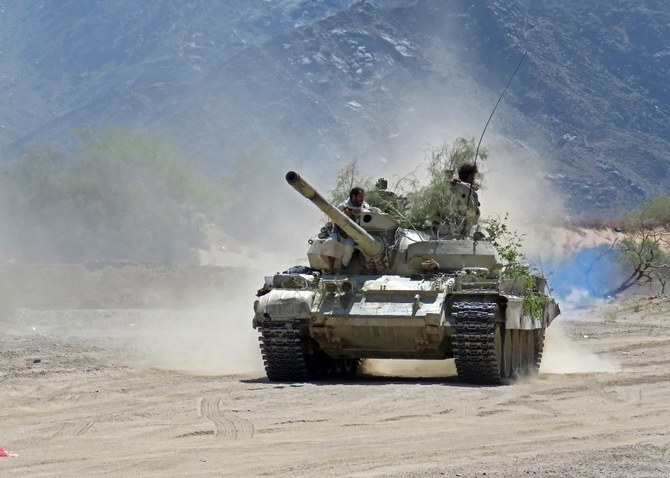
The coalition has reported near-daily strikes over the past month against the Iran-backed Houthis. (SPA/File Photo)
Short Url
Updated 15 November 2021
Follow

Redeployment of forces to Yemen’s west coast part of strategy to support govt: Coalition

  • Brigadier General Turki Al-Maliki urged UN to play its role in implementing Stockholm agreement
  • Said Houthis were not enabling UN to supervise implementation of the agreement

DUBAI: The Arab coalition forces said more than 140 members of the Houthi militia were killed and 18 military vehicles were destroyed in Al-Bayda and Marib in Yemen, TV news channel Al-Arabiya reported Monday.  

The strikes came in support of Yemeni forces on the west coast, the coalition said, adding that the coalition air forces have carried 26 operations in both governorates during the past 24 hours. 

The coalition said it is supporting Yemeni forces on the west coast outside the framework of the Stockholm Agreement.

The official spokesman for the coalition, Brigadier General Turki Al-Maliki, said on Monday that the redeployment of coalition and Yemeni forces to the western coast came within its military strategy of supporting the Yemeni government on all fronts, Saudi Press Agency (SPA) reported.

“The joint forces in the western coast carried out last Thursday the redeployment and repositioning of their military forces under the directives of the Joint Forces Command of the coalition, and the repositioning process was characterized by discipline and flexibility as planned and in line with the future plans of the coalition,” he said.

Al-Maliki also said the Houthis still controlled three ports in the area (Hodeidah, Salif and Ras Issa), and were not enabling the UN to supervise the implementation of the Stockholm Agreement. He added that Houthi violations of the agreement numbered more than 30,000, according to SPA.

He urged the UN and its mission in Hodeidah to play its role in implementing the agreement, as well as calling on the international community to pressure the Houthi militia to fully comply and implement its provisions.

Also on Monday, Saudi Arabian defenses said they intercepted a Houthi drone which had been launched toward Khamis Mushait.


Village in southern Lebanon buries a child and father killed in Israeli drone strike

Updated 7 sec ago
Follow

Village in southern Lebanon buries a child and father killed in Israeli drone strike

  • Hassan Jaber, a police officer, and his 3-year-old son, Ali, were on foot when the strike hit a passing car in Yanouh on Monday
  • The car’s driver, Ahmad Salami, was also killed. The Israeli military said Salami was an artillery official with Hezbollah
YANOUH: Mourners in southern Lebanon on Tuesday buried a father and his young son killed in an Israeli drone strike that targeted a Hezbollah member.
Hassan Jaber, a police officer, and his child, Ali, were on foot when the strike on Monday hit a passing car in the center of their town, Yanouh, relatives said. Lebanon’s health ministry said the boy was 3 years old. Both were killed at the scene along with the car driver, Ahmad Salami, who the Israeli military said in a statement was an artillery official with the Lebanese militant group.
It said it was aware of a “claim that uninvolved civilians were killed” and that the case is under review, adding it “makes every effort to reduce the likelihood of harm” to civilians.
Salami, also from Yanouh, was buried in the village Tuesday along with the father and son.
“There are always people here, it’s a crowded area,” with coffee shops and corner stores, a Shiite religious gathering hall, the municipality building and a civil defense center, a cousin of the boy’s father, also named Hassan Jaber, told The Associated Press.
When the boy and his father were struck, he said, they were going to a bakery making Lebanese breakfast flatbread known as manakish to see how it was made. They were standing only about 5 meters (5.5 yards) from the car when it was struck, the cousin said.
“It is not new for the Israeli enemy to carry out such actions,” he said. “There was a car they wanted to hit and they struck it in the middle of this crowded place.”
Jaber said the little boy, Ali, had not yet entered school but “showed signs of unusual intelligence.”
“What did this innocent child do wrong, this angel?” asked Ghazaleh Haider, the wife of the boy’s uncle. “Was he a fighter or a jihadi?”
Attendees at the funeral carried photos of Ali, a striking child with large green eyes and blond hair. Some also carried flags of Hezbollah or Amal, a Shiite party that is allied with but also sometimes a rival of Hezbollah.
Lebanon’s Internal Security Forces, of which the child’s father was a member, said in a statement that the 37-year-old father of three had joined in 2013 and reached the rank of first sergeant.
The strike came as Israel has stepped up its campaign against Hezbollah and its allies in Lebanon.
The night before the strike in Yanouh, Israeli forces launched a rare ground raid in the Lebanese village of Hebbarieh, several kilometers (miles) from the border, in which they seized a local official with the Sunni Islamist group Al-Jamaa Al-Islamiya, or the Islamic Group in English. The group is allied with Hezbollah and the Palestinian militant group Hamas.
The low-level conflict between Lebanon and Israel escalated into full-scale war in September 2024, later reined in but not fully stopped by a US-brokered ceasefire two months later.
Since then, Israel has accused Hezbollah of trying to rebuild and has carried out near-daily strikes in Lebanon that it says target Hezbollah militants and facilities.
Israeli forces also continue to occupy five hilltop points on the Lebanese side of the border. Hezbollah has claimed one strike against Israel since the ceasefire.