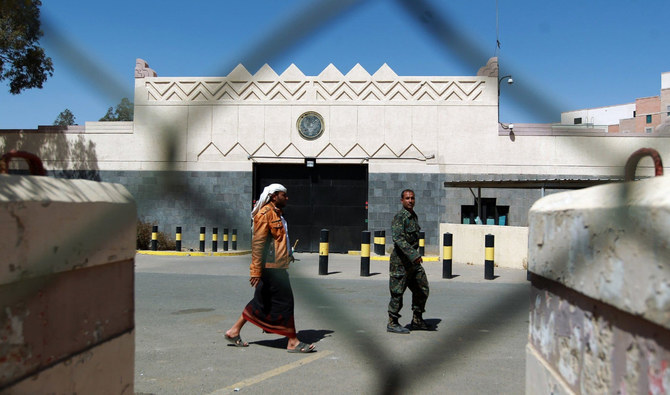
CHICAGO: Leaders of both the US Senate and House Foreign Relations committees on Friday condemned the Iranian-backed Houthis who recently breached the US Embassy in Sana’a, Yemen, and are holding staff hostage.
Washington closed the embassy in 2015 amid escalating violence in the country and American diplomats left the country. However some local staff continue to work there, and these are the employees reportedly held by the Houthis. Some but not all of those detained have been released, according to reports this week.
New Jersey Senator Bob Menendez and Senator Jim Risch from Idaho, respectively the chair and ranking member of the Senate Foreign Relations Committee, and Representatives Gregory Meeks from New York and Michael McCaul from Texas, respectively the chair and ranking member of the House Foreign Affairs Committee, on Friday issued a joint statement about the situation.
They said: “We are deeply concerned by reports that the Houthis have breached our embassy compound in Sana’a and detained and harassed a number of US locally employed staff, and former staff employed by the United Nations.
“Such acts violate international law and basic principles of human rights, and must not be tolerated.
“This is just the latest in a series of violent acts by the Houthis. Over the past year, the Houthis have carried out hundreds of cross-border attacks against Saudi Arabia, threatening civilians, including American citizens, and deployed numerous ballistic missiles inside Yemen.”
They added that the ongoing Houthi offensive against the “strategically important governorate of Marib” has “upended countless Yemeni lives, triggered fresh waves of displacement, and exacerbated the world’s worst humanitarian crisis.”
The politicians continued: “The Houthis have long expressed a desire to assume a greater role in the governance of Yemen, but with governance comes responsibility and a need to uphold the basic principles of human rights and international law. Breaching the sovereign territory of a foreign embassy and threatening and detaining its staff clearly demonstrate the Houthis have no interest in peace, nor in making the changes necessary to become legitimate members of the international community.”
They said the actions of the Houthis will “have consequences” if the detainees are not immediately released.
The latest developments come days after Tim Lenderking, the US special envoy for Yemen, and Cathy Westley, the charge d’affaires for the US embassy to Yemen, currently based in Riyadh, visited the Yemeni city of Aden.
During their trip on Nov. 8 they met Prime Minister Maeen Abdulmalek Saeed, Foreign Minister Ahmed Awad bin Mubarak and Aden Governor Ahmed Lamlas, along with other senior government officials and representatives of Yemeni civil society.


![]()

US politicians condemn Houthi breach of US Embassy in Yemen
Short Url
https://arab.news/me7cb
US politicians condemn Houthi breach of US Embassy in Yemen
- Top-ranking members of the Foreign Relations Committees in the Senate and House of Representatives demanded the immediate release of detained staff
- ‘Breaching the sovereign territory of a foreign embassy and threatening and detaining its staff clearly demonstrate the Houthis have no interest in peace,’ they said


Latest updates


© 2026 SAUDI RESEARCH & PUBLISHING COMPANY, All Rights Reserved And subject to Terms of Use Agreement.