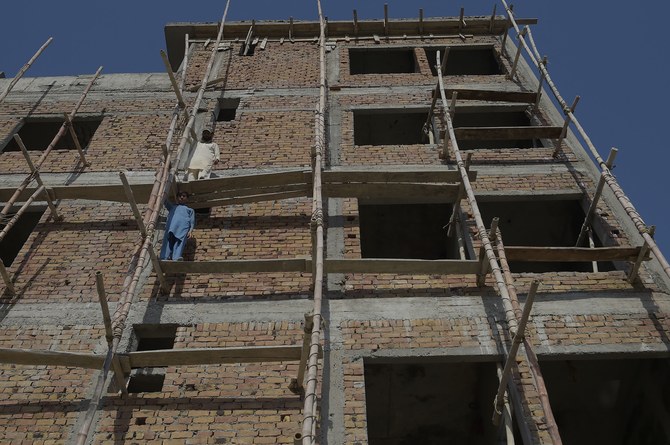
KARACHI: Over 60 percent of Pakistan’s construction activities have come to a standstill following an unprecedented increase in the rates of basic building material amid rising global commodity prices, industrial stakeholders said on Thursday.
According to an estimate by Pakistani builders, the prices of steel, cement and other construction material increased by more than 70 percent due to the rising freight costs, weaker rupee and surge in local demand.
“The prices of all raw materials have increased by more than 70 percent during the last one year,” Mohsin Shaikhani, chairman of the Association of Builders and Developers of Pakistan, told Arab News. “About 50 to 60 percent of construction activities in the country have come to a standstill.”
Shaikhani added the overall construction cost had gone up from about Rs2,500 to Rs4,000 square feet across the country.
Pakistan’s construction sector contributed about Rs794 billion to the gross domestic product in FY20.
The building activities during the same period increased by 8.1 percent due to the government support and uptick in investment by the private sector, according to a report by the Pakistan Credit Rating Agency.
The construction sector absorbs about 7.6 percent of the country’s total labor force and provides stimulus to over 40 allied industries.
The country’s public sector development program primarily drives the construction demand since it allows the government to spend on mega projects like highways, bridges and other infrastructure development programs.
The companies working on the public sector projects said they were the main victims of price escalation since they had to stop construction work on multiple schemes.
“About 90 percent work on the projects across Pakistan has come to a standstill due to frequent price escalation of building material,” Saeed Ahmed Mughal, secretary information of Karachi Contractors Association, a representative body of companies mainly working on government projects, said. “Only those who have material in their stock are currently active.”
“It is very difficult for constructors to match the current expenses with what they had quoted during the bidding process,” he continued. “We want the federal and provincial authorities to factor in price escalations before we resume our work.”
The price escalation has also impacted the estimates of Prime Minister Imran Khan’s flagship Naya Pakistan Housing Scheme which aims to build five million units for low- and middle-income segments.
Pakistan is currently facing a housing backlog of 11 to 12 million units.
“The low-cost housing projects are in a difficult situation,” said Shaikhani. “The valuation of a house which was worked out at Rs3 million initially has increased to Rs4.5 million.”
Chairman of Naya Pakistan Housing Task Force Zaigham Mahmood Rizvi agreed the construction sector was facing challenges due to the rising rates of building material.
“The developers and builders have been telling us it is difficult to construct a house according to their earlier estimates,” Rizvi said.
He added, however, the Naya Pakistan Housing and Development Authority was trying to come up with a solution.
“The negotiations for the revaluation [of projects] are going on,” he informed.
The price of steel, a key building material used for construction, has increased by 85 percent since March 2020, and it is currently trading around Rs192,000 per ton due to the short supply.
Rizvi maintained the operationalization of the country’s two steel mills – the Pakistan Steel and Tuwairqi Steel Mills that was set up by a Saudi group – was likely to provide some relief to the construction sector.
Some Pakistani traders expect reduction in steel price in the coming months, hoping it would also spur construction activities.
“The international market is showing some corrections and if the impact is passed on to consumers in Pakistan it will reduce the price to about Rs30,000 per ton within the next three months,” Shammon Baqir Ali, chairman of Karachi Iron and Steel Merchants Association, said while talking to Arab News.
The Naya Pakistan Housing and Development Authority did not respond to queries regarding the progress on low-cost housing units and possible policy measures to rescue the troubled construction sector.


![]()

Pakistani builders say 60 percent construction projects on standstill amid rising material costs
Short Url
https://arab.news/2nkvb
Pakistani builders say 60 percent construction projects on standstill amid rising material costs
- Industrial stakeholders blame an overall surge in global commodity prices, higher freight charges and weaker rupee for escalating building material rates
- The increase in prices has also impacted Prime Minister Imran Khan’s low-cost housing projects under the Naya Pakistan scheme
Latest updates




© 2026 SAUDI RESEARCH & PUBLISHING COMPANY, All Rights Reserved And subject to Terms of Use Agreement.