



International Space Station astronauts return to earth in SpaceX craft

1 / 4
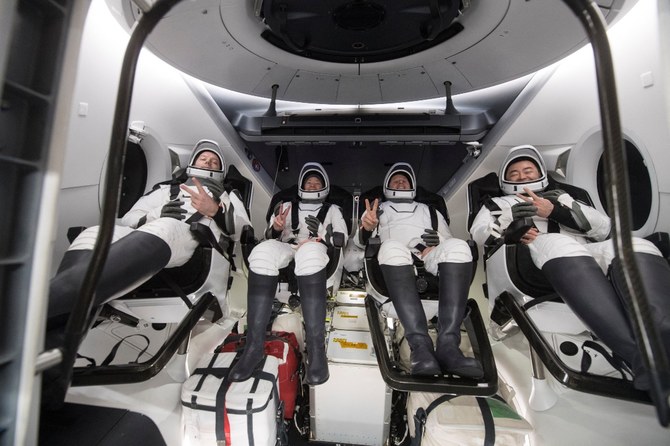
The SpaceX capsule carrying four astronauts left the International Space Station bound for Earth on Monday after spending six busy months aboard the orbital outpost. (AFP/SpaceX)
2 / 4
(L-R) ESA astronaut Thomas Pesquet, NASA astronauts Megan McArthur and Shane Kimbrough, and Japan Aerospace Exploration Agency (JAXA) astronaut Aki Hoshide. (NASA/AFP)
3 / 4
Since arriving on April 24, the crew conducted hundreds of experiments and helped upgrade the station's solar panels. (AFP/SpaceX)
4 / 4
The SpaceX Dragon capsule dubbed “Endeavour” splashed down off the coast of Pensacola, Florida, on Nov. 8, 2021. (SpaceX/AFP)
Short Url
Updated 09 November 2021
Follow

International Space Station astronauts return to earth in SpaceX craft

  • It landed in the Gulf of Mexico at 10:33 p.m. US Eastern Time
  • SpaceX began providing astronauts a taxi service to the ISS in 2020

WASHINGTON: A SpaceX capsule carrying four astronauts back to Earth after a busy six months on the International Space Station landed Monday off the coast of Florida, a NASA live broadcast showed.
Slowed by the Earth’s atmosphere, as well as four huge parachutes, the Dragon capsule was able to withstand the dizzying descent thanks to its heat shield.
It landed in the Gulf of Mexico at 10:33 p.m. US Eastern Time (0333 GMT Tuesday), marking the end of the “Crew-2” mission.
A boat will retrieve the capsule, and the astronauts on board will be brought back to land via helicopter.
Since arriving on April 24, the crew of two Americans, a Frenchman and one Japanese astronaut conducted hundreds of experiments and helped upgrade the station’s solar panels.
They boarded their Dragon, dubbed “Endeavour,” and undocked from the ISS at 2:05 p.m. (1905 GMT), NASA announced.
Endeavour then looped around the ISS for around an hour-and-a-half to take photographs, the first such mission since a Russian Soyuz spaceship performed a similar maneuver in 2018.
The Dragon, which flew mostly autonomously, has a small circular window at the top of its forward hatch through which the astronauts can point their cameras.
“Proud to have represented France once again in space! Next stop, the Moon?” tweeted Thomas Pesquet from the European Space Agency (ESA).

This NASA handout photo shows the SpaceX Crew Dragon Endeavour spacecraft as it lands. (NASA/AFP)

Their activities have included documenting the planet’s surface to record human-caused changes and natural events, growing Hatch chile peppers and studying worms to better understand human health changes in space.
Crew-2’s departure was delayed a day by high winds.
Bad weather and what NASA called a “minor medical issue” have also pushed back the launch of the next set of astronauts, on the Crew-3 mission, which is now set to launch Wednesday.
Until then, the ISS will be inhabited by only three astronauts — two Russians and one American.
SpaceX began providing astronauts a taxi service to the ISS in 2020, ending nine years of US reliance on Russian rockets for the journey following the end of the Space Shuttle program.
The crew also faced a final challenge on their journey home — they had to wear diapers after a problem was detected with the capsule’s waste management system, forcing it to remain offline.
They had no access to a toilet from the time the hatch closed at 12:40 p.m. (1740 GMT) until after splashdown — around 10 hours.
“Of course that’s sub-optimal, but we’re prepared to manage,” NASA astronaut Megan McArthur said at a press conference ahead of the departure.
“Space flight is full of lots of little challenges, this is just one more that we’ll encounter and take care of in our mission.”
A SpaceX all-tourist crew encountered a similar waste-related problem during a September flight, which triggered an alarm system.
NASA later said a tube had come unglued, sending urine to the capsule’s fan system instead of a storage tank.


Zuckerberg says Meta no longer designs apps to maximize screentime

Updated 3 sec ago
Follow

Zuckerberg says Meta no longer designs apps to maximize screentime

  • Meta Platforms CEO faces questioned at a landmark trial over youth social media addiction
  • It was the billionaire Facebook founder’s first time testifying in court on Instagram’s effect on the mental health of young users
LOS ANGELES: Meta Platforms CEO Mark Zuckerberg pushed back in court on Wednesday against a lawyer’s suggestion that ​he had misled Congress about the design of its social media platforms, as a landmark trial over youth social media addiction continues.
Zuckerberg was questioned on his statements to Congress in 2024, at a hearing where he said the company did not give its teams the goal of maximizing time spent on its apps.
Mark Lanier, a lawyer for a woman who accuses Meta of harming her mental health when she was a child, showed jurors emails from 2014 and 2015 in which Zuckerberg laid out aims to increase
time spent on the app by double-digit percentage points. Zuckerberg said that while Meta previously had goals related to ‌the amount of ‌time users spent on the app, it has since changed its ​approach.
“If ‌you ⁠are trying ​to ⁠say my testimony was not accurate, I strongly disagree with that,” Zuckerberg said.
The appearance was the billionaire Facebook founder’s first time testifying in court on Instagram’s effect on the mental health of young users.
While Zuckerberg has previously testified on the subject before Congress, the stakes are higher at the jury trial in Los Angeles, California. Meta may have to pay damages if it loses the case, and the verdict could erode Big Tech’s longstanding legal defense against claims of user harm.
The lawsuit and others like it are part of a ⁠global backlash against social media platforms over children’s mental health.
Australia has prohibited access ‌to social media platforms for users under age 16, and ‌other countries including Spain are considering similar curbs. In the US, ​Florida has prohibited companies from allowing users under age ‌14. Tech industry trade groups are challenging the law in court.
The case involves a California woman ‌who started using Meta’s Instagram and Google’s YouTube as a child. She alleges the companies sought to profit by hooking kids on their services despite knowing social media could harm their mental health. She alleges the apps fueled her depression and suicidal thoughts and is seeking to hold the companies liable.
Meta and Google have denied the allegations, and ‌pointed to their work to add features that keep users safe. Meta has often pointed to a National Academies of Sciences finding that research does not ⁠show social media changes ⁠kids’ mental health.
The lawsuit serves as a test case for similar claims in a larger group of cases against Meta, Alphabet’s Google, Snap and TikTok. Families, school districts and states have filed thousands of lawsuits in the US accusing the companies of fueling a youth mental health crisis. Over the years, investigative reporting has unearthed internal Meta documents showing the company was aware of potential harm.
Meta researchers found that teens who report that Instagram regularly made them feel bad about their bodies saw significantly more “eating disorder adjacent content” than those who did not, Reuters reported in October.
Adam Mosseri, head of Instagram, testified last week that he was unaware of a recent Meta study showing no link between parental supervision and teens’ attentiveness to their own social media use. Teens with difficult life circumstances more often said they used Instagram habitually ​or unintentionally, according to the document shown at ​trial.
Meta’s lawyer told jurors at the trial that the woman’s health records show her issues stem from a troubled childhood, and that social media was a creative outlet for her.
