

Potential relocation of Karachi seaport to cost Pakistan $9.6 billion – World Bank

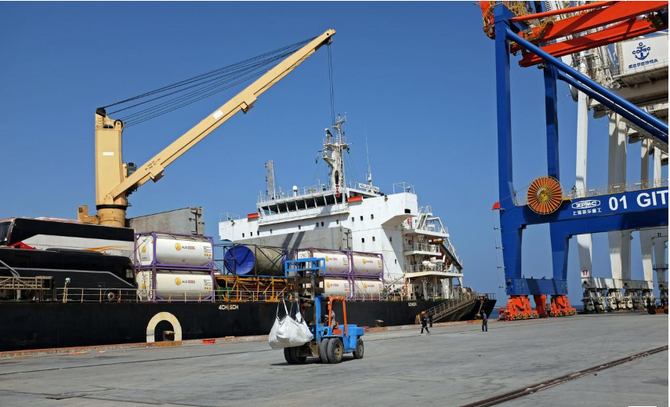
A general view of Gwadar port in Gwadar, Pakistan, on October 4, 2017. (REUTERS)
Short Url
Updated 06 November 2021
Follow

Potential relocation of Karachi seaport to cost Pakistan $9.6 billion – World Bank

  • As one of the oldest ports in the region anticipates growing demand amid exhausting infrastructure resources, an international study identifies alternative solutions
  • The World Bank says relocation process may face resistance from Karachi Port Trust staff union, dockyard workers union and the country’s armed forces

KARACHI: A potential relocation of Pakistan’s Karachi Port is estimated to cost $9.6 billion as it faces increasing demand for services amid exhausting infrastructure resources, said a recent World Bank report.

Karachi Port has a history of 135 years. It handles a chunk of national traffic and is usually called “Gateway to Pakistan.”

Over the next twenty years, the port demand is expected to increase by 129 percent at 4.2 percent per year, according to the World Bank study released on Tuesday.

The report accessed four alternatives for a national port strategy: to develop both Karachi and Qasim Ports simultaneously; focus on one at a time; or develop a third new port sometime in the mid-2030s when Port Qasim would reach its maximum capacity.

“A potential relocation [cost] of Karachi Port [to Somiani Bay 85 Kilometers to the north of Karachi] is about $9.6 billion,” the WB report said. “The major costs are the construction of 6,629-meter length of new quay walls ($4.0 billion), three new port terminals ($1.4 billion) and the TPX [Thule Produce Yard] area ($1.6 billion).”

Historically, Karachi handled a large trade volume but in the last five years its share has fallen from 60 percent to 45 percent since Port Qasim managed to capture a large percentage of its share. The main reason behind the shift was concern for environment since coal traffic was moved to new specialized terminals at Port Qasim under the orders of the apex court.

The report also explored the option of only developing Port Qasim, with an improved maritime access involving a cost of $550 million, but this action alone would not be able to address Karachi’s traffic snarls.

Approximately, 95 percent of Karachi Port’s cargo is transported by road, causing severe traffic congestion in the city.

The report said an immediate high-level commitment was required to start building an elevated expressway linking northern highways to Karachi Port.

“This would be a major contribution to increase capacity efficiency of Karachi Port,” it added. “The cost is estimated at $300 million, which is far less than investing in a new port.”

With staff of 5,343 and 394 officers, Karachi Port handles about 50 million tons of cargo per year, including over two million TEU [twenty-foot equivalent unit] containers. The port has 11.5-kilometer-long channel with 30 berths and three oil piers.

“By 2030, access to land would have been exhausted for new berths and existing berths will not be able to cater to the projected cargo volumes,” the report maintained.

It also discussed the possible resistance to any potential relocation of the port, saying there were areas under the control of the armed forces, including the naval dockyard and stores and similar strategic installations.

“These organizations will refuse to agree to shift,” the report said.

Karachi Port Trust Staff Union and Dockyard Workers Union are both very strong and politically well connected.

Despite giving them golden handshakes, the report maintained, members of these unions were likely to give maximum resistance. They can stop the shipping, berthing and operation, and go on an indefinite or long strike.

"They are also capable of bringing the whole of Pakistan to a grinding halt," said the report.


Pakistan, Bangladesh explore avenues for cooperation in railways sector

Updated 11 sec ago
Follow

Pakistan, Bangladesh explore avenues for cooperation in railways sector

  • Islamabad, Dhaka have lately been looking to strengthen institutional linkages to broaden cooperation amid thaw in ties
  • Pakistan offers expertise in railway development, rolling stock and manufacturing to visiting Bangladeshi officials

KARACHI: Pakistani and Bangladeshi officials have discussed ways to strengthen cooperation in the railways sector, including technical collaboration and capacity-building, the Pakistani railways ministry said on Saturday, as the two sides explore avenues to expand bilateral ties.

The statement came after a visit of Bangladesh’s Secretary for International Organizations Farhad Islam and High Commissioner to Pakistan Mohammad Iqbal Hussain Khan to the Pakistan Railways Workshop Division in Lahore.

It comes amid Islamabad’s efforts to rebuild relations with Bangladesh since the ouster of former prime minister Sheikh Hasina, with both countries looking to strengthen institutional linkages to broaden their cooperation.

The visiting Bangladeshi officials were welcomed at the Pakistan Railways headquarters and briefed on the overall functioning, technical capabilities and projects, according to the Pakistani railways ministry.

“The delegation was subsequently given a detailed tour of the Mughalpura Locomotive Workshop, where they were briefed on various stages of locomotive maintenance, rehabilitation, and manufacturing processes,” the ministry said.

“The distinguished guests termed their visit as highly informative, productive, and encouraging, and appreciated the technical expertise and professional competence of Pakistan Railways.”

Pakistan and Bangladesh were part of the same country until Bangladesh’s secession following a bloody civil war in 1971, an event that long cast a shadow over bilateral ties.

Both countries have moved closer since August 2024, following the ouster of Hasina who was considered an India ally. While Pakistan-Bangladesh ties warm up, relations between Dhaka and New Delhi remain strained over India’s decision to grant asylum to Hasina.

A short documentary highlighting the working and operational strength of Pakistan Railways workshops was also presented to the Bangladeshi officials during their visit.

“Federal Minister for Railways, Mr. Muhammad Hanif Abbasi, remains fully committed to further strengthening bilateral relations with brotherly country Bangladesh, particularly in the areas of railway development, exchange of expertise, rolling stock, and cooperation in manufacturing sectors,” the railways ministry said.

“Minister has expressed his resolve to take forward railway-to-railway cooperation between the two countries, emphasizing that mutual collaboration in the railway sector can yield substantial benefits for both nations.”