

‘Golden Man of Islamabad’ brings peculiar street art of living statues to Pakistani capital

Muhammad Ahsan, the Golden Man of Islamabad, poses for a picture in Islamabad, Pakistan, on November 5, 2021. (AN Photo)
Short Url
Updated 07 November 2021
Follow

‘Golden Man of Islamabad’ brings peculiar street art of living statues to Pakistani capital

  • Painted from head to toe in gold, Muhammad Ahsan stands on street corners and entertains people
  • He was inspired by TikTok videos to try his hand at the street art after failing to find a job

ISLAMABAD: When 18-year-old Muhammad Ahsan arrived in the Pakistani capital to find a job, little did he know that a series of coincidences would soon turn him into the city’s new and unique performance artist, the “Golden Man of Islamabad.”
Painted from head to toe in gold, Ahsan stands on street corners attracting considerable and positive attention, not just from passersby, but also authorities. While his sort of performance is not a new thing— “living statues,” as they are known, are common in Europe and many other countries, also in Asia — Ahsan is the first one to be spotted in Islamabad.
He has been gaining popularity ever since Islamabad’s deputy commissioner, Hamza Shafqat, posted his photo on social media last week and gave him special permission to perform around the city.
Originally from Karachi, Ahsan traveled to Islamabad several months ago. Despite countless efforts he could not find employment and on a day when he was about to give up, he started to browse videos on TikTok to cheer himself up. It was there that he saw clips of Girjesh Gaud who performs as a living statue in Mumbai, India.
“He spray-paints his clothes and puts gold power on his face and I thought to do the same,” Ahsan told Arab News on a busy intersection of Islamabad’s Jinnah Market. “Soon after I started performing as a living statue and the public’s response was very positive.”
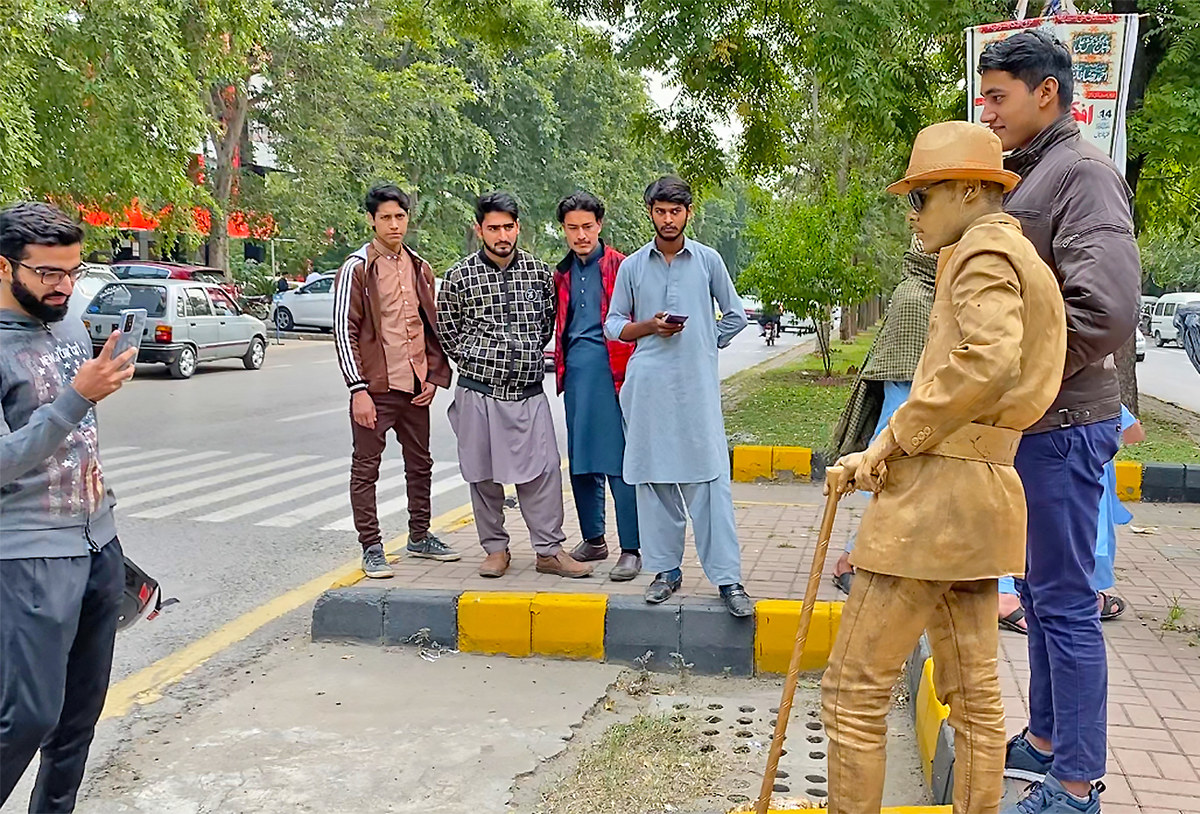


Muhammad Ahsan takes photos with pedestrians who recognized him from social media in Islamabad, Pakistan, on November 5, 2021. (AN Photo)

His golden statue outfit is complete with gold smartphone and earbuds. He also carries a golden backpack.
School children are his biggest fans and like to take photos with him, though he also attracts fruit vendors, pedestrians and car drivers who often pull over to shake his hands.
“I cannot tell how many people stop and take photos with me,” he laughed. “Many of them make videos and some even ask me to visit their residence since they want me to be in pictures with their family. Overall, it has been a positive experience for me.”
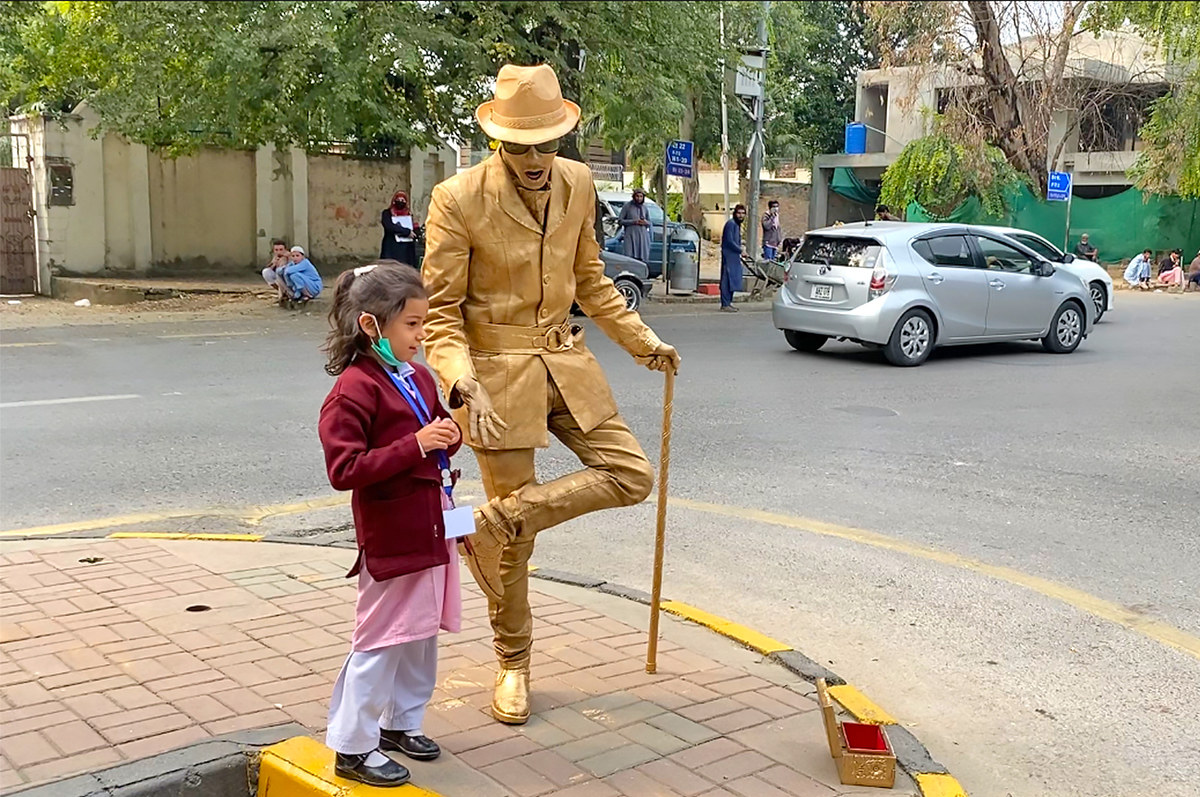


A young child takes a photo with Muhammad Ahsan in Islamabad, Pakistan, on November 5, 2021. (AN Photo)

The youngest of seven siblings, Ahsan says he wants to grow his popularity through social media to be able to support his family.
“This is what I do now and I hope to continue with this,” he said. “I like to make people smile.”
As people pose with Ahsan, they drop money into a box that he keeps by his feet.
Sheikh Mohammad Zahid, one of the several people who pulled over to meet the golden man, told Arab News he had seen Islamabad’s first living statue on social media.
“I have never seen something like this before,” he said. “I stopped just to watch him more closely.”
Ikram Yunis, a delivery driver, said Ahsan was bringing happiness to the city.
“It is very nice to see him,” he said. “We love our home Islamabad and he is adding to its beauty.”

Pakistan offers seaport for global cargo transshipment amid Gulf conflict escalation

Updated 12 sec ago
Follow

Pakistan offers seaport for global cargo transshipment amid Gulf conflict escalation

  • Karachi Port Trust says its services can ensure ‘continuity and stability’ of maritime trade
  • The region is currently witnessing significant disruptions to global trade and oil shipments

KARACHI: Pakistan has offered its Karachi seaport for uninterrupted global cargo transshipments as escalating Middle East tensions threaten maritime trade, the country’s largest port operator said on Friday.

Iran has been rocked by joint US and Israeli strikes since Feb. 28 that killed Supreme Leader Ayatollah Ali Khamenei. Tehran retaliated with missile and drone attacks on US, Israeli and allied targets across the Gulf, plunging the region into conflict and uncertainty.

The escalation disrupted air travel, heightened military activity, and disrupted shipping through the Strait of Hormuz, a key route carrying roughly 20 percent of global oil shipments.

The Karachi Port Trust (KPT) said in a statement it was ready to support international shipping lines by offering transshipment services to regional ports, helping ensure the “continuity and stability” of global maritime trade.

“Karachi Port Trust remains fully prepared to support the international maritime community and to provide reliable, efficient, and secure port services in the interest of sustaining regional trade connectivity,” KPT Chairman Shahid Ahmed said, according to a statement circulated by the port authority.

It added the facility could help stabilize maritime trade by offering transshipment services for cargo destined for ports across the region.

The statement said as a demonstration of its capability, international vessels MV TS TACOMA and MV TS SYDNEY arrived in Karachi and discharged large number of containers as transshipment cargo.

“The containers will subsequently be transshipped from Karachi to Jebel Ali in the Middle East,” it continued.

Pakistan Maritime Affairs Minister Junaid Anwar Chaudhry on Thursday highlighted the importance of the Gwadar port city’s transshipment role as major shipping routes face disruption from the ongoing conflict.

The developments come as the Strait of Hormuz, a strategic waterway between Iran and Oman and one of the world’s most critical oil transit routes, has been blocked by Iran which has threatened to attack ships that attempt to transit through it.

US President Donald Trump has assured shipping companies of naval escorts and insurance support to protect vessels.

The escalating tensions have contributed to a sharp rise in energy prices and significant disruptions to tanker traffic through the strategic waterway.

Pakistan has long viewed its seaports as strategic assets that could boost trade with Central Asia and the Gulf region, while helping the country earn valuable foreign exchange.