

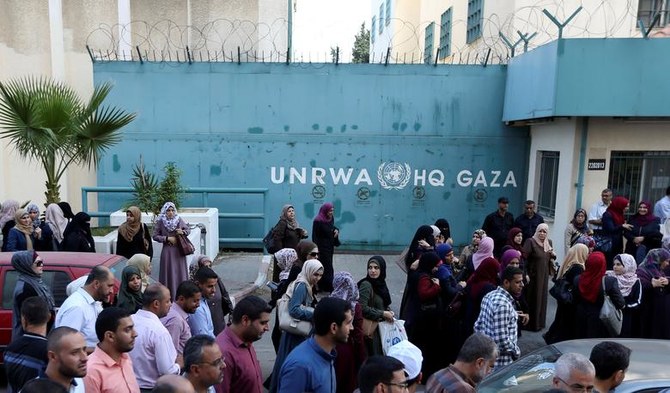

LONDON: Cuts to the UN’s Palestine relief agency, which includes a British government grant, mean the agency is now close to collapse, the agency’s head has told The Guardian.
The UK has cut more than half of its funding provided to the agency — down from £42.5 million ($57 million) in 2020 to £20.8 million ($28 million) in 2021.
Philippe Lazzarini, commissioner-general of UN Relief and Works Agency for Palestine Refugees, explained that Palestinians in the West Bank and Gaza — as well as Jordan, Syria, and Lebanon — face distress as cuts bite the agency’s budget.
UNRWA faces an existential crisis due to the budget shortfall of $100 million, Lazzarini said.
He said the mood among Palestinians was one of boiling despair and hopelessness. When the UN agency is struggling financially to deliver the most essential services, it creates a deep sense of abandonment, he added.
London was previously the third-largest donor to the UN agency, but foreign aid budget cuts implemented because of the pandemic saw London slash the amount of humanitarian funding it was providing across the board.
“It is a direct impact of this policy decision to reduce the aid budget from the equivalent of 0.7 percent of gross national income to 0.5 percent,” Lazzarini told The Guardian. “It has a humanitarian impact. It has a human development impact. We calculate the decrease in aid as the equivalent of more than 70,000 boys and girls in our schools.”
In London to try to drum up funds for the organization, Lazzarini also responded to critics who said the agency — which has a core budget of $800 million — was bloated.
With that money, UNRWA operates about 700 schools catering for 550,000 children and provides health centers and social welfare to Palestinian refugees and their descendants.
“We have had the same resources as 2013, and yet over the years we have had many demands placed upon us, so we have had no other choice but to go for drastic austerity measures to keep services afloat,” he said.
He warned that a slew of funding cuts from other sources have exacerbated the financial issues the body is facing.
“It is not a short-term problem. Our current funding model is leading the agency to a collapse,” Lazzarini said. “It has become so unstable it is causing an existential threat to the organization. Year after year, we are in an ever more exacerbated situation.
“Right now, at the beginning of November, I have nothing in my bank account. I do not know how I will cover the costs and salaries and that means thousands of teachers and thousands of health workers, and that means losing critical services in a highly unstable environment.
“We started this year with a critical liability. I cannot print money. I cannot borrow money. All I can do is delay and build up.”
For Palestinian refugee education, UNRWA is “irreplaceable,” Lazzarini said.
“Every year we have tens of schools that are rewarded by the British Council for the quality of their education. By investing in the education of more than 500,000 boys and girls in the region, we are not only investing in the future but in the stability of the region.
“It is a good question what happens to these children if we cannot educate them, and the schools are shut. There will be a void. We would enter into uncharted territory, and the question is, who will fill this gap in places like Gaza, in the refugee camps in Lebanon. We do not have the answer.”
He said the fundamental reason for the ongoing issues with UNRWA is the lack of a political solution to the question of Palestinian statehood.
“It is not UNRWA that is perpetuating refugee statehood. Refugee statehood is perpetuated by the absence of a political solution, and there is no Palestinian, I promise you, that wants to remain a refugee after such a long time.”


