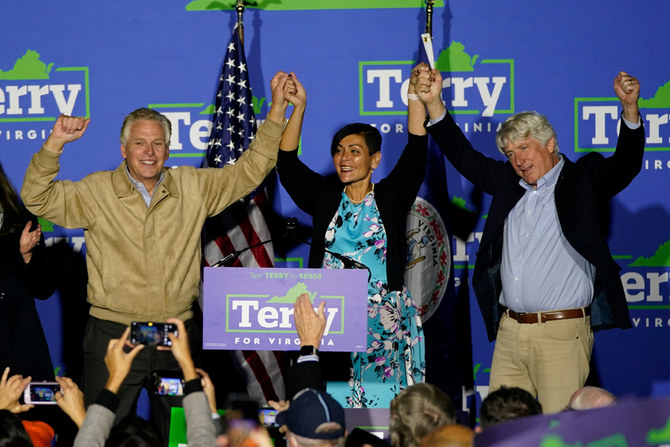

CHICAGO: Hala Ayala on Tuesday lost her bid to become the first Arab-American lieutenant governor of the state of Virginia, in an election wave that appears to be the beginning of a political backlash against President Joe Biden and the Democrats.
Ayala’s chances in Virginia looked promising because Biden had won the state in the November 2020 presidential election with a 10 percent lead over Republican incumbent Donald Trump.
Ayala’s loss to former Republican state delegate Winsome Sears followed the narrow defeat of Virginia’s former Democratic Gov. Terry McAuliffe to Republican challenger Glenn Youngkin.
McAuliffe had served as governor of Virginia from 2014 to 2018, while Youngkin was chief financial officer and later chief operating officer of The Carlyle Group, a private equity firm based in Washington D.C.
The Youngkin victory portends a potential Republican surge over Democrats in next year’s midterm elections for control of the US House and Senate.
Despite the implications for Biden and the Democrats next year, Tuesday’s elections brought a new dawn for Arab Americans in at least one city with a history of anti-Arab sentiment.
Abdullah Hammoud, a Michigan state legislator since 2017, was elected as the first Arab-American mayor of the city of Dearborn. More than 60 percent of the city’s 110,000 population are of Arab heritage.
It was a dramatic turnaround from 1985, when Michael Guido warned voters of an “Arab problem” before winning the mayor’s office. Guido later befriended Arab Americans.
He was succeeded as mayor in 2007 by John B. O’Reilly Jr., who this year announced his retirement for health reasons.
Hammoud tweeted: “I’m honored & humbled by today’s support. Our residents spoke loudly — we want change & bold leadership to tackle the challenges our city faces.”
He added: “We live in the greatest city in America and I’m excited about what we can achieve together. Let’s get to work!”
There were 14 candidates competing for seven seats on Dearborn’s City Council. Several Americans of Lebanese heritage won council seats, according to the latest Dearborn election commission returns: Michael T. Sareini, Kamal Al-Sawafy, Robert Abraham and Mustapha Hammoud.
Not as fortunate were three Yemeni Americans who entered the race: Sam Luqman, Saeid Al-Awathi, and Khalil Othman.
Dearborn’s Yemeni-American community has grown significantly over the past decade and is fighting for representation.
Last year, writer Adel Mozip became the first Yemeni American to be elected to a seat on the Dearborn School Board.
In neighboring Dearborn Heights, Mayor Daniel Paletko died from COVID-19, creating a vacancy and election battle for two positions: Filling his remaining term in office, which ends on Dec. 31, and to serve a full mayoral term beginning in January.
Lebanese immigrant and former US Marine Bill Bazzi, a Dearborn Heights City Council member since 2018, was selected by his colleagues to serve as interim mayor following Paletko’s death.
He faced off against City Council Chairwoman Denise Malinowski-Maxwell and Anthony Camilleri, and easily won both the completion of Paletko’s term and the new four-year term as mayor.
In addition to Bazzi, three of the seven Dearborn Heights City Council members are Lebanese American and Muslim. Dearborn Heights is 32 percent Arab American, according to 2019 census data.
In Boston, where the mayor’s office has been held by a man since 1630, two women — Annissa Eassaibi George and Michelle Wu — battled to become the city’s first female chief executive.
The daughter of a Tunisian immigrant father and Polish-American mother, George served on the Boston City Council and is believed to be the only Tunisian to ever be elected to American public office.
But Wu, who is Asian American, claimed victory early Wednesday morning. The vote turned on many issues, including whether George was a “woman of color” like Wu.
Back in Virginia, Arab-American Sam Rasoul, who lost to Ayala in his bid to represent the Democrats for lieutenant governor, won re-election to the 11th State Legislative District, an office he has held since 2014.
Rasoul had raised more than $2 million in his campaign, winning more than 64 percent of the vote, according to the unofficial tally.
“We did it! We won! It’s been an awesome ride and more work to be done,” he tweeted. “Thank you my friends for giving me the honor of being in public service. Know I love serving with every fiber of my being. Onward.”