

Egypt, US sign 7 grant deals worth $125m

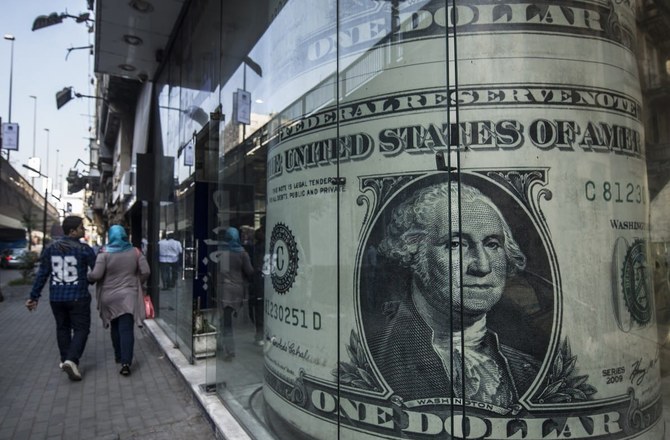
A currency exchange shop displays a giant US dollar banknote, Cairo, Egypt, Nov. 3, 2016. (Getty Images)
Short Url
Updated 02 November 2021
Follow

Egypt, US sign 7 grant deals worth $125m

  • The agreements come within the framework of the joint economic relations program between the two countries
  • US Ambassador Jonathan Cohen: This assistance is part of the US government’s $30 billion investment in Egypt over the past 40 years

CAIRO: Egypt’s Minister of International Cooperation Rania Al-Mashat announced the signing of seven grant agreements with the US Agency for International Development worth a total of $125 million.

The agreements come within the framework of the joint economic relations program between the two countries in order to support the implementation of Egypt’s development vision.

Al-Mashat noted that the announced agreements will stimulate the state’s development efforts in the fields of education, science and technology, agriculture, health, economic governance, trade and investment. A grant worth $5 million was also directed to the health sector earlier to improve the country’s response to the pandemic.

Al-Mashat revealed that Egypt’s International Cooperation Ministry, the National Council for Women and the World Economic Forum had also launched the “Closing the Gender Gap Accelerator” initiative — the first of its kind in Africa and the Middle East — which takes institutional measures to empower women.

She explained that the ministry is seeking to agree on a new partnership with USAID to help achieve the goals of the initiative to “bridge the gender gap, improve the work environment for women in the private sector, and enhance financial inclusion for women.”

US Ambassador Jonathan Cohen said: “I am pleased to announce $125 million in economic aid from the US to Egypt. This assistance is part of the US government’s $30 billion investment in Egypt over the past 40 years, which has brought about clean water and wastewater services to 25 million Egyptians, eliminated polio, built 2,000 schools, and provide 4,000 university scholarships.”

Egypt’s development cooperation portfolio with USAID has recorded about $900 million since 2014, while the partnership portfolio between Egypt and the US since 1978 amounts to around $30 billion.


Aoun hails disarmament progress: ‘Lebanon achieved in 1 year what it had not seen in 4 decades’

Updated 20 January 2026
Follow

Aoun hails disarmament progress: ‘Lebanon achieved in 1 year what it had not seen in 4 decades’

  • President Joseph Aoun highlights achievements during first year in office despite many challenges
  • Army announced this month it had successfully disarmed Hezbollah in the south of the country

BEIRUT: Lebanese President Joseph Aoun confirmed on Tuesday that the country’s armed forces “are now the sole operational authority south of the Litani River, despite doubts, accusations of treason, insults and slander.”

Speaking at the Presidential Palace in Baabda during a traditional New Year meeting with members of the diplomatic corps and the heads of international missions, he highlighted what he viewed as Lebanon’s achievements since he took office on Jan. 9, 2025.

The government’s approval in August and September last year of plans to bring all weapons in the country under state control, and ensure the authority of the state across all Lebanese territory using its own forces, was “no minor detail,” he said.

“Lebanon achieved in one year what it had not seen in four decades,” he added, as he recalled taking office in a “deeply wounded state” that has suffered decades of institutional paralysis and economic crises.

Despite campaigns of distortion, intimidation and misinformation, and Israel’s failure to abide by the November 2024 ceasefire agreement, the changed reality on the ground over the past 12 months speaks for itself, he said.

“The truth is what you see, not what you hear,” Aoun said, pointing out that “not a single bullet was fired from Lebanon during my first year in office, except for two specific incidents recorded last March, the perpetrators of which were swiftly arrested by official authorities.”

The army carried out “extensive operations” to clear large areas of the country of illegal weapons regardless of who controlled them, the president continued, in line with the terms of the Nov. 27 ceasefire agreement with Israel, which he described as “an accord Lebanon respects and that was unanimously endorsed by the country’s political forces.”

These efforts reflected a determination to spare the country a return to the “suicidal conflicts that have come at a heavy cost in the past,” he added.

Aoun stressed his commitment during the second year of his presidency to restoring control of all Lebanese territory to the exclusive authority of the state, securing the release of prisoners, and the reconstruction of war-ravaged areas.

He said that southern Lebanon, like all of the country’s international borders, would fall under the sole control of the Lebanese Armed Forces, putting a definitive end to any attempts “to draw us into the conflicts of others, even as those same parties pursue dialogue, negotiations and compromises in pursuit of their own national interests.”

The Lebanese Army Command announced early this month the completion of the first phase of its plans to disarm nonstate groups south of the Litani River. The government is now awaiting an army report next month detailing its next steps.

Gen. Rodolphe Haykal, the army’s commander, has said that the plan “does not have a specific time frame for completing this phase, which encompasses all Lebanese regions.”

A Lebanese official confirmed to Arab News that the army now has exclusive control of territory south of the Litani River, and no other armed forces or military factions have a presence there.

Aoun’s affirmation of his determination to “stay on course” came two days after Hezbollah leader Naim Qassem gave a sharply worded speech that delivered both implicit and explicit rebukes aimed at the president and Foreign Minister Youssef Raji.

His criticisms focused on their efforts to take control of weapons north of the Litani River, following a declaration by Aoun that “the time for arms is over,” a position that Hezbollah vehemently rejects in what appears to be an attempt to derail the gradual, phased disarmament strategy embraced by the Lebanese government and the international community.

Progress in the efforts of the military to take control of all weapons in the country hinges on securing vital logistical support for the country’s armed forces, a condition tied to the International Conference for Supporting the Lebanese Army and Internal Security Forces, which is due to take place on March 5 in Paris.

Aoun told the diplomats that the conference is the result of efforts led by the international Quintet Committee supporting Lebanon: the US, Saudi Arabia, France, Qatar and Egypt.

Archbishop Paolo Borgia, the papal ambassador to Lebanon, speaking in his role as dean of the diplomatic corps, said that the current crisis in the country serves “as a harsh test” that must remind political leaders of their duty to prevent history from repeating itself.

He called for respect for all electoral processes as a vital part of any nation’s democratic life, and for “genuine peace without weapons, one that can disarm enemies through the convincing power of goodness and the strength of meeting and dialogue.”

He added: “Those holding the highest public offices must give special attention to rebuilding political relationships peacefully, both nationally and globally, a process grounded in mutual trust, honest negotiations and faithful adherence to commitments made.”