

Pakistani officials dismiss British claim Karachi to submerge in Arabian Sea in four decades

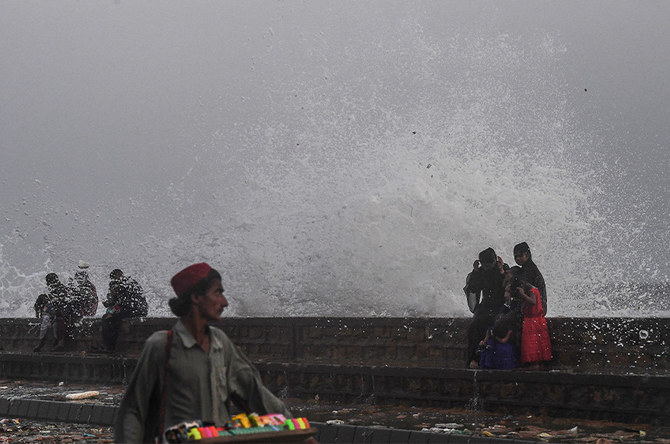
People gather on sea view during high tide of the Arabian Sea in Karachi on June 13, 2019. (AFP/ FILE)
Short Url
Updated 03 November 2021
Follow

Pakistani officials dismiss British claim Karachi to submerge in Arabian Sea in four decades

  • Officials and experts maintain the British High Commission’s statement is not backed by scientific evidence
  • The director of the country’s meteorological department says the sea level has gone down in Pakistan’s coastal region

KARACHI: Pakistani officials and experts dismissed an international claim on Tuesday that Karachi would submerge in the Arabian Sea in the next 39 years due to the negative effects of climate change, saying the statement was not backed by any scientific evidence.
The British High Commission in Islamabad said on Saturday Pakistan’s seaside metropolis would completely submerge by 2060 if the current trajectory of rising sea levels continued.
Quoting experts, it said Pakistan was the eighth most vulnerable country in the world to climate change, adding the rising temperatures would cut down 36 percent of glaciers in the Hindu Kush and Himalayan mountain ranges.
The high commission said it was a critical situation for Pakistan that required immediate action.
While admitting that climate change was an urgent issue with serious implications for Karachi, however, Pakistani officials and experts said the statement that the city would soon be submerged was exaggerated and lacked scientific evidence.
“This claim has no scientific proof and it does not offer any reason why Karachi will get submerged in the sea,” Ameer Haider Laghari, director meteorological department, told Arab News.
He also challenged the claim that sea level along the Karachi coast was on the rise.
“If anything, we have witnessed in the last few decades that sea level near Karachi has gone down,” he maintained.
Leghari admitted the risk of a tsunami in Karachi could not be ruled out due to the presence of three seismic plates in the region, though he said even such a high tide was not likely to sink the city.
The World Meteorological Organization, a UN body on weather, climate and water, in its State of Climate Report 2021 said the rate of global sea level rise had “more than doubled to record high.”
It noted an increase of 4.4 millimeters per year from 2013 to 2021, saying it was “mainly due to melting glaciers and ice sheets.”
It added if this trend continued, it would have profound implications for everyone in the world.


However, environmental expert, Dr. Shahid Amjad, said the high commission’s claim seemed “far-fetched” given the current level of sea in the south of Karachi.
“As per the available data of the last 100 years, the sea level rise is two millimeters per annum. If water continues to rise at the same rate, it will be 120 millimeters in the next 60 years which is just 12 centimeters,” he explained, adding the sea erosion coupled with rising temperatures could cause sea expansion in Pakistan’s coastal areas.
“But Karachi is unlikely to be impacted,” he added.


Pakistan PM urges unity, economic resilience in New Year message

Updated 4 sec ago
Follow

Pakistan PM urges unity, economic resilience in New Year message

  • Sharif says Pakistan stabilized economy, countered security threats in 2025
  • The prime minister vows reform, unity and diplomacy as the country enters 2026

ISLAMABAD: Prime Minister Shehbaz Sharif urged national unity, economic resilience and a continued focus on reform in a New Year message on Wednesday, saying the country had weathered security and economic challenges in 2025 and must now build on its gains as it enters 2026.

Sharif’s statement comes as Pakistan seeks to consolidate macroeconomic stabilization and navigate a volatile regional and global environment. He framed the year ahead as one requiring cohesion, discipline and sustained reform, while reaffirming Islamabad’s commitment to diplomacy and multilateral engagement.

“Over the past year, we responded to the aggression of enemies and countered the menace of terrorism with matchless courage and bravery, both on the battlefield and in negotiation rooms,” the prime minister said in a post on social media platform X.

“We have also taken meaningful steps to strengthen economic fundamentals, improve governance, expand social protection, and lay the groundwork for long-term development,” he added. “Our efforts are guided by our collective resolve to build a stable, self-reliant, and prosperous Pakistan that delivers opportunity and dignity to every citizen.”

Sharif said Pakistan had begun to restore confidence through fiscal discipline, structural reforms and renewed momentum in investment, exports and energy security, crediting the public’s “hard work, patience, and sacrifices” for recent progress.

On foreign policy, he said the country would continue to prioritize dialogue and cooperation amid rising instability.

“At a time of global uncertainty and conflict, Pakistan will continue to advocate dialogue over confrontation, development over division, and cooperation over unilateralism,” he said.

“With unity, discipline, and hard work, we shall build a Pakistan that is economically strong, socially just, and resilient in the face of challenges,” Sharif added.