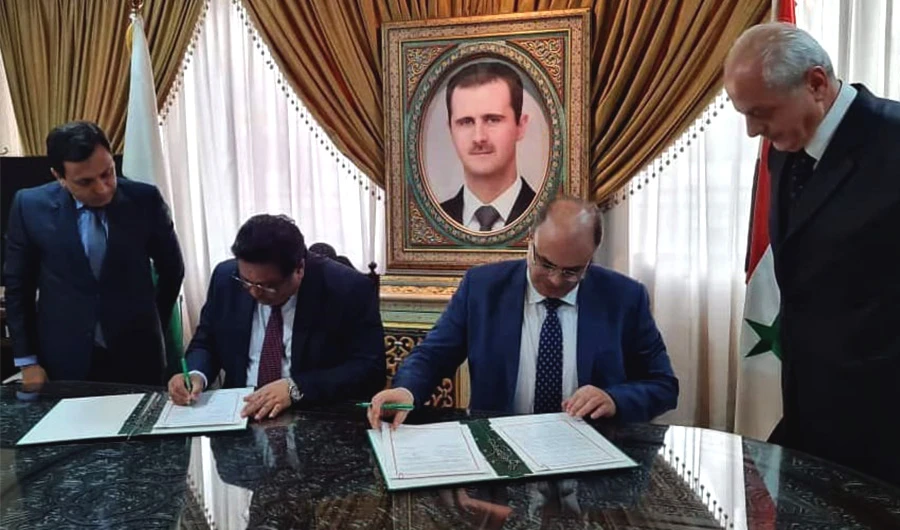
ISLAMABAD: Pakistan and Syria on Sunday signed a memorandum of understanding (MoU) on a joint working group to expand bilateral trade and economic ties, the Pakistani commerce ministry said.
Officials from both countries have recently been discussing expansion of bilateral relations, following a meeting between Syrian Chargé D’ affaires in Islamabad, Mazen Obeid, and Pakistani Interior Minister Sheikh Rashid Ahmed in September.
Last month, the Pakistan International Airlines (PIA) also announced expansion of direct flights to the Syrian capital of Damascus.
The MoU was signed at the office of the Syrian Minister for Economy and Foreign Trade Samer Al-Khalil in Damascus on Sunday. Pakistan’s Ambassador to Syria Air Marshal (retired) Saeed Muhammad Khan inked the document.
“They cited the MoU as an essential document for starting bilateral cooperation in different domains, especially the direct exchange of visits of businessmen from both sides,” Pakistan’s embassy in Damascus said in a statement.
“The two sides discussed various issues relating to exploring and activating venues of bilateral cooperation in the field of commerce and economic exchanges.”
Ambassador Khan said the resumption of direct flights between Pakistan and Syria was “an important step” toward activating bilateral trade and encouraging business delegations from both sides to explore opportunities in various fields.
The Pakistani embassy said the two sides agreed to fix a time for ministers of economy and trade to discuss related issues and exchange views over a webinar.
Pakistan, Syria sign accord to expand trade ties
https://arab.news/m6kd3
Pakistan, Syria sign accord to expand trade ties
- Both sides call the accord an ‘essential document’ for direct visits of businesspersons
- Last month Pakistan International Airlines also announced direct flights to Damascus
Pakistan PM calls PIA privatization ‘vote of confidence’ as government pushes reforms
- The loss-making national flag carrier was sold to a Pakistani consortium for $482 million after two failed attempts
- Finance minister vows to continue economic reforms, engage international partners through trade and investment
KARACHI: Prime Minister Shehbaz Sharif said on Tuesday the privatization of state-owned Pakistan International Airlines marked a “vote of confidence” in the country’s economy, as the government presses ahead with structural reforms aimed at easing pressure on public finances and attracting investment.
The sale of the loss-making national carrier by a Pakistani consortium, which secured a 75 percent stake for Rs135 billion ($482 million), follows two previous attempts to privatize PIA. The development comes as Pakistan seeks to build on macroeconomic stabilization after a prolonged balance-of-payments crisis, with authorities trying to shift the economy toward export-led growth and policy continuity.
“It was our firm commitment to the people of Pakistan that speedy and concrete steps would be taken to privatize loss-making state-owned enterprises that have been a burden on the economy,” Sharif said in a post on X. “The successful completion of the transparent and highly competitive bidding process for the privatization of PIA marks an important milestone in fulfilling that commitment.”
“The strong participation of our leading business groups and some of Pakistan’s most seasoned and respected investors is a powerful vote of confidence in our economy and its future,” he added.
https://x.com/cmshehbaz/status/2003498418984128908?s=46&t=SApcAZAv0zK56lMSgiF_fg
The government has made privatization of state-owned enterprises a key pillar of its reform agenda, alongside changes to taxation, energy pricing and trade policy, as it seeks to stabilize the economy and restore investor confidence.
Meanwhile, Finance Minister Muhammad Aurangzeb told an international news outlet Pakistan had reached a critical turning point, with macroeconomic stability and sustained reforms helping shift the economy from stabilization toward growth.
“Macroeconomic stability, sustained reforms and policy continuity are restoring confidence, shifting the economy from stabilization to export-led growth,” he said in an interview with USA Today, according to a statement issued by the finance ministry, adding that the government was opening new opportunities for domestic and global investors.
Aurangzeb said inflation had eased sharply, external balances had improved and foreign exchange reserves had risen above $14.5 billion, while Pakistan had recorded both a primary fiscal surplus and a current account surplus for the first time in several years.
The finance minister noted that economic growth remained insufficient to meet the needs of a fast-growing population, pointing out the importance of continuing structural reforms and encouraging investment in sectors such as agriculture, minerals, information technology and climate resilience.
Despite ongoing risks from global commodity prices, debt pressures and political uncertainty, Aurangzeb said the government remained committed to staying the reform course and engaging international partners through trade and investment.