

Dengue continues to sting Pakistan’s Lahore as cases cross 10,000 mark

Patients take rest on beds arranged inside a makeshift dengue ward in a hospital in Lahore on October 17, 2021. (AFP/File)
Short Url
Updated 01 November 2021
Follow

Dengue continues to sting Pakistan’s Lahore as cases cross 10,000 mark

  • Provincial capital reported three deaths, 452 new cases in 24 hours
  • Punjab health department asks officials to speed up waste disposal

ISLAMABAD: At least three more people lost their lives to dengue fever in Lahore, the capital of Pakistan’s most populous Punjab province, in the last 24 hours, Pakistani media reported on Sunday, as the number of confirmed dengue cases surpassed the 10,000 mark. 
Dengue is a threat to nearly half of the world’s population. Of the estimated 220 million people infected each year, two million, mostly children in Latin America and Asia, develop its severe form called dengue hemorrhagic fever. 
There is no specific treatment for the disease, though its early detection can help in treatment. 
“So far, over 25 people in the city have died due to the dengue virus post-monsoon season,” SAMAA news website reported, citing the Punjab health department. 
“The total number of cases in the city has surpassed the 10,000 mark, with 452 new cases.” 
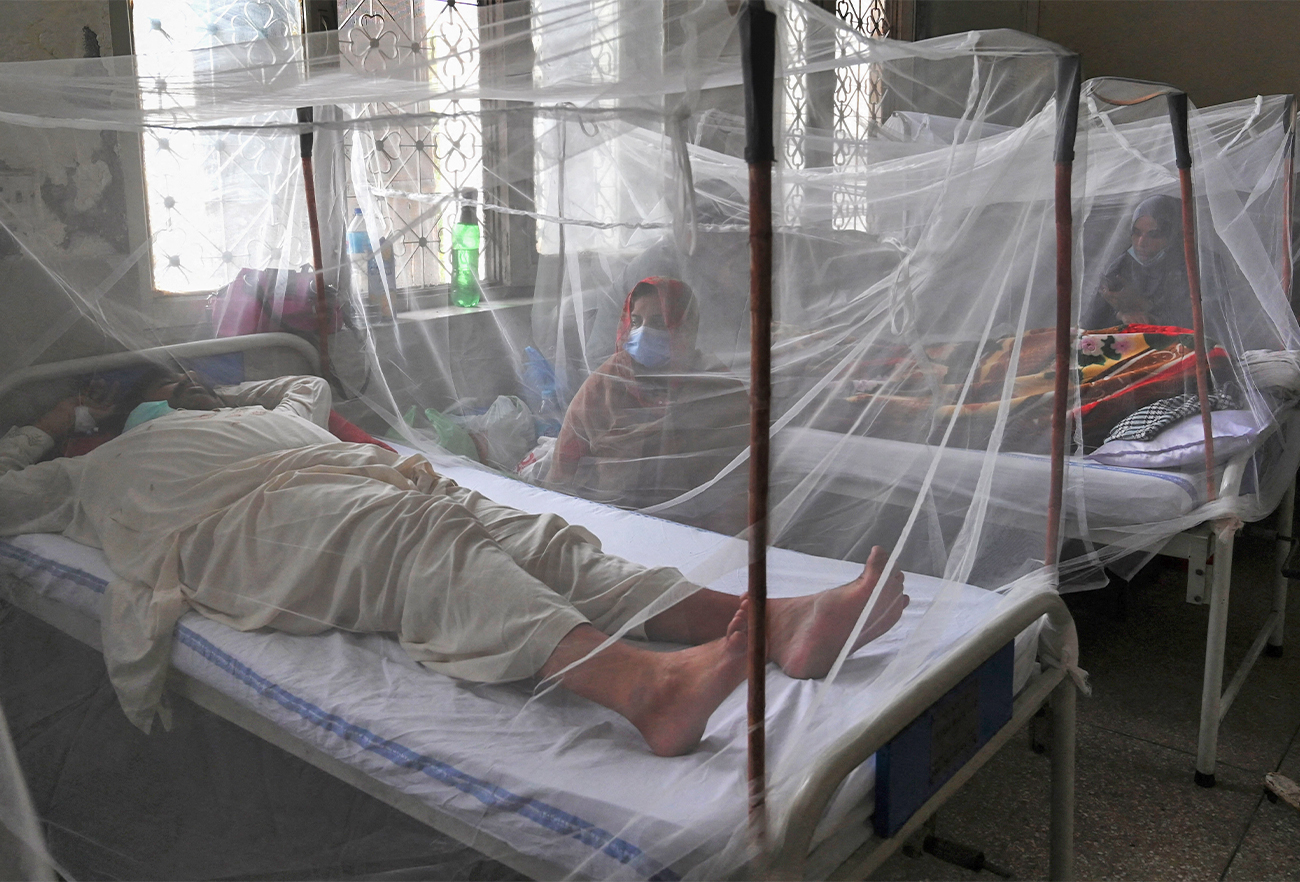


Relatives sit next patients suffering from dengue fever resting under a mosquito net at a hospital in Lahore, Pakistan, on September 29, 2021. (AP)

At least 1,489 people were in critical condition in the provincial capital. Most of the cases were reported in Defense, Gulberg, Iqbal Town and Samanabad areas of the city. 
The Punjab health department has directed officials to speed up the process of waste disposal, urging people to cooperate with the government, according to the report.
The situation in Islamabad and Rawalpindi was no different, with the total number of cases in Islamabad and Rawalpindi reaching 2,600 and 1,100, respectively. Twelve people have died of the dengue virus in Islamabad so far this year. 
The Sindh province reported an uptick in cases too, with more than 69 people contracting the fever on Friday. Karachi, the largest megapolis of the country, has been one of the most affected cities in the province, where over 1,500 dengue cases have been reported in October alone. 
In Khyber Pakhtunkhwa, four people have died of the dengue fever this year, the report said. The province has recorded a total of 6,291 cases this year. 


Punjab expands Pakistan-India Wagah border arena with museum, partition-themed park

Updated 02 January 2026
Follow

Punjab expands Pakistan-India Wagah border arena with museum, partition-themed park

  • The border crossing, near eastern city of Lahore, is the primary land route between Pakistan and India and one of the most recognizable symbols of their often-tense relations
  • The site is best known for its daily flag-lowering ceremony, a choreographed military ritual performed by border forces from both countries that draws thousands of spectators

ISLAMABAD: Maryam Nawaz, chief minister of Pakistan’s Punjab province, on Thursday inaugurated the newly constructed arena at Wagah border cross between Pakistan and India, which includes a museum and a partition themed park.

The Wagah border crossing, located near the eastern city of Lahore, is the primary land route between Pakistan and India and one of the most recognizable symbols of the often-tense relationship between the two neighbors. It serves as a key point for prisoner exchanges and limited movement of travelers, while remaining tightly regulated due to security considerations.

The site is best known for its daily flag-lowering ceremony, a choreographed military ritual performed by border forces from both countries that draws thousands of spectators. Over the years, the ceremony has evolved into a popular tourist attraction, blending displays of nationalism with public spectacle and making it one of Pakistan’s most visited landmarks, which connects with India’s Attari.

Flanked by military officials, CM Nawaz visited the crossing and inaugurated the new arena, with its seating capacity increased from 7,500 to 25,000 spectators, the state-run Radio Pakistan broadcaster reported. The chief minister also visited the martyrs’ monument and offered her respects.

“In addition to the arena’s expansion, several new constructions have been added at the Joint Check Post Wagah. These new developments include a theme park depicting the partition of the Subcontinent, featuring models of a railway station, military equipment and a Martyrs’ Memorial,” the broadcaster reported.

“A Pakistan Museum has also been established within the arena, showcasing the country’s history and culture from the Freedom Movement to the present day.”

In August 1947, Britain divided the Indian Sub-continent, its former colony, into two countries — Hindu-majority India and Muslim-majority Pakistan.

Excitement over independence was quickly overshadowed by some of the worst bloodletting that left up to 1 million people dead as gangs of Hindus and Muslims slaughtered each other.

Creating two independent nations also tore apart millions of Hindu and Muslim families in one of the world’s largest peacetime migrations, which displaced at least 15 million people.

The fate of Kashmir, then a princely state, was left undecided. The Himalayan territory continues to remain a flashpoint in relations between the neighbors, who have fought multiple wars over it.