ISLAMABAD: The Pakistani government on Sunday reached an agreement with the outlawed Tehreek-e-Labbaik Pakistan (TLP) party in a bid to end a week-long protest that paralyzed parts of the country, government representatives announced, without sharing details of the treaty.
Both sides unanimously decided to constitute a steering committee to oversee implementation of the agreement after intense negotiations over the weekend. They did not disclose whether thousands of protesters, who were currently camped in Wazirabad, a city some 190 kilometers away from the federal capital, would disperse or stay there till the implementation of the agreement.
The banned group has been pushing the government to release its chief, Saad Rizvi, who was arrested in April this year for inciting violence against the state and expel the French envoy over the publication of caricatures of Prophet Muhammad (PBUH) in France last year. Since details of the agreement were kept secret, therefore it was not immediately clear if the government had accepted the demands of the protesters.
“The government and the TLP have signed the agreement with mutual confidence and consensus,” Mufti Muneeb-ur-Rehman, a representative of the TLP, said at a press conference along with the government team in Islamabad. “This agreement has the support and backing of Saad Rizvi.”
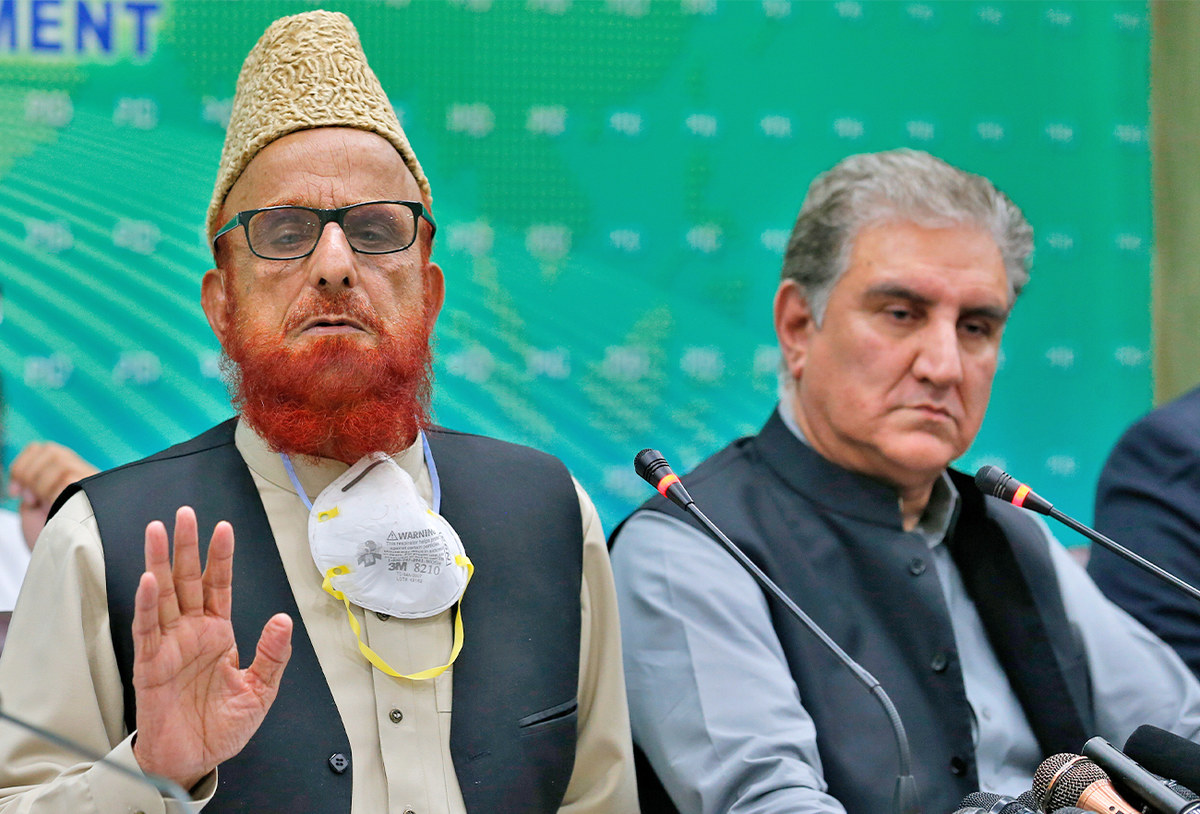
Pakistan's Foreign Minister Shah Mahmood Qureshi, right, and top religious leader Mufti Muneebur Rehman, who helped negotiate an end to a protest march by Islamists, addresses a press conference, in Islamabad, Pakistan, on October 31, 2021. (PID)
The government team comprised Foreign Minister Shah Mahmood Qureshi, National Assembly Speaker Asad Qaiser and State Minister for Parliamentary Affairs Ali Muhammad Khan.
“The details of this agreement will be revealed at an appropriate time,” Rehman said. “Actions speak louder than words.”
The TLP began a long march toward Islamabad from Lahore on October 22 after violent clashes with law enforcement personnel killed two policemen. Two more policemen were killed and several others injured in similar incidents in Muridke and Sadhoke as the protesters forced their way past barricades and hurdles toward Islamabad.
Rehman said this agreement was not a “victory or defeat” of anybody, rather it was a victory of Pakistan and Islam.
“Its positive outcome will be visible in the next week. This agreement is signed in the best interest of the nation,” he said, adding that the milestone was achieved after “sense prevailed over aggression.”
The steering committee headed by the minister for parliamentary affairs would be functional from Sunday (today) and it would likely chalk out a strategy to ensure the release of Rizvi from the jail and removal of a ban on his party.
“This agreement is not the type that is signed in the afternoon and someone could say in the evening that it is worthless,” Rehman said, while assuring the public that “good will come out of it.”
“We are assured that this [agreement] will be implemented in letter and spirit,” he added.
Foreign Minister Qureshi said that both sides demonstrated magnanimity to resolve the crisis. “A path of peace and betterment is found,” he said, thanking the TLP leadership for its contribution.