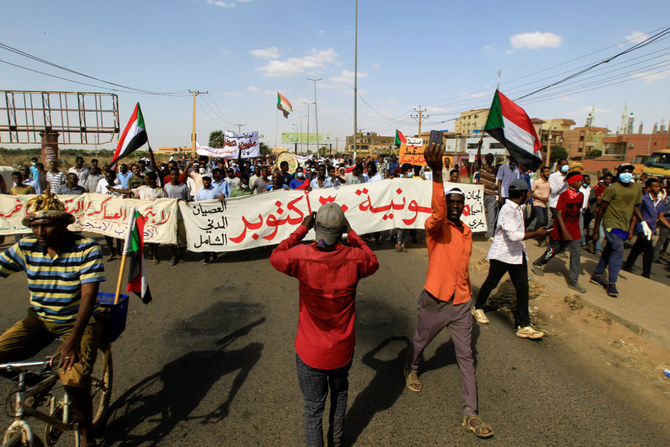
CAIRO: Tens of thousands of Sudanese took to the streets across the country Saturday, in the largest pro-democracy protest yet since the military seized control earlier this week.
Three protesters were killed and dozens injured — several by live rounds — as security forces opened fire in several locations, a doctors’ union said.
The coup, condemned by the international community, has threatened to derail Sudan’s fitful transition to democracy, which began after the 2019 ouster of long-time autocrat Omar Al-Bashir. Since then, the military and civilian leaders have governed in an uneasy partnership.
Pro-democracy groups had called for protests across the country Saturday to demand the re-instating of a deposed transitional government and the release of senior political figures from detention.
The United States and the United Nations had warned Sudan’s strongman, Gen. Abdel-Fattah Burhan, that they view the military’s treatment of the protesters as a test, and called for restraint.
Burhan has claimed that the transition to democracy would continue despite the military takeover, saying he would install a new technocrat government soon. But the pro-democracy movement in Sudan fears the military has no intention of easing its grip, and will appoint politicians it can control.
Saturday’s large turnout is bound to increase pressure on the generals who face condemnations from the US and other Western countries to restore a civilian-led government.
Crowds began to gather Saturday afternoon in the capital of Khartoum and its twin city Omdurman. Marchers chanted “Give it up, Burhan,” and “revolution, revolution.” Some held up banners reading, “Going backward is impossible.”
The demonstrations were called by the Sudanese Professionals’ Association and the so-called Resistance Committees. Both were at the forefront of an uprising that toppled longtime autocrat Omar Al-Bashir and his Islamist government in 2019. They are also calling for the dismantling of paramilitary groups and restructuring of the military, intelligence and security agencies.
All three protesters killed Saturday were shot in Omdurman. One was shot in his head, another in his stomach, and a third in his chest, the Sudan Doctors Committee and protesters said.
The committee, which is part of the Sudanese Professionals’ Association, said security forces had used live ammunition against protesters in Omdurman and nearby. It said it counted more than 110 people wounded, some with gunshots, in Khartoum, Omdurman and the eastern province of Al-Qadarif.
Sudanese police denied using live ammunition and said in a statement that a policeman was wounded by gunfire. They said they used tear gas to disperse groups of demonstrators who allegedly attacked their forces and “important positions.” The statement did not elaborate.
Elsewhere, security forces fired tear gas at protesters as they attempted to cross the Manshia Bridge over the Nile River to reach Khartoum’s downtown, said Mohammed Yousef Al-Mustafa, a spokesman for the professionals’ association.
“No power-sharing mediation with the military council again,” he said, marching at an area protest.
Anti-coup protests also erupted in other areas, including the Red Sea city of Port Sudan, Kassala in eastern Sudan, and Obeid, in North Kordofan province, according to activists.
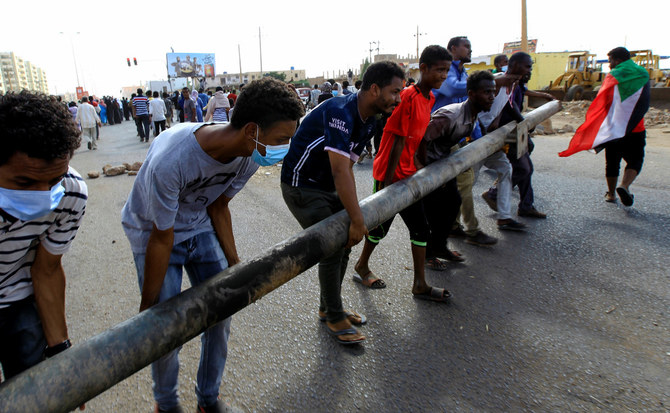
As night fell, plain clothes security forces chased off protesters in Khartoum and Omdurman, to prevent them from setting up sit-ins, activists said. In some neighborhoods, protesters blocked roads with makeshift barricades.
Earlier on Saturday, security forces blocked major roads and bridges linking Khartoum’s neighborhoods. Security was tight downtown and outside the military’s headquarters, the site of a major sit-in during the 2019 uprising.
Since the military takeover, street protests have been daily. With Saturday’s fatal shootings, the overall number of people killed by security forces since the coup rose to 12, according to the Sudan Doctors’ Committee and activists. More than 280 others were wounded. Troops have fired live ammunition, rubber bullets and tear gas at anti-coup demonstrators, and beat protesters with sticks in recent days.
Meanwhile, talks are ongoing to try to mitigate the crisis.
Late Friday, the UN special envoy for Sudan, Volker Perthes, met with Gen. Mohammed Hamdan Dagalo, a coup leader seen as close to Burhan. Dagalo commands the feared Rapid Support Forces, a paramilitary unit that controls the streets of Khartoum and played a major role in the coup.
He said the UN’s transition mission for Sudan is facilitating dialogue between the top generals and civilian leaders. Perthes said this “remains the only path toward a peaceful solution to the current crisis.”
A Sudanese military official said Saturday that a UN-supported national committee began separate meetings with Prime Minister Abdalla Hamdok and Burhan to find common ground.
The official said Hamdok demanded the release of all government officials and political figures arrested since the coup. Burhan, the official said, gave an initial approval to release “most” of the detained, but rejected the release of others, including Khalid Omar, the minister of Cabinet Affairs, saying they face accusations of inciting troops to rebellion.
The official spoke on condition of anonymity as he wasn’t authorized to release the information.
Meanwhile, the UN said it is closely monitoring security forces’ response on Saturday.
“They will be held individually accountable for any excessive use of force against protesters,” said Clément Nyaletsossi Voule, the UN special rapporteur on the right to freedom of peaceful assembly and association.
Burhan has claimed that the takeover was necessary to prevent a civil war, citing what he said were growing divisions among political groups. However, the takeover came less than a month before he was to have handed some power to a civilian.
Burhan installed himself as head of a military council that he said will rule Sudan until elections in July 2023. Observers say it’s doubtful the military will allow a full transition to civilian rule, if only to block civilian oversight of the military’s large financial holdings.


![]()
![]()
![]()

Tens of thousands protest Sudan’s coup, 3 protesters killed

Short Url
https://arab.news/bz37f
Tens of thousands protest Sudan’s coup, 3 protesters killed
- Resistance Committees accuse security forces of using live bullets against protesters
- UN-supported national committee hold separate meetings with PM Hamdok and coup leader to find common ground


Latest updates


Recommended


© 2026 SAUDI RESEARCH & PUBLISHING COMPANY, All Rights Reserved And subject to Terms of Use Agreement.