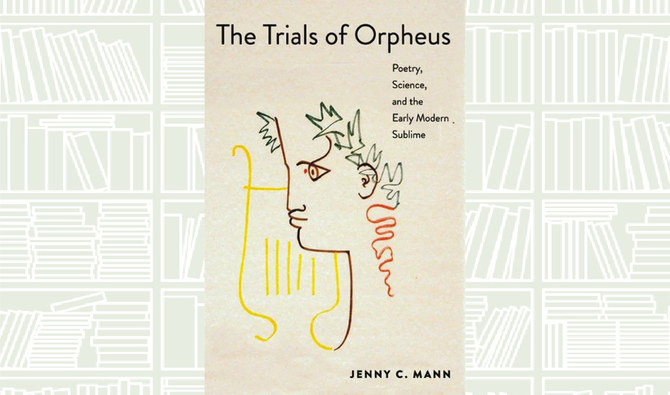
In ancient Greek mythology, the lyrical songs of Orpheus charmed the deities, and compelled animals, rocks, and trees to obey his commands. This mythic power inspired Renaissance philosophers and poets as they attempted to discover the hidden powers of verbal eloquence. They wanted to know: How do words produce action? In The Trials of Orpheus, Jenny Mann examines the key role the Orpheus story played in helping early modern writers and thinkers understand the mechanisms of rhetorical force. Mann demonstrates that the forms and figures of ancient poetry indelibly shaped the principles of 16th- and 17th-century scientific knowledge.
Mann explores how Ovid’s version of the Orpheus myth gave English poets and natural philosophers the lexicon with which to explain language’s ability to move individuals without physical contact. These writers and thinkers came to see eloquence as an aesthetic force capable of binding, drawing, softening, and scattering audiences. Bringing together a range of examples from drama, poetry, and philosophy, Mann demonstrates that the fascination with Orpheus produced some of the most canonical literature of the age.


What We Are Reading Today: The Trials of Orpheus by Jenny C. Mann
https://arab.news/yj3jq
What We Are Reading Today: The Trials of Orpheus by Jenny C. Mann


What We Are Reading Today: Making Waste by Sophie Gee
Why was 18th-century English culture so fascinated with the things its society discarded? Why did Restoration and Augustan writers such as Milton, Dryden, Swift, and Pope describe, catalog, and memorialize the waste matter that their social and political worlds wanted to get rid of—from the theological dregs in “Paradise Lost” to the excrements in “The Lady’s Dressing Room” and the corpses of “A Journal of the Plague Year?” In “Making Waste,” the first book about refuse and its place in Enlightenment literature and culture, Sophie Gee examines the meaning of waste at the moment when the early modern world was turning modern.
Gee explains how English writers used contemporary theological and philosophical texts about unwanted and leftover matter to explore secular, literary relationships between waste and value. She finds that, in the 18th century, waste was as culturally valuable as it was practically worthless—and that waste paradoxically revealed the things that the culture cherished most.