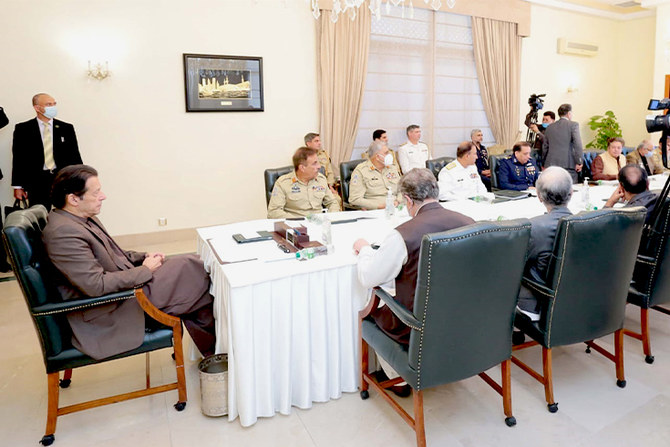

ISLAMABAD: Members of Pakistan’s National Security Committee (NSC) on Friday praised the police force for showing restraint against violent protesters of the banned Tehreek-e-Labbaik Pakistan (TLP) party as its supporters continued to march toward the federal capital, with four policemen killed in clashes.
TLP activists launched their protest eight days ago, demanding the release of their top leader Saad Rizvi who was arrested in April amid similar protests. The banned religious political paty is also calling for the expulsion of the French ambassador to Pakistan over the publication of anti-Islam caricatures in France last year.
The demonstrators left Lahore for Islamabad last Friday after violent clashes with law enforcement personnel and stayed in Muridke for three days, giving time to the government to meet the group’s demands.
The dialogue between the administration officials and TLP leaders, however, failed to make any headway, after which the protesters announced they were going to resume their march.
According to a statement issued by the Prime Minister’s Office, the NSC received a detailed briefing on the country’s internal security situation and the ongoing agitation by the banned group.
“The Prime Minister stressed that no group or entity will be allowed to cause public disruption or use violence to pressure the government,” said the statement. “Taking serious note of the unprovoked violent attacks committed by TLP members, the Committee resolved not to tolerate any further breach of law by this proscribed group.”
Participants at the NSC meeting praised the police for showing restraint even after being targeted by TLP workers who killed four uniformed personnel and injured hundreds of others, warning that the patience displayed by state institutions should not be viewed as a “sign of weakness.”
While emphasizing that all Pakistanis had the right to peaceful protest, the statement said the committee members unanimously agreed that TLP activists were deliberately employing violence against public property, state officials, and ordinary citizens to create instability in the country.
“All organs of the state [are] ready to act as per the law to protect the life and property of citizens,” the statement said.
The prime minister and committee members expressed condolences over the loss of lives of policemen and committed to compensating and looking after their families, the statement said.
Commending the exceptional performance of the law enforcement agencies, the prime minister assured that the government would firmly stand behind them since it was their mandate to enforce the law and protect the public.
The participants also criticized TLP’s “misuse of religion” for political gains, adding that the group was misleading the common man and creating internal discord within society.
“TLP’s violence [has] ended up furthering the agenda of sectarian elements and external enemies of the state,” it said.
The meeting highlighted the fact that despite the love and respect for Prophet Muhammad (PBUH) among the overwhelming majority of the global Muslim population, no such violent agitation was taking place in other countries.
“The committee unanimously resolved to guard [the country’s] sovereignty from all internal and external threats and not allow TLP to challenge the writ of the state in any way,” the statement added.
The participants endorsed the government’s decision to negotiate with the group within Pakistan’s legal and constitutional framework, without showing any leniency to TLP workers “for any crimes committed.”
Earlier in the day, Pakistan’s interior minister Sheikh Rashid Ahmed acknowledged that there was no breakthrough in talks with TLP leaders, though he added the state was willing to go to any length to establish its writ.
He said the prime minister was likely to address the nation on Saturday to explain his administration’s position on the issue.
Pakistan’s information minister Chaudhry Fawad Hussain also urged TLP protesters to go back to their homes, clear the roads, and resolve the issue peacefully.
He said the government did not want bloodshed or confrontation and was trying its best to resolve the matter through negotiations.
However, he made it clear that any negotiations with TLP leaders would take place within the country’s legal and constitutional ambit.
“The state will not tolerate gangs that seek to impose their agenda at gunpoint,” Hussain added.