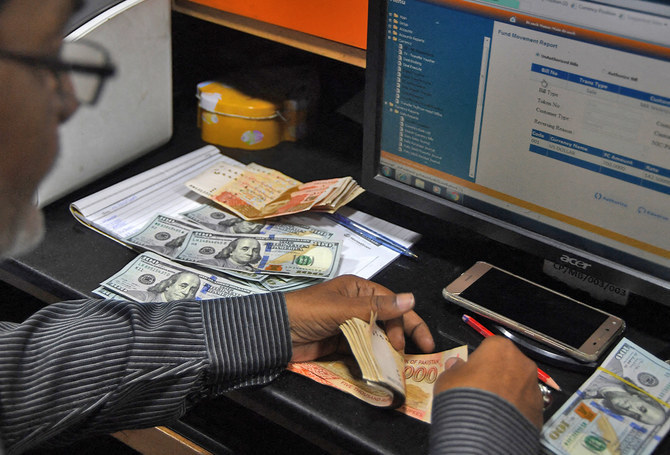
KARACHI: Pakistan’s currency market bounced back on Wednesday to gain 1 rupee against the US dollar in intra-day trading after long-time ally Saudi Arabia announced a support package of $4.2 billion, traders and bankers said.
The Saudi money will help Pakistan to shore up its foreign reserves, which has been shrinking.
The rupee closed the previous session at 175.60 against the dollar. It has depreciated around 13.6 percent since May.
“Rupee appreciation is result of the Saudi funding announcement, widely seen as a positive surprise much needed to bolster the external account,” Saad Hashemy, executive director at BMA Capital, told Reuters.
Saudi Arabia announced on Tuesday $3 billion to support Pakistan’s foreign reserves, as well as extending financing of the oil derivatives trade for a total of $1.2 billion during the year, Pakistan’s Information Minister Fawad Chaudhry said.
Pakistan has been in talks with the International Monetary Fund (IMF) for the last two weeks to secure a $1 billion tranche, but its sixth review remained inconclusive.
Pakistan’s Prime Minister Imran Khan thanked Saudi Arabia.
“The Kingdom of Saudi Arabia has always been there for Pakistan in our difficult times, including now when the world confronts rising commodity prices,” Imran Khan said in a tweet.
In 2018, Saudi Arabia gave $3 billion in foreign currency support and further loan worth up to $3 billion in deferred payments for oil imports.

Pakistan’s rupee rebounds on $4.2 billion Saudi support package
https://arab.news/6yrtk
Pakistan’s rupee rebounds on $4.2 billion Saudi support package
- Country’s currency market bounced back on Wednesday to gain 1 rupee against the U.S. dollar in intra-day trading
- Pakistan has been in talks with IMF for the last two weeks to secure $1 billion tranche of $6 billion bailout loan
Pakistan invites investors, innovators to back tech partnerships, announces national AI event
- Indus AI Week 2026 to run Feb. 9–15 as IT minister cites inclusive AI policy launched last year
- The week-long event will bring together relevant officials, startups, investors and universities
ISLAMABAD: Pakistan on Friday invited foreign investors and technology innovators to engage with its emerging artificial intelligence ecosystem as the government announced a week-long national AI initiative aimed at accelerating adoption across the public and private sectors.
Federal Minister for Information Technology Shaza Fatima Khawaja said the government would host Indus AI Week 2026 from Feb. 9 to 15, building on Pakistan’s National Artificial Intelligence Policy introduced last year to promote responsible use of the technology.
The announcement comes as Pakistan seeks to position itself as a credible participant in the global AI economy, amid growing interest from governments in the Global South to harness AI for productivity, skills development and innovation while managing regulatory and ethical risks.
“With the introduction of Pakistan’s National AI Policy last year, we laid the foundation for responsible and inclusive AI development,” Khawaja said, according to an official statement circulated by her ministry. “Indus AI Week reflects our determination to take that work further by moving beyond dialogue and toward adoption.”
“We invite international partners, investors and innovators to engage with Pakistan’s growing AI landscape,” she added.
The initiative will be organized by the IT ministry through a public-private partnership and is designed as an open national platform bringing together policymakers, technology firms, startups, universities, students and the wider public.
The program will include a national technology showcase, startup and innovation sessions linking founders with investors, skills training and certification opportunities and public engagement activities aimed at translating AI policy into practical use cases.
The week will open with the Indus AI Summit at Islamabad’s Jinnah Convention Center on Feb. 9, followed by an innovation and learning arena at the Islamabad Sports Complex on Feb. 9-10, with universities, companies and public institutions across the country hosting parallel events through Feb. 15.


