



ISLAMABAD: Pakistan’s information minister Chaudhry Fawad Hussain said on Wednesday the government had decided to treat the banned Tehreek-e-Labbaik Pakistan (TLP) party as a militant group since its activists had killed three policemen and injured 49 in recent clashes with law enforcement personnel.
The banned religious faction decided to march on Islamabad on Friday afternoon, seeking the release of its top leader, Saad Rizvi, and the expulsion of the French envoy to Pakistan over anti-Islam caricatures published in his country last year.
The Punjab provincial administration deployed heavy police contingents in and around the eastern city of Lahore after the group announced its decision to march toward the federal capital.
As clashes broke out between the two sides, three police personnel lost their lives while several others were injured.
“TLP is not a religious party,” Hussain said during a media briefing on the decisions taken in today’s federal cabinet meeting. “It is a militant group and will be treated as such.”
The information minister pointed out that the group had held protest demonstrations six times since its inception in 2015 on various pretexts, adding that the state had exhibited tremendous patience while dealing with its followers.
He also recalled the group had killed six policemen and injured over 700 in one of its previous protests.
“There is a limit to the patience of the state,” he continued. “We have taken a clear decision that such activities will not be tolerated at any cost.”
Hussain said that Pakistan had defeated terrorist organizations like Al Qaeda while adding that no one should mistake the state as a weak entity.
“Nobody will be allowed to blackmail the state,” he added.
The minister informed the prime minister had held a meeting with senior military and intelligence officials as well to discuss the TLP issue.
He urged the country’s judiciary and election commission to play their role to deal with the banned outfit.
Hussain also warned the people using social media in support of the banned religious group of stern action for being involved in illegal activity.
“Stop spreading fake news on social media,” he said. “We will come down hard on you and go to any extent.”
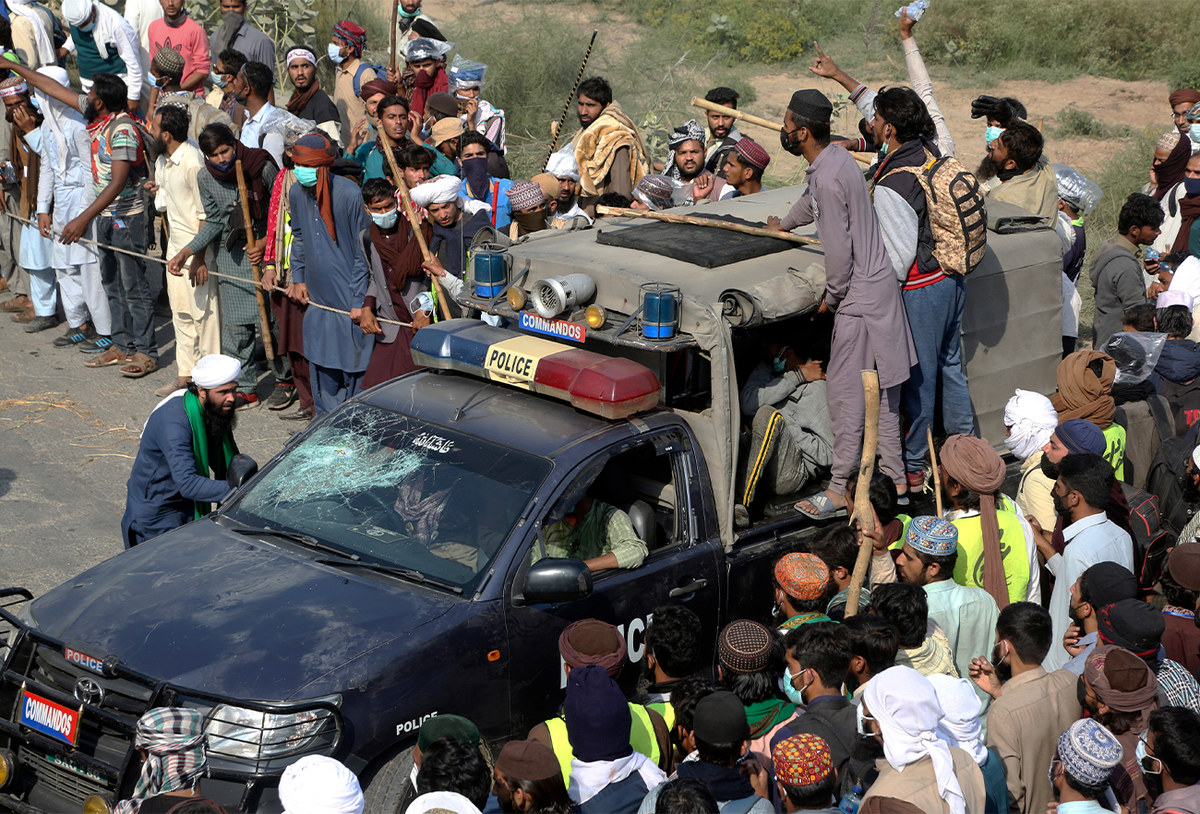
Supporters of Tehreek-e-Labiak Pakistan, a radical Islamist party, celebrate after capturing a police vehicle during their protest march toward Islamabad, on a highway in the town of Sadhuke, in eastern Pakistan, on October 27, 2021. (AP)
Earlier today, the district administrations of Islamabad and Rawalpindi sealed all major thoroughfares and link roads with shipping containers to stop TLP protesters from entering the federal capital after its leaders announced to resume their march.
The government had been negotiating with the group to convince its leadership to call off its protest.
The country’s interior minister on Monday said the government was ready to meet all of the TLP’s demands – which also include releasing supporters arrested in April and quashing cases against them – but they should “review” their demand regarding the French envoy.
In response, TLP leaders decided to relaunch their march on Islamabad.
“We stopped our protesters in Muridke for two days on the request of the government,” Ghulam Abbas Faizi, a senior TLP leader, said in a statement on Wednesday. “The government should show seriousness in the negotiations.”
He said the party would launch a call to supporters to start countrywide protests if the government resorted to violence against demonstrators.
In similar protests by the TLP in April, six policemen were killed in violent clashes around the country and at least 800 people were injured.
On Monday, all main roads and junctions leading to the diplomatic enclave, which houses major embassies, and the Parliament House in Islamabad, were sealed with shipping containers and extra police officers were deployed at all locations to block the movement of TLP supporters.
Rawalpindi Traffic Police said in a statement it had blocked the main Murree Road for all kinds of traffic from both sides, advising commuters and citizens to use the Express Way and IJP Road as alternate routes to enter Rawalpindi.
Peshawar Road and Old Airport Road can be used to enter Islamabad from Rawalpindi, police said, with additional traffic sergeants deployed to ensure smooth flow of traffic.
Islamabad Traffic Police have also placed diversions for both sides of traffic from Rawal Dam Chowk to Faizabad. A diversion has also been placed for both sides of traffic at Murree Road, Faizul Islam stop and from and to Faizabad.


