

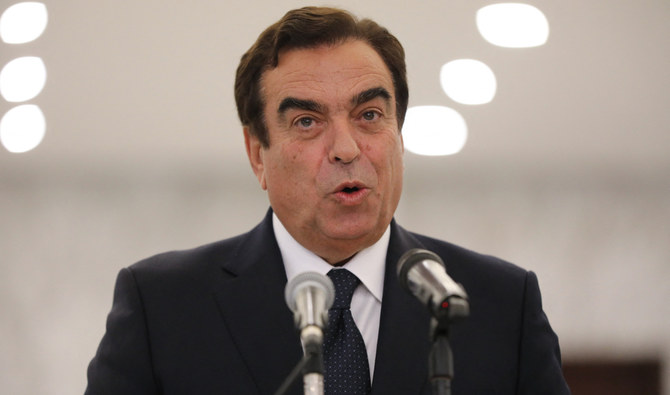

DUBAI: The Gulf Cooperation Council condemned Wednesday the comments made by the Lebanese Minister of Information on the situation in Yemen, saying it reflects limited knowledge and shallow understanding.
A day earlier, Lebanon’s information minister George Kordahi triggered a social media frenzy when a video of him referring to the Houthis as defending themselves emerged online.
When the TV host of Barlamanasha3b asked him about his position on what is happening in Yemen, Kordahi said ‘they’ [referring to Houthis] are defending themselves’.
He questioned in an exclamatory tone, ‘Them! Are they attacking anyone?’.
“In my opinion, this Yemeni war is absurd and should stop,” he said.
During his appearance on the media platform Barlamanasha3b [People’s Parliament]'s broadcast, carried out on Aug. 5, Kordahi also wished for a ‘temporary military coup’ to emanate and restructure Lebanon's political life. “I wish that a military coup happens in Lebanon, yet a temporary military coup that comes to organize and reorganize the political life in Lebanon,” Kordahi was heard telling the TV host in the short video.
An independent online media platform, Megaphone posted on Twitter the two-and-a-half-minute video that has so far been viewed by nearly 6000 users.
Saudi ambassador to #Lebanon just retweeted several stories citing #Saudi sources saying, “We are in front of a sharp diplomatic crisis because of the comments of Media Minister George Kurdahi” pic.twitter.com/b2iSHWJaWz
— Sarah Dadouch | سارة دعدوش (@SarahDadouch) October 26, 2021
At the time, Kordahi had not yet been named as information minister in Prime Minister Najib Mikati's cabinet that was formed during September.
When the host opposed him by saying ‘there is nothing called temporary military coup’, Kordahi maintained saying: “Yes there is a temporary military coup for at least five years [in my opinion] then they reappoint the political regime.”
Meanwhile, a cohost asked him about the nonstop drone attacks carried out by Houthis against Saudi civilians and properties, he replied saying: “Yes but you could also see them as people … and see the damages that are being inflicted upon them while being bombarded at their homes, properties, villages, squares, funerals and weddings by warplanes … it is about time this war comes to an end.”
Kordahi reiterated his opinion that ‘it is an absurd war’.
The Lebanese minister said: “We cannot compare between the efforts of Hezbollah in liberation and liberating Lebanese lands and the efforts of Houthis who are defending themselves against foreign aggression.”
According to the video, the cohost asked Kordahi if he considers the Saudis and Emiratis a ‘foreign aggression’.
“What?” he replied hesitantly as he moved his head forward before the cohost rephrased his question asking ‘do you consider Saudis and Emiratis as foreign aggression against Yemen?’
“Aggression, for sure there is aggression. Not because it is Saudi or Emirati but yes there has been aggression for the past five or six years or for how long!” said Kordahi before the female host corrected him saying its ‘eight years’.
“Eight years [of aggression] continuously against those people! Enough! What couldn’t be achieved within two or three years, you won’t achieve it within eight years. So this has become an absurd war that’s my opinion,” he concluded.
Just in : Lebanese Prime Minister: George Qardahi's words do not represent the government's official position on the Yemeni issue. - Al Arabiya TV
— حسن سجواني Hassan Sajwani (@HSajwanization) October 26, 2021
Citing a Saudi source, MTV news posted on its twitter handle that the source said they were facing a severe diplomatic crisis because of Kordahi's offensive statements on Arab countries regardless of the timing of the interview, but it indicated his intentions’.
Beirut-based Washington Post correspondent Sarah Dadouch tweeted that the Saudi ambassador to Lebanon just retweeted several stories citing Saudi sources saying, “We are in front of a sharp diplomatic crisis because of the comments of Media Minister George Kordahi”
Meanwhile, Emirati Twitter user Hassan Sajwani tweeted “Lebanese Prime Minister: George Qardahi's words do not represent the government's official position on the Yemeni issue. - Al Arabiya TV”
A former television presenter, Kordahi has stirred controversy in the past given his questionable opinions on matters ranging from Syrian President Bashar Assad to his views on harassment in the workplace.
A well-known and highly popular among a large segment of the Lebanese population, the 71-year-old media figure rose to fame when he hosted the pan-Arab version of “Who Wants to be Millionaire?” for several years.
Arab News published earlier that his controversial political opinions might not have mattered then, but they sure do matter now that he is a member of Lebanon’s cabinet.


