

US envoy: Iran nuclear deal effort is at ‘critical phase’

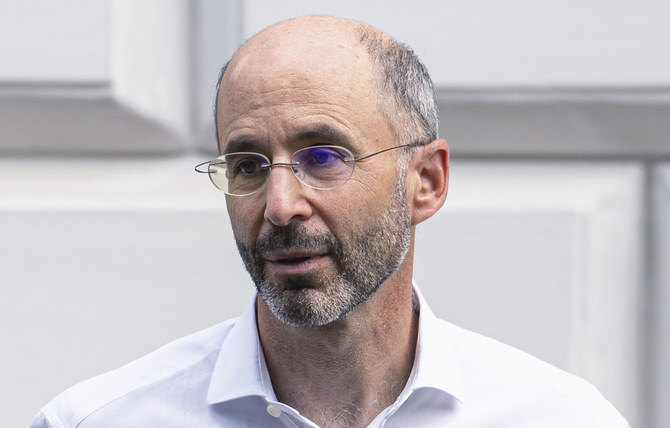
Robert Malley, US Special Envoy for Iran, is shown in Vienna, Austria. (AP/File)
Short Url
Updated 27 October 2021
Follow

US envoy: Iran nuclear deal effort is at ‘critical phase’

  • Iran has said for more than a month that it would ‘soon’ return to indirect talks in Vienna with the US on resuming compliance with the accord

WASHINGTON: Efforts to revive the 2015 Iran nuclear deal are at a “critical phase” and Tehran’s reasons for avoiding talks are wearing thin, a US official has said while raising the possibility of further diplomacy even if the deal cannot be resuscitated.

US Special Envoy for Iran Robert Malley told reporters Washington was increasingly worried Tehran would keep delaying a return to talks, but said it had other tools to keep Iran from developing a nuclear weapon and would use them if need be.

“We’re in a critical phase of the efforts to see whether we can revive the JCPOA,” Malley said, referring to the deal formally called the Joint Comprehensive Plan of Action. “We’ve had a hiatus of many months and the official reasons given by Iran for why we’re in this hiatus are wearing very thin.”

While saying that the window for both the US and Iran to resume compliance with the agreement would eventually close, Malley said the US would still be willing to engage in diplomacy with Iran even as it weighed other options to prevent Tehran from getting the bomb.

He also hinted at the economic benefits that might flow from Iran’s return to the agreement, under which Tehran took steps to limit its nuclear program in return for relief from US, EU and UN economic sanctions.

While saying the window for returning to the JCPOA will not be open forever because eventually Iran’s nuclear advances will have overtaken it, Malley said Washington would continue to look for diplomatic arrangements with Tehran.

“You can’t revive a dead corpse,” he said, stressing that the US had not reached that point yet. “We will continue to pursue diplomacy, even as we pursue other steps if we face a world in which we need to do that.”

Malley refused to describe those other steps. Since talks in Vienna on reviving the deal adjourned in June, Washington has increasingly spoken of pursuing other options, a phrase that hints at the possibility, however remote, of military action.

The envoy, who spent last week consulting US partners in the Gulf and in Europe, emphasized that all sides had “a strong preference for diplomacy, for an effort to revive the JCPOA and, were that to happen, to find ways to engage Iran economically.”


San Francisco parents scramble as teachers strike leaves 50,000 students out of school

Updated 3 sec ago
Follow

San Francisco parents scramble as teachers strike leaves 50,000 students out of school

  • On Tuesday, the San Francisco Unified School District’s 120 schools remained closed for a second day
  • About 6,000 teachers are striking over wages, health benefits, and resources for special needs students
SAN FRANCISCO: Connor Haught has been juggling virtual work meetings and arts and crafts projects for his two daughters as his family tries to navigate a teachers strike in San Francisco with no end date in sight.
Haught’s job in the construction industry allows him to work from home but, like many parents in the city, he and his wife were scrambling to plan activities for their children amid the uncertainty of a strike that has left nearly 50,000 students out of the classroom.
“The big concern for parents is really the timeline of it all and trying to prepare for how long this could go on,” Haught said.
The San Francisco Unified School District’s 120 schools were set to remain closed for a third day Wednesday, after about 6,000 public schoolteachers went on strike over higher wages, health benefits, and more resources for students with special needs.
Some parents are taking advantage of after-school programs offering full-day programming during the strike, while others are relying on relatives and each other for help with child care.
Haught said he and his wife, who works evenings at a restaurant, planned to have their 8- and 9-year-old daughters at home the first week of the strike. They hope to organize play dates and local excursions with other families. They have not yet figured out what they will do if the strike goes on a second week.
“We didn’t try to jump on all the camps and things right away because they can be pricey, and we may be a little more fortunate with our schedule than some of the other people that are being impacted,” Haught said.
The United Educators of San Francisco and the district have been negotiating for nearly a year, with teachers demanding fully funded family health care, salary raises and the filling of vacant positions impacting special education and services.
Teachers on the picket lines said they know the strike is hard on students but that they walked out to offer children stability in the future.
“This is for the betterment of our students. We believe our students deserve to learn safely in schools and that means having fully staffed schools. That means retaining teachers by offering them competitive wage packages and health care and it means to fully fund all of the programs we know the student need the most,” said Lily Perales, a history teacher at Mission High School.
Superintendent Maria Su said Tuesday there was some progress in the negotiations Monday, including support for homeless families, AI training for teachers and establishing best practices for the use of AI tools.
But the two sides have yet to agree on a wage increase and family health benefits. The union initially asked for a 9 percent raise over two years, which they said could help offset the cost of living in San Francisco, one of the most expensive cities in the country. The district, which faces a $100 million deficit and is under state oversight because of a long-standing financial crisis, rejected the idea. Officials countered with a 6 percent wage increase paid over three years.
On Tuesday, Sonia Sanabria took her 5-year-old daughter and 11-year-old nephew to a church in the Mission District neighborhood that offered free lunch to children out of school.
Sanabria, who works as a cook at a restaurant, said she stayed home from work to take care of the children.
“If the strike continues, I’ll have to ask my job for a leave of absence, but it will affect me because if I don’t work, I don’t earn,” Sanabria said.
She said her elderly mother helps with school drop off and pick up but leaving the children with her all day is not an option. Sanabria said she has given them reading and writing assignments and worked with them on math problems. Sanabria said she is making plans for the children day-by-day and expressed support for the striking teachers.
“They are asking for better wages and better health insurance, and I think they deserve that because they teach our children, they take care of them and are helping them to have a better future,” she said, adding, “I just hope they reach agreement soon.”