WASHINGTON: The US intelligence community has assessed that Daesh in Afghanistan could have the capability to attack the US in as little as six months, and has the intention to do so, a senior Pentagon official told Congress on Tuesday.
The remarks by Colin Kahl, undersecretary of defense for policy, are the latest reminder that Afghanistan could still pose serious national security concerns for the United States even after it ended its two-decade-old war in defeat in August.
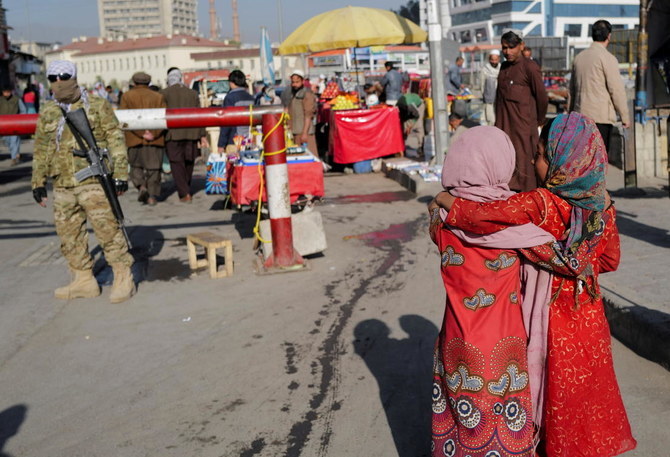
The Taliban, which won the war, are enemies of Daesh and have seen its attempts to impose law and order after the US pullout thwarted by suicide bombings and other attacks claimed by Daesh.
They include bombings targeting the minority Shiite sect and even a Daesh beheading of a member of a Taliban militia force in the eastern city of Jalalabad.
In testimony before the Senate Armed Services Committee, Kahl said it was still unclear whether the Taliban has the ability to fight Daesh effectively following the US withdrawal in August. The United States fought the Taliban as well as striking groups like Daesh and Al-Qaeda.
“It is our assessment that the Taliban and Daesh-K are mortal enemies. So the Taliban is highly motivated to go after Daesh-K. Their ability to do so, I think, is to be determined,” Kahl said, using an acronym for Daesh in Afghanistan.
Kahl estimated Daesh had a “cadre of a few thousand” fighters.
Acting Foreign Minister Amir Khan Muttaqi of the new Taliban government has said the threat from Daesh militants will be addressed. He also said Afghanistan would not become a base for attacks on other countries.
Kahl suggested Al-Qaeda in Afghanistan posed a more complex problem, given its ties to the Taliban. It was those ties that triggered the US military intervention in Afghanistan in 2001 following Al-Qaeda’s Sept. 11 attacks on New York and Washington. The Taliban had harbored Al-Qaeda leaders.
Kahl said it could take Al-Qaeda “a year or two” to regenerate the capability to carry out attacks outside of Afghanistan against the United States.
Democratic President Joe Biden, whose supervision of the chaotic end to the war last summer has damaged his approval ratings, has said the United States will continue to be vigilant against threats emanating from Afghanistan by carrying out intelligence-gathering operations in the country that would identify threats from groups like Al-Qaeda and Daesh.
Kahl said the goal was to disrupt those groups so that Daesh and Al-Qaeda don’t become capable of striking the United States.
“We need to be vigilant in disrupting that,” he said.
Still, US officials privately warn that identifying and disrupting groups like Al-Qaeda and Daesh is extremely difficult without any troops in the country. Drones capable of striking Daesh and Al-Qaeda targets are being flown in from the Gulf.
Kahl said the United States did not yet have any agreement with countries neighboring Afghanistan to host troops for counterterrorism efforts.


Daesh in Afghanistan could be able to attack US in 6 months-Pentagon official
https://arab.news/45frs
Daesh in Afghanistan could be able to attack US in 6 months-Pentagon official

- Afghanistan could still pose serious national security concerns for the US even after it ended its two-decade-old war in defeat in August
- Undersecretary of defense for policy said it was still unclear whether the Taliban has the ability to fight Daesh effectively following the US withdrawal


Jordan’s king, UK’s PM discuss Gaza, regional stability
- King Abdullah urges support for Syria’s efforts to protect its security, stability, sovereignty
- King also meets UK’s chief of defense staff during London visit
LONDON: The UK’s Prime Minister Keir Starmer met King Abdullah II of Jordan to discuss ways to support regional stability in the Gaza Strip and the West Bank, Downing Street said on Tuesday.
The meeting was also attended by Crown Prince Hussein and focused on the continuing need to advocate for increased access for humanitarian aid into Gaza.
It also aimed at supporting reforms within the Palestinian Authority to facilitate the ceasefire and help implement the US-led peace plan.
The parties praised the strong relationship between the UK and Jordan, especially in defense cooperation.
The king reaffirmed Jordan’s opposition to Israeli actions aimed at establishing settlements and asserting sovereignty over the occupied West Bank, according to the Jordan News Agency.
He emphasized the importance of implementing the US-backed agreement to end the war in Gaza. He also urged support for the efforts of the Syrian Arab Republic to protect its security, stability, and sovereignty, Petra added.
Deputy Prime Minister and Foreign Minister Ayman Safadi, the Director of His Majesty’s Office Alaa Batayneh, and Jordan’s Ambassador to the UK Manar Dabbas were also present at the meeting.
The king met on Monday in London Air Chief Marshal Richard Knighton, the UK’s chief of the defense staff. Their discussion centered on enhancing defense cooperation between Jordan and the UK. Maj. Gen. Yousef Huneiti, the chairman of Jordan’s joint chiefs of staff, also attended this meeting.
The king had met former British officials and members of Parliament prior to meeting Knighton. Discussions addressed the UK’s role in supporting efforts to restore stability within the region, alongside developments in Jerusalem, Gaza, Syria, and Iran.


