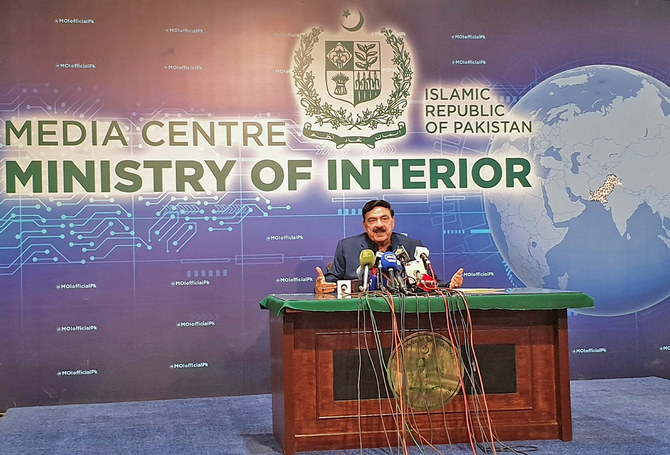
ISLAMABAD: Federal interior minister Sheikh Rashid Ahmed told a news conference on Tuesday the government was willing to accept all the Tehreek-e-Labbaik Pakistan (TLP) party’s demands but it was not in a position to shut down the French embassy or expel its ambassador.
Thousands of workers and supporters of the banned TLP religious faction decided to march on Islamabad on Friday, seeking the release of their top leader, Saad Rizvi, and demanding the expulsion of the French envoy to Pakistan over the caricatures of the Prophet Muhammad (PBUH) published in France last year.
The government formed a committee to negotiate with the group and pacify the situation while asking the TLP leaders to review their demand regarding the expulsion of the European envoy.
“The top issue of the TLP leadership is the closure of the French embassy and expulsion of the French ambassador,” Ahmed said while addressing the news conference, adding: “Pakistani security forces, its institutions and democratic government are on the same page and they have decided that all [of the TLP] demands are legitimate except for the one that relates to the French diplomatic mission.”
He said fulfilling the TLP demand could create significant problems for Pakistan that is already facing tough economic circumstances.
The minister urged Saad Rizvi and the consultative body of his religious faction to deliberate over the issue more carefully.
“We want them to review their demand,” he said.
Ahmed informed that Pakistan was also planning a conference of the foreign ministers of various Muslim countries, adding that the government did not want any unpleasant circumstances to emerge right ahead of that event.
Founded in 2015, the TLP religious group has made the sanctity of the Prophet Muhammad (PBUH) central to its politics.
Its leadership has also opposed any amendments to the country’s blasphemy laws and tried to put the government under pressure to adopt a more aggressive posture toward France after the repeated publication of the anti-Islam caricatures.


![]()

Pakistan refuses to expel French ambassador, asks banned religious group to review its demand
Short Url
https://arab.news/54jug
Pakistan refuses to expel French ambassador, asks banned religious group to review its demand
- Interior minister says military and civilian institutions agree expelling French envoy would create economic problems for Pakistan
- Urges TLP leader Saad Rizvi and the consultative body of his religious party to review their demand "more carefully"
Latest updates


© 2026 SAUDI RESEARCH & PUBLISHING COMPANY, All Rights Reserved And subject to Terms of Use Agreement.