

Ethiopia launches air strike on Tigray’s ‘western front’

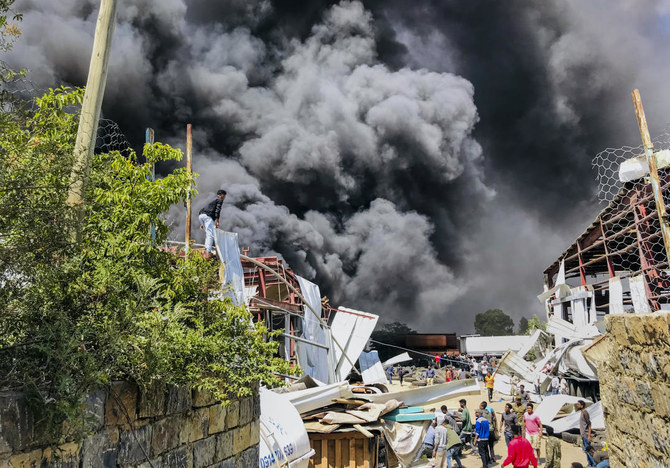
Above, smoke from fires billows at the scene of an earlier airstrike in Mekele, the capital of the Tigray region of northern Ethiopia on Oct. 20, 2021. (AP)
Short Url
Updated 24 October 2021
Follow

Ethiopia launches air strike on Tigray’s ‘western front’

  • The seventh aerial bombardment in the war-hit region this last week

ADDIS ABABA: Ethiopia’s military launched an air strike on a rebel-held facility in Tigray’s west on Sunday, a government official said, the seventh aerial bombardment in the war-hit region in a week.

“Today the western front of (Mai Tsebri) which was serving as a training and military command post for the terrorist group TPLF has been the target of an air strike,” government spokeswoman Selamawit Kassa said, referring to the Tigray People’s Liberation Front (TPLF).

Prime Minister Abiy Ahmed’s government has been locked in a war against the TPLF since last November, though Tigray itself had seen little combat since late June, when the rebels seized control of much of Ethiopia’s northernmost region and the military largely withdrew.

But on Monday Ethiopia’s air force launched two strikes on Tigray’s capital Mekele that the UN said killed three children and wounded several other people.

Since then there have been three more strikes on Mekele and another targeting what the government described as a weapons cache in the town of Agbe, about 80 kilometers (50 miles) to the west.

The strikes coincide with ramped-up fighting in Amhara region, south of Tigray.

They have drawn rebukes from Western powers, with the US last week condemning “the continuing escalation of violence, putting civilians in harm’s way.”

A strike Friday on Mekele forced a UN flight carrying 11 humanitarian personnel to turn back to Ethiopian capital Addis Ababa, and the UN subsequently announced it was suspending its twice-weekly flights to the region.

The conflict has spurred fears of widespread starvation, as the UN estimates it has pushed 400,000 people in Tigray into famine-like conditions.


Pakistani fighter jet crashes in Jalalabad, pilot captured: Afghan military, police

Updated 28 February 2026
Follow

Pakistani fighter jet crashes in Jalalabad, pilot captured: Afghan military, police

  • Fighting between Pakistan and Afghanistan’s Taliban military entered its third day on Saturday
  • Pakistan’s strikes on Friday hit Taliban military installations and posts, including in Kabul and Kandahar

JALALABAD: A Pakistani jet has crashed in Jalalabad city and the pilot captured alive, the Afghan military and police said Saturday, with residents telling AFP the man parachuted from the plane before being detained.
"A Pakistani fighter jet was shot down in the sixth district of Jalalabad city, and its pilot was captured alive," police spokesman Tayeb Hammad said.
Wahidullah Mohammadi, spokesman for the military in eastern Afghanistan, confirmed the Pakistani jet was downed by Afghan forces "and the pilot was captured alive".

The AFP journalist heard a jet overhead before blasts from the direction of the airport in Jalalabad, the capital of Nangarhar province, which sits on the road between Kabul and the Pakistani border.

Fighting between Pakistan and Afghanistan’s Taliban military entered its third day on Saturday, following overnight clashes as the international community expressed increasing concern about the conflict and called for urgent talks.

Pakistan’s strikes on Friday hit Taliban military installations and posts, including in Kabul and Kandahar, in one of the deepest Pakistani incursions into its western neighbor in years, officials said.

Islamabad accuses the Taliban of harboring Tehreek-e-Taliban Pakistan (TTP) militants, who it claims are waging an insurgency inside Pakistan, a charge the Taliban denies.

Pakistan described its actions as a response to cross-border assaults, while Kabul denounced them as a breach of its sovereignty, saying it remained open to dialogue but warned any wider conflict would result in serious consequences.

The fighting has raised ‌the risk ‌of a protracted conflict along the rugged 2,600-kilometer frontier.

Diplomatic efforts gathered ‌pace ⁠late on Friday ⁠as Afghanistan said its foreign minister, Amir Khan Muttaqi, spoke by telephone with Saudi Arabia’s Prince Faisal bin Farhan about reducing tensions and keeping diplomatic channels open.

The European Union called for both sides to de-escalate and engage in dialogue, while the United Nations urged an immediate end to hostilities.

Russia urged both sides to halt the clashes and return to talks, while China said it was deeply concerned and ready to help ease tensions.

The United States supports Pakistan’s right to defend itself against attacks by ⁠the Taliban, a State Department spokesperson said.

Border fighting continues

Exchanges of fire continued along ‌the border overnight.

Pakistani security sources said an operation dubbed “Ghazab Lil Haq” was ongoing and that Pakistani forces had destroyed multiple Taliban posts and camps in several sectors. Reuters could not independently verify the claims.

Both sides have reported heavy losses with conflicting tolls that Reuters could not verify. Pakistan said 12 of its ‌soldiers and 274 Taliban were killed while the Taliban said 13 of its fighters and 55 Pakistani soldiers died.

Taliban deputy spokesman Hamdullah Fitrat ⁠said 19 civilians were ⁠killed and 26 wounded in Khost and Paktika. Reuters could not verify the claim.

Pakistan’s Defense Minister Khawaja Muhammad Asif said “our cup of patience has overflowed” and described the fighting as “open war,” warning that Pakistan would respond to further attacks.

Taliban Interior Minister Sirajuddin Haqqani said in a speech in Khost province that the conflict “will be very costly,” and that Afghan forces had not deployed broadly beyond those already engaged.

He said the Taliban had defeated “the world, not through technology, but through unity and solidarity,” and through “great patience and perseverance,” rather than superior military power.

Pakistan’s military capabilities far exceed those of Afghanistan, with a standing army of hundreds of thousands and a modern air force.

In stark contrast, the Taliban lacks a conventional air force and relies largely on light weaponry and ground forces.

However, the Islamist group is battle-hardened after two decades of insurgency against US-led forces before returning to power in 2021.