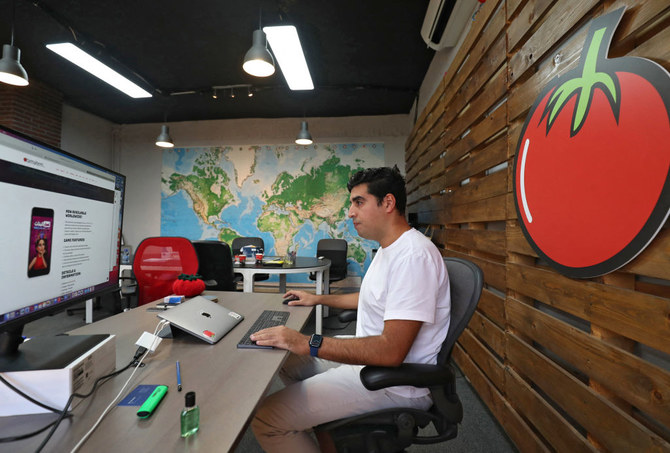

Its logo is a tomato, not an apple, but in just eight years Jordanian company Tamatem has already bitten a chunk out of the lucrative market for Arabic mobile games.
"Less than one percent of internet content is in Arabic, even though there are 400 million Arab users," said the company's founder and CEO Hussam Hammo.
"There is a very big gap in this market that we are trying to fill," added the 38-year-old entrepreneur, sitting in his elegant Amman offices.
Hamo founded Tamatem - which means tomato - in 2013 and it was the first Arab company to win investment from the "500 Startups" programme based in Silicon Valley, California.
Eight years on the company has grown to about 80 staff who convert mobile phone games into Arabic, also adapting content to fit Arab culture.
"Language was a barrier to mobile games growth" in the region, said Nour Khrais, founder and chief executive of games developer Maysalward.
"The Arabic language connects (the player) emotionally."
With offices now in the United Arab Emirates and Saudi Arabia, Tamatem has published more than 50 mobile games, which have been downloaded more than 100 million times on Apple and Google Play stores.
"Seventy percent of smartphone users in the Arab world have set their phones in Arabic, which means they like to use content in their mother language," said Hammo.
"Sadly when you search in English for a game in app stores you will find millions of games, but when you search in Arabic there are only a few thousand," he added.
But competition is fierce, and Khrais said the Middle East and North Africa region was "the largest growth region in the world in the field of electronic games".
Market analysts Mordor Intelligence said the global gaming market in 2020 was valued at $174 billion, and was expected to reach $314 billion in 2026.
Tamatem, which has partnerships with companies in the US, China, France, South Korea, Bulgaria and Croatia, converts games by replacing characters' voices and names, adapting music and clothing, adding Muslim holidays like Ramadan and even changing car licence plates.
"We don't only do translation, we do the most important thing which is educating by making the content relevant to the Arab culture," said chief operating officer Eyad Al Basheer.
"Hollywood Story" from Nanobit.com, in which players can become movie stars, strut the red carpet, hang out with fans and even shoot blockbusters, was renamed "Malekat al Moda" -- or "Queen of Fashion".
Instead of locations in New York and Los Angeles, the avatars travel between Dubai, Beirut and Cairo, in an Arabic game which has now been downloaded more than 15 million times.
Strategy multiplayer and civilisation-building game "Clash of Empire" from developer Leme Games launched its Arabic version "Tahadi Al-Molouk" or "Challenge of Kings" this year.
To fit Arab audiences, the figure of the notorious crusader Richard the Lionheart has been replaced by legendary dynastic Muslim leader, Salah al-Din al-Ayubi.
One of the company's biggest hits is "Shake the Metal" which taps into the popular sport of drifting. Featuring car models beloved in the Arab world, it has now been downloaded five million times.
The most popular of Tamatem's Arabic mobile games however, is "VIP Belote", which is based on the French card game and has been downloaded more than 20 million times.
In a 2019 report by the World Economic Forum, Tamatem was chosen as one of the best 100 Arabic companies "shaping the fourth industrial revolution".
And the Covid-19 pandemic has proved a boon, with the number of mobile gamers soaring by 150 percent, Hammo said.
"Tamatem made games easier, and we understand things that we didn't understand before, because it was in English," said player Khader Hamid, a 28-year-old civil engineer.
Mona Rummaneh, a 30-year-old working in e-marketing, said Arabic games left her "confident that all the content is appropriate for our culture and morals".
She recalled how after the Beirut port explosion in August 2020, she and other gamers voiced their solidarity with Lebanese players.
"So it is more than just a game," she said.