Swedish teen rapper killed in Stockholm shooting

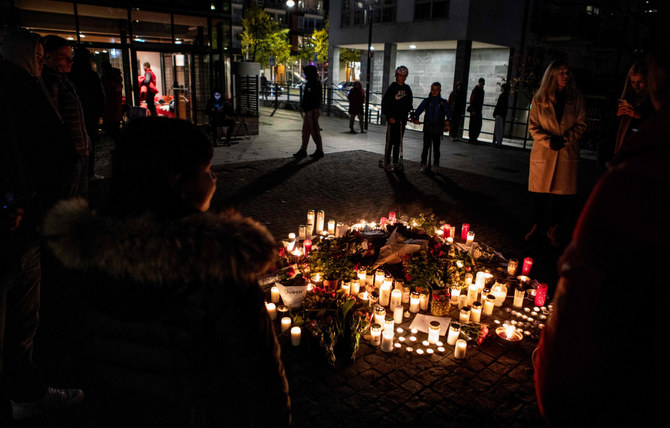
People lay flowers and candles near a crime scene in the Hammarby Sjostad district in Stockholm on October 22, 2021 after e Swedish rap artist Einar, officially named Nils Kurt Erik Einar Gronberg, was shot dead late on October 21. (AFP)
Short Url
Updated 23 October 2021
Follow

Swedish teen rapper killed in Stockholm shooting

  • The son of Swedish actress Lena Nilsson, Einar grew up in southern Stockholm and often referred to the criminal scene in the area in his work

STOCKHOLM: Award-winning Swedish rapper Einar, who has topped the country’s charts, was shot and killed in Stockholm, police and media said Friday as police hunted for suspects.

The 19-year-old Einar, who raps in Swedish, was the most streamed artist on Spotify in Sweden in 2019.

He was shot several times outside an apartment building shortly before 11 p.m. (2100 GMT) on Thursday.

Ambulance personnel administered first aid but he died at the scene, Stockholm police spokeswoman Towe Hagg told AFP.

Police have opened a murder investigation.

“We are actively working to figure out why it happened and who can be behind it,” Hagg said.

In line with usual practice, the police have not yet confirmed the identity of the victim. But Sweden’s mainstream media identified him as Einar, whose full name is Nils Kurt Erik Einar Gronberg.

Many of Einar’s songs reference a life of crime, including drugs and weapons. He had public feuds with rival artist Yasin, who in July was jailed for 10 months for his role in a planned kidnapping of Einar in 2020.

The plan was ultimately aborted, but Einar was abducted several weeks later without Yasin’s involvement.

Einar was beaten, robbed, photographed in humiliating conditions and blackmailed, according to prosecutors.

The kidnapping was part of a broader case involving 30 suspects in a criminal network accused of a variety of crimes.

Among the suspects was another rapper, Haval Khalil, who was sentenced in July to two-and-a-half years in prison for complicity in the kidnapping and who has also had public spats with Einar.

The verdict was appealed and the case is currently being heard by the Svea Court of Appeal, which is expected to go on until December.

Einar had been called to attend the trial as a plaintiff, but was not planning to do so, his lawyer Rodney Humphreys told AFP.

“The same way he didn’t attend the trial in the district court,” Humphreys said.

The Aftonbladet newspaper reported Friday that Einar was living with a “price on his head” after a series of threats against him which had escalated recently.

Einar himself was one of several suspects arrested for a stabbing at a restaurant in central Stockholm earlier this month.

The son of Swedish actress Lena Nilsson, Einar grew up in southern Stockholm and often referred to the criminal scene in the area in his work.

He started his career posting songs to social media, and broke through in 2019 releasing “Katten i trakten” (The cat in the area), which hit No. 1 on Sweden’s singles chart.

He won several music awards, including Swedish Grammis.

Fans and friends expressed their grief on Einar’s social media.

“Einar was a real brother to me and I will miss him so much. We just released our first record last week and it feels so strange since I spoke to him just a day ago,” producer Trobi wrote on Instagram.

Prime Minister Stefan Lofven said that “it is a young life that has been lost, and I understand that he meant a lot to many young people”.

“It’s tragic that another life has been lost,” he told news agency TT.

Another lesser-known Swedish rapper, 23-year-old Rozh Shamal, was also killed in a 2019 gangland shooting.

Sweden has in recent years struggled to rein in rising shootings and bombings -- usually settlings of scores by gangs and organised crime involved in drug trafficking.

As of October 15, 273 shootings had been recorded with 40 people dead so far in 2021, according to police statistics.

During 2020, 47 people were killed in 366 shootings in the country of 10.3 million people.


Trump raises the possibility of a ‘friendly takeover of Cuba’ coming out of talks with Havana

Updated 4 sec ago
Follow

Trump raises the possibility of a ‘friendly takeover of Cuba’ coming out of talks with Havana

WASHINGTON: President Donald Trump said Friday that the US is in talks with Havana and raised the possibility of a “friendly takeover of Cuba” without offering any details on what he meant.
Speaking to reporters outside the White House as he left for a trip to Texas, Trump said Secretary of State Marco Rubio was in discussions with Cuban leaders “at a very high level.”
“The Cuban government is talking with us,” the president said. “They have no money. They have no anything right now. But they’re talking to us, and maybe we’ll have a friendly takeover of Cuba.”
He added: “We could very well end up having a friendly takeover of Cuba.”
Trump didn’t clarify his comments but seemed to indicate that the situation with Cuba, a communist-run island that has been among Washington’s bitterest adversaries for decades, was coming to a critical point. The White House did not respond to requests for more information Friday.
The president also said that Cuba “is, to put it mildly, a failed nation” and “they want our help.”
His remarks came two days after the Cuban government reported that a Florida-registered speedboat carrying 10 armed Cubans from the US opened fire on soldiers off the island’s north coast. Four of the armed Cubans were killed, and six were injured in responding gunfire, according to Cuba’s government. One Cuban official also was injured.
Cuba has been on Trump’s mind since at least early January, after US forces ousted one of Havana’s closest allies, Venezuela’s socialist President Nicolás Maduro. Trump suggested in the aftermath of that raid that military action in Cuba might not be necessary because the island’s economy was weak enough — particularly in the absence of oil shipments from Venezuela that stopped after Maduro was taken into custody — to soon collapse on its own.
“We’ve had a lot of years of dealing with Cuba. I’ve been hearing about Cuba since I’m a little boy. But they’re in big trouble,” he said Friday.
Then, noting the exile community from the island living in the US, Trump said there could be something coming that “I think  very positive for the people that were expelled, or worse, from Cuba and live here.” He did not elaborate.
The US has maintained a strict trade embargo on Cuba since 1962, the year after a failed, CIA-sponsored invasion of the island at the Bay of Pigs. Trump nonetheless indicated earlier this month that talks with Cuban officials were underway.
Cuba’s government confirmed earlier this week that it was communicating with US officials following the shooting of the American boat. Rubio has said the US Department of Homeland Security and Coast Guard are investigating what happened.
An executive order that Trump signed in late January pledged to impose tariffs on countries providing oil to Cuba, threatening to further cripple a country already plagued by a deepening energy crisis, though US authorities have since indicated that oil from Venezuela can be sold to Cuban interests in some cases.
Carlos Fernández de Cossío, Cuba’s deputy foreign minister, posted, then later deleted on Friday that “the US maintains its fuel embargo against Cuba in full force, and its impact as a form of collective punishment is unwavering.”
“Nothing announced in recent days changes this reality,” he wrote on X before the post was removed. “The possibility of conditional sales to the private sector already existed and does not alleviate the impact on the Cuban population.”
Meanwhile, 40-plus US civil society organizations sent a letter to Congress on Friday asking that it “press the Trump administration to reverse its aggressive policy toward Cuba” and saying that efforts to cut oil shipments to the Caribbean island would spark a humanitarian collapse.
Signees included the Alliance of Baptists, ActionAid USA and the Presbyterian Church.
“Policies that deliberately impose hunger and mass hardship on millions of civilians constitute a form of collective punishment, and as such are a grave violation of international humanitarian law,” the letter reads.