MALUALKON, South Sudan: He feels like a man who has drowned.
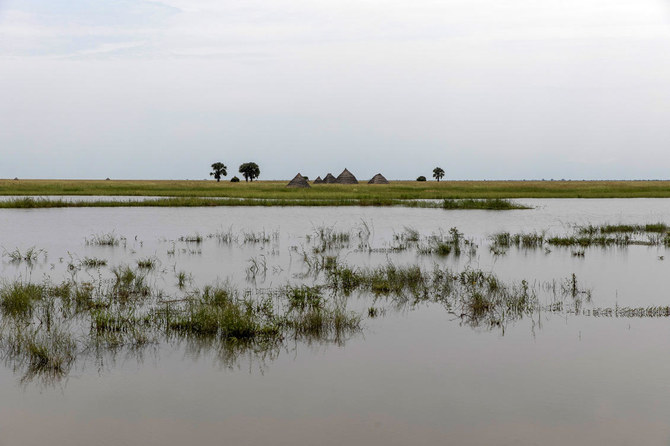
The worst flooding that parts of South Sudan have seen in 60 years now surrounds his home of mud and grass. His field of sorghum, which fed his family, is under water. Surrounding mud dykes have collapsed.
Other people have fled. Only Yel Aguer Deng’s family and a few neighbors remain.
This is the third straight year of extreme flooding in South Sudan, further imperiling livelihoods of many of the 11 million people in the world’s youngest country. A five-year civil war, hunger and corruption have all challenged the nation. Now climate change, which the United Nations has blamed on the flooding, is impossible to ignore.
As he empties a fishing net, Daniel Deng, a 50-year-old father of seven, recalls a life of being forced to flee again and again because of insecurity. “But this one event (the flood) is too much,” he said. “It is the worst thing that happened in my lifetime.”
The UN says the flooding has affected almost a half-million people across South Sudan since May. Here in Northern Bahr el Ghazal state, the Lol river has burst its banks.
This state is usually spared from extreme flooding that plagues the South Sudan states of Jonglei and Unity that border the White Nile and the Sudd marshlands. But now, houses and crops have been swamped.
A new report this week coordinated by the World Meteorological Organization warned of increasing such climate shocks to come across much of Africa, the continent that contributes the least to global warming but will suffer from it most.
In these rural South Sudan communities, shelters of braided grass put up a fragile resistance in a land of seemingly endless water.
In Langic village, Ajou Bol Yel’s family of seven hosted nine neighbors who had lost their homes. The elders sleep outside on beds protected by mosquito nets, while the children share the floor.
In Majak Awar, some 100 families have been displaced twice, in June when homes were flooded and again in August when their shelters were ruined, too.
“I want to leave for Sudan,” whispered Nyibol Arop, a 27-year-old mother of five, as she boiled her morning tea just steps away from the stagnant water that threatens her current shelter.
It is hard to see a stable future when constantly on the move, a lesson learned during the civil war that displaced millions of people before a peace agreement in 2018.
“Floods are not constant. Some people will stay, and some will go,” said Thomas Mapol, a 45-year-old father of nine, as he showed off the destroyed houses of his village near Majak Awar. “But me, I cannot move anywhere. There is no other place that I know.”


![]()

In South Sudan, flooding called ‘worst thing in my lifetime’
Short Url
https://arab.news/gq6xv
In South Sudan, flooding called ‘worst thing in my lifetime’
- This is the third straight year of extreme flooding in South Sudan
- The UN says the flooding has affected almost a half-million people across South Sudan since May


Latest updates


© 2026 SAUDI RESEARCH & PUBLISHING COMPANY, All Rights Reserved And subject to Terms of Use Agreement.