

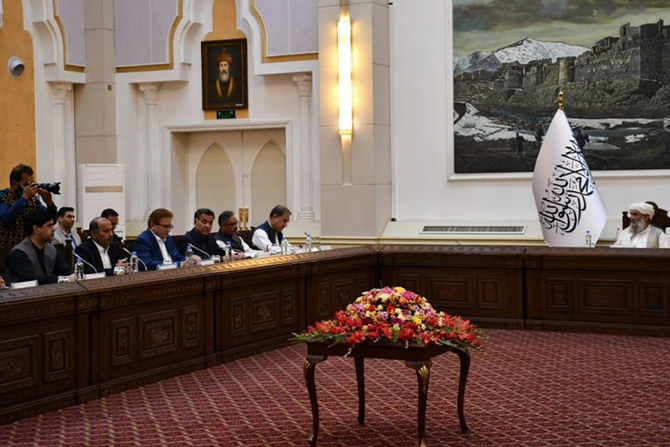

ISLAMABAD: Pakistan’s foreign minister Shah Mahmood Qureshi on Thursday told journalists in Kabul a Taliban delegation would visit his country “in the next few days” to address bilateral issues and further strengthen the relations between the two countries.
The foreign minister went to Afghanistan earlier today on his first visit since the Taliban overran the neighboring state in mid-August, the Pakistani foreign office said, with an aim to hold talks to cover “entire spectrum” of bilateral relations.
Qureshid is the highest-ranking Pakistani official to visit Kabul since the Taliban announced their interim government in early September and was accompanied by the Pakistani intelligence chief, Lt. Gen. Faiz Hamid.
Speaking to journalists after an elaborate meeting with Taliban officials, he said he had exchanged views with the Afghan interim prime minister Mullah Hassan Akhund and nearly all members of his cabinet.
Qureshi added he was accompanied by a number of Pakistani officials who were continuing working group discussions with their Afghan counterparts to thrash out significant issues.
“A Taliban delegation will also visit Islamabad in the next few days to carry forward these discussions,” he said while pointing out that the continued conversation would help the two states finalize bilateral issues and further consolidate their relationship.
The foreign minister said he had a useful interaction with the Taliban administration in which the two sides discussed a range of issues to set the strategic direction of their future relationship.
“It was a very fruitful meeting,” he told journalists in a brief video interview posted on Twitter. “We discussed almost all issues related to the future trade, transportation and regional connectivity.”
Prior to his brief media interaction, Qureshi had told the Afghan interim prime minister that Islamabad would continue to provide humanitarian assistance to Kabul.
The foreign office announced in a statement issued before his departure from Pakistan that the talks between the two sides would cover the “entire spectrum” of bilateral relations and focus on ways and means to deepen cooperation in diverse areas.
“Utilizing the opportunity, the foreign minister will share Pakistan’s perspective on issues of regional peace and stability,” the statement added.
Since the fall of Kabul, Pakistan has been at the center stage of almost all developments in Afghanistan, be it the evacuation of foreign diplomats, aid workers and vulnerable Afghans, efforts to avert a humanitarian crisis or the formation of an inclusive government in the war-battered country.
On Wednesday, Islamabad urged the international community to continue its economic engagements with Afghanistan and unfreeze the Afghan financial assets parked in other countries.
Pakistan’s special representative for Afghanistan, Ambassador Muhammad Sadiq, highlighted the issue while addressing a conference in Moscow that brought together officials from various regional countries, including representatives of Afghanistan’s new Taliban government.
The international community froze nearly $10 billion of Afghanistan’s financial assets in other countries after the fall of Kabul on August 15 since the money was viewed as a key instrument to mount political pressure on the Taliban.
“Foreign minister’s visit reflects Pakistan’s consistent policy of supporting the brotherly Afghan people, deepening bilateral trade and economic relations, and facilitating closer people-to-people contacts,” the foreign office statement read.
Last week, the Pakistani government also started a free online visa service for neighboring Afghanistan and abolished the $8 fee for it as a “goodwill gesture.”


