

Supreme Court says no evidence of Zahir Jaffer’s mother’s involvement in murder, grants bail

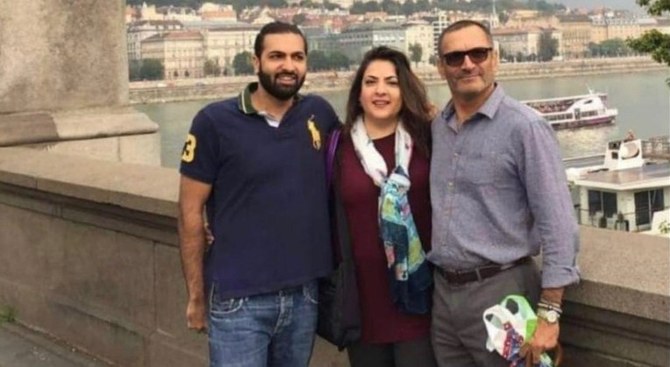
In this undated photo, Zahir Jaffer (left) poses for a pictures with his mother Asmat Adamjee (center) and his father Zakir Jaffer (right) in UK. (Photo courtesy: Social media)
Short Url
Updated 18 October 2021
Follow

Supreme Court says no evidence of Zahir Jaffer’s mother’s involvement in murder, grants bail

  • Top court rejects bail plea of Zakir Jaffer, father of key accused in Noor Mukadam murder case
  • Last week court indicted 12 people in the case, trail to be most closely watched in recent history

ISLAMABAD: The Pakistani Supreme Court on Monday granted bail to Asmat Adamjee, the mother of Zahir Jaffer, the key accused in July’s gruesome murder and beheading of Noor Mukadam, local media reported.
Mukadam, 27, was found beheaded at a residence in Islamabad’s upscale F-7/4 neighborhood on July 20 in a case that has sparked public outrage and grabbed media attention unlike any other recent crime against women. Key suspect Zahir Jaffer was arrested from the crime scene on the day of the murder.
Last week, a district and sessions court in Islamabad indicted 12 people, including the main accused Jaffer, for their alleged involvement in the murder of Mukadam, the daughter of a former Pakitani diplomat.
Others against whom charges were framed include Jaffer’s parents, Zakir Jaffer andAdamjee, their three household staff, Iftikhar, Jan Muhammad and Jameel, and six workers from Therapy Works, a counselling center from where Jaffer had received certification to become a therapist and where he had been receiving treatment in the weeks leading up to the murder.
“Apparently, there’s no evidence of Asmat Adamjee’s involvement in the case,” Justice Umar Atta Bandial was reported by Pakistani media as saying in court.
A Twitter account run by the Mukadam family said: “Supreme Court has granted bail to Asmat Adamjee, mother of Zahir Jaffer in Noor Mukadam murder case.”


Bail was granted against a surety bond of one million rupees.
Zahir’s parents were taken into custody on July 25 for alleged abetment and concealment of evidence, among other charges filed against them. They have since been in custody.
At last week’s indictment hearing, Jaffer said he had committed the “crime” but appealed to the judge to release him from jail and put him under house arrest.
The court has now summoned witnesses on October 20 to record their statements and plans to complete the trial of all twelve suspects within eight weeks as ordered by the Islamabad High Court.


Pakistan’s Mahnoor Omer named among TIME’s ‘Women of the Year’ for 2026

Updated 01 March 2026
Follow

Pakistan’s Mahnoor Omer named among TIME’s ‘Women of the Year’ for 2026

  • Omer moved a Pakistani court against the so-called ‘period tax’ in Sept. 2025 which has since sparked a national debate
  • Taxes on sanitary pads in Pakistan can add up to 40 percent to retail price, UNICEF says only around 12 percent women use such products

ISLAMABAD: Pakistani women’s rights activist Mahnoor Omer, who fought against taxes on menstrual products, has been named among the TIME magazine’s ‘Women of the Year’ for 2026.

Omer’s efforts have been recognized alongside 16 activists, artists, athletes and businesswomen in the TIME’s Women of the Year 2026 list, including Olympic gold medalist Sydney McLaughlin-Levrone and Oscar-nominated filmmaker Chloe Zhao.

Dissatisfied with the efforts to educate Pakistani girls about sexual violence, Omer founded the Noor Foundation at the age of 14 and held her own workshops with village girls about everything from climate change to menstruation, according to the TIME magazine.

Two years later, a conversation with a domestic worker about the price of pads made her realize that not everyone could afford these essentials. She moved a court against the so-called “period tax” in Sept. 2025 and the case has sparked a national debate on the subject, considered a taboo by many in Pakistan, since its first hearing late last year.

“A decade and one law degree after her interest in activism was sparked, Omer, now 25, is putting her passion and expertise to work in the name of gender equity,” TIME wrote about Omer on its website.

Taxes imposed on sanitary products in Pakistan can add up to 40 percent to the retail price. UNICEF estimates just 12 percent of women in the country use commercially produced pads or tampons. The alternative, using cloth, risks health impacts including rashes and infections, and can make it impossible for girls to attend school while menstruating.

Omer’s suit, which awaits the government response, has sparked a national discussion. She says she spoke about menstruation to her father and male cousins, who thanked her for standing up for their daughters.
The 25-year-old, who is currently enrolled in a master’s degree in gender, peace, and security at the London School of Economics, sees this case as just the first of many.

“I’m not free until every woman is free,” she was quoted as saying by TIME. “I want to leave no stones unturned in terms of what I can do with the next few decades, as a lawyer for the women in my country and gender minorities in general.”