

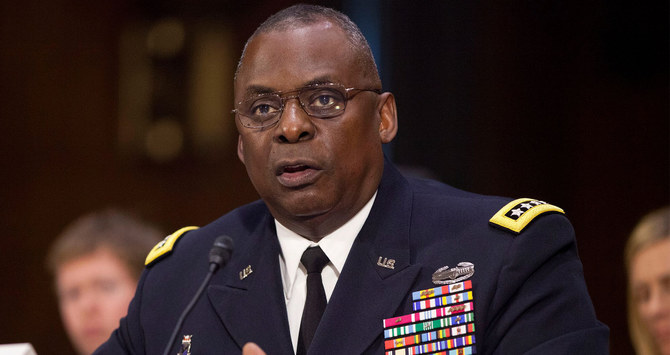

WASHINGTON: US Defense Secretary Lloyd Austin headed to the Black Sea region Sunday aiming to shore up alliances with countries pressured by Russia and show gratitude for their contributions to the two-decade war in Afghanistan.
Austin will visit Georgia, Romania and Ukraine before taking part in the in-person defense ministers summit at NATO in Brussels on Oct. 21-22.
“We are reassuring and reinforcing the sovereignty of countries that are on the front lines of Russian aggression,” a senior US defense official told reporters ahead of the trip.
All three countries are in the NATO orbit — Romania a full member and Georgia and Ukraine partner states.
All three also sit on the rim of the Black Sea, where Russia has sought to expand its own influence and prevent expansion of the North Atlantic Treaty Organization, the US-European alliance.
Russia has occupied Ukraine’s Crimea and has troops stationed in Georgia’s breakaway regions of Abkhazia and South Ossetia. And Kiev is battling pro-Russian separatists in the country’s east, in a conflict that has cost 13,000 lives.
In June, Russian forces menaced Dutch and British warships as they sailed near Crimea.
Austin will also extend thanks to its partners for their contributions, and significant losses, as part of coalition forces in Afghanistan over two decades, before the hasty US exit this year that ceded the country to the Taliban.
“We are going to be showing recognition and appreciation for the sacrifices and the commitments of our partners and allies,” the official said. In Georgia, Austin will meet with Prime Minister Irakli Garibashvili and Minister of Defense Juansher Burchuladze, with a key aim to keep up defense cooperation as a three-year US Army training program expires this year.
Georgia hopes Austin’s visit will help advance its case for becoming a full NATO member.
It will be “another clear message from the US in support of Georgia’s sovereignty and territorial integrity, its stable and democratic development, and for the country’s Euro-Atlantic goals” Foreign Minister David Zalkaliani said Wednesday.
“We expect that meetings will be focused on further deepening our cooperation, regional security issues, and the process of Georgia’s NATO integration,” he said.
In Ukraine, Austin will have talks with President Volodymyr Zelensky and Minister of Defense Andriy Taran, both of whom visited Washington at the beginning of September to press their case for NATO membership with President Joe Biden.
And in Romania, he will see President Klaus Iohannis and Minister of National Defense Nicolae-Ionel Ciuca, amid a fresh political crisis in the country.
In all three, the US wants to expand defense support but also sees problems of democratic development and corruption.
In Georgia, tens of thousands of protesters were out in the streets this week over the arrest of ex-president and opposition leader Mikheil Saakashvili and over allegations of fraud in recent elections.
Ukraine is under heavy pressure from the West, which provides the country extensive aid, to halt rampant graft.
“It is our belief that strengthening democratic institutions creates greater resilience against Russian influence and external manipulation,” the US official said.
“Our bilateral assistance is actually very much focused on the specific aspects of institutional reform that are necessary for NATO. And that applies to both Georgia and to Ukraine.”
Austin will end the week at NATO headquarters in Brussels, where ties with the US, frayed by the previous administration of Donald Trump, took a fresh hit last month when Washington unexpectedly announced a new pact with Australia and Britain focused on China in the Indo-Pacific region.
The US official said Austin would reinforce US commitment to the pact and press for military adaptation to address future threats.
“NATO needs to keep building its credible deterrence capabilities for its deterrence and defense mission,” the official said.


