

Chip shortage and power crunch hit China auto sales in 'Golden September'

1 / 2
2 / 2
Getty Images
Short Url
Updated 12 October 2021
Follow

Chip shortage and power crunch hit China auto sales in 'Golden September'

  • The sales drop was due to the domestic power crunch caused partly by the shortage of coal and prolonged global chip shortage

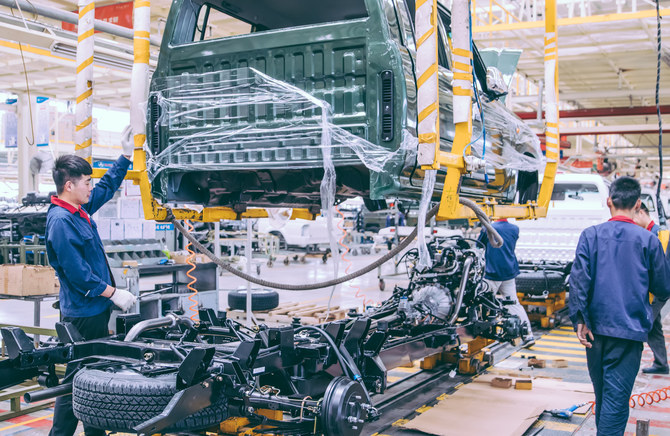
China's auto sales slumped 19.6 percent in September from a year earlier, industry data showed on Tuesday, falling for a fifth consecutive month as a prolonged global shortage of semiconductors and a domestic power crunch disrupt production.


This time of year, known as "Golden September, Silver October", is usually a high point in sales for the industry, with consumers making purchases after staying away from showrooms during the stifling summer months.


Sales in the world's biggest car market totalled 2.07 million vehicles in September, data from the China Association of Automobile Manufacturers (CAAM) showed.


The sales drop was due to the domestic power crunch caused partly by the shortage of coal and prolonged global chip shortage that has forced many major automakers to idle or curtail production, said Chen Shihua, a senior official at CAAM.


He added that the chip supply shortage eased in China last month and that the industry body now expects the supply to improve further in the final three months this year but constraints would remain.


One bright spot in the data was the strong sales of new energy vehicles (NEV), which more than doubled in September to 357,000, thanks to the government's promotion of greener vehicles to cut pollution. These include battery-powered electric vehicles, plug-in petrol-electric hybrids and hydrogen fuel-cell vehicles.


Tesla Inc, which is making Model 3 sedans and Model Y sport-utility vehicles in Shanghai, sold 56,006 China-made vehicles in September, the highest since it started production in Shanghai about two years ago, and up 27 percent from 44,264 in August.


Chinese EV makers Nio Inc and Xpeng Inc delivered over 10,000 vehicles each last month. Volkswagen AG said it sold 10,126 ID. series EVs in China in September.


Another CAAM official, Xu Haidong, said NEV sales likely to hit three million units this year, up from 1.4 million last year.


Oman tourism strengthens as hotel guests hit 2.14m, revenues rise 21% 

Updated 7 sec ago
Follow

Oman tourism strengthens as hotel guests hit 2.14m, revenues rise 21% 

JEDDAH: Oman’s tourism sector strengthened through November, with hotel guest numbers rising to 2.14 million and revenues at higher-end properties jumping more than 21 percent, supported by events and air travel. 

Hotel revenues at three- to five-star properties reached nearly 258 million Omani rials ($670 million), up from 212.4 million rials during the same period in 2024, while average occupancy increased to 55.4 percent from 48.6 percent, according to official data published by the Oman News Agency. 

Domestic tourism continued to underpin growth, with Omani guests increasing 7 percent to 791,286. Visitors from Gulf Cooperation Council countries rose 7.4 percent to 195,825, while arrivals from other Arab nations slipped 1.6 percent to just over 94,000.  

“These indicators reflect the positive performance of Oman’s hotel sector, supported by the ongoing growth in tourism activity,” the ONA report stated. 

International demand strengthened across key markets. Guests from Asia increased by 10 percent to 305,460, and African visitors rose by 19.3 percent to 13,246, while European arrivals jumped 23 percent to 574,243.  

Travelers from the US increased nearly 30 percent to 69,697, and arrivals from Oceania surged 35.5 percent to 38,028. African visitors rose 19.3 percent to 13,246.  

Growth in leisure travel was complemented by expanding business and events activity. The Oman Convention and Exhibition Center generated a direct economic impact of nearly 15 million rials in 2025, hosting regional and international events that attracted 20,000 participants and investors from around 60 countries, ONA reported. 

Said bin Salim Al-Shanfari, CEO of OCEC, said the center’s achievements reflect its role as a national platform that directly supports the economy while enhancing Oman’s competitiveness in conferences, exhibitions, and events.  

He highlighted that OCEC hosted over 250 local, regional, and international events, attracting more than 1.9 million visitors, participants, and investors. He also emphasized the center’s support for over 100 small and medium-sized enterprises and graduation ceremonies for 65,000 students, reinforcing its social and economic role. 

Cultural and artistic events, including concerts and exhibitions, attracted more than 11,000 visitors, contributing to longer stays and higher hotel occupancy. 

The CEO concluded that OCEC is progressing confidently, utilizing strategic partnerships to attract more events and strengthen its role as a hub that connects business, culture, and society while boosting Oman’s regional and international standing. 

Air travel data reinforced the recovery trend. Passenger numbers at Muscat International Airport rose 1.8 percent to nearly 11.94 million by the end of November, even as total flights declined 4.1 percent to 84,296. 

“The data showed that international flights at Muscat International Airport totaled 75,460, down 5.2 percent, carrying 10.72 million passengers, up 0.7 percent. Meanwhile, domestic flights rose 6.7 percent to 8,836, carrying around 1.22 million passengers, a 12.5 percent increase,” a separate ONA report stated, citing NCSI. 

At Salalah Airport, passengers rose 10 percent to over 1.57 million, while total flights increased around 6 percent to 10,237. International flights totaled 4,489, carrying 622,198 passengers, down 0.7 percent, while domestic flights rose 13.6 percent to 5,748, carrying 952,098 passengers, up 18.3 percent.