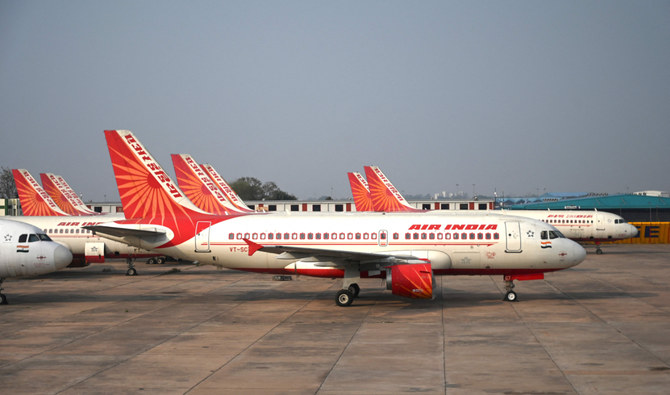
NEW DELHI: Tata Sons, the holding company of Tata Group, India’s oldest conglomerate, has won the bid to acquire the debt-laden national flag carrier Air India, the Indian government said on Friday, almost seven decades after the airline founded by the group was taken over by the state.
Air India, founded as Tata Airlines in 1932, was nationalized in 1953. It has been running at a loss since 2007, with an estimated total debt of more than $8.1 billion.
The government said that only one-fourth of Air India’s debt will be incurred by the bidder, while the remaining amount would go to state-owned Air India Assets Holding Limited.
“We received two financial bids on Sept. 15. A panel of ministers cleared the winning bid. Tata is the winning bid,” Department of Investment and Public Asset Management Disinvestment Secretary Tuhin Kanta Pandey announced in a press conference in New Delhi.
“Tata presented a winning bid of RS18,000 crores ($2.4 billion),” Pandey said. “The transaction is expected to close by the end of December 2021.”
Civil Aviation Secretary Rajiv Bansal said during the same conference that the airline will be retained by Tata during the first year after the takeover.
“The current bidder will retain all the current employees of Air India for the first year. In the second year, they will see who to retain and can also give voluntary retirement from service,” Bansal said. “As of today, there are 12,085 employees in Air India, out of which 8,084 are permanent and 4,001 are contractual. Besides this, Air India Express has an employee strength of 1,434.”
Budget carrier Air India Express is a subsidiary of Air India.
Former head of Tata Group and chairman emeritus Ratan Tata welcomed the airline’s return to its fold.
“On an emotional note, Air India, under the leadership of J.R.D. Tata had, at one time, gained the reputation of being one of the most prestigious airlines in the world,” Tata said in a statement issued by the group. “While admittedly it will take considerable effort to rebuild Air India, it will hopefully provide a very strong market opportunity to the Tata Group’s presence in the aviation industry.”
He added: “Tata will have the opportunity of regaining the image and reputation it enjoyed in earlier years. Mr. J.R.D. Tata would have been overjoyed if he was in our midst today.”
India’s first licensed pilot, J.R.D. Tata established the airline and used to fly mail between Mumbai and Karachi — which after the end of British colonial rule became a part of neighboring Pakistan.
Air India former executive director Jitendra Bhargava told Arab News that the airline’s return to the group will have a sizable impact on the country’s aviation industry. “It is a historic decision by the government to disinvest Air India,” he said. “This will have multiple effects on Indian aviation, one is that Air India will get a fresh lease of life, and second, all the carriers which were competing with the weak Air India will now have to compete with a strong Air India in a few months after the Tata takeover.”


![]()

Air India returns to Tata Group in $2.4bn deal
Short Url
https://arab.news/22wuy
Air India returns to Tata Group in $2.4bn deal
- The government said that only one-fourth of Air India’s debt will be incurred by the bidder


Latest updates


© 2026 SAUDI RESEARCH & PUBLISHING COMPANY, All Rights Reserved And subject to Terms of Use Agreement.