QUETTA: Survivors of a devastating earthquake that killed at least 23 people on Thursday and flattened out hundreds of mud houses in a remote district in Pakistan’s southwestern Balochistan province blamed the high death toll on inadequate medical facilities in the area.
According to the US Geological Survey, the 5.9 magnitude earthquake that jolted the country’s biggest province earlier in the day had its epicenter in Harnai district which experienced significant loss of life and property.
Abdul Wahid Baloch, a 43-year-old resident of the area, said he was sleeping at about 3am when he felt strong tremors.
“I ran toward the door but the roof made of mud collapsed over my head and I almost got buried in the debris,” he said. “I started screaming and was rescued by my nephew who then shifted me to a hospital. We received no treatment until medical teams arrived from Quetta.”
Baloch said he saw dozens of injured people on the floor of the District Headquarters (DHQ) Hospital since there were not enough beds.
It was difficult to carry out timely rescue operations, he added, and provide necessary medical facilities due to the lack of resources in the area. The power also remained cut for hours and there was no mobile phone connectivity.
More than 100 mud houses collapsed and many buildings were damaged, district official Sohail Anwar told media. Television images showed buildings with gaping cracks, caved-in roofs and crumpled walls.
About 250 homes collapsed and many people were killed by falling roofs and crumbling walls in the district’s Babu Mohallah neighborhood, Nawab Khan, a local journalist, told Reuters.
Earlier in the day, Prime Minister Imran Khan shared his condolences with families who lost their loved ones in the powerful earthquake.
“I have ordered immediate assistance on an emergency basis for the Harnai, Balochistan, earthquake victims & for an immediate assessment of the damage for timely relief & compensation,” he said in a Twitter post. “My condolences & prayers go to the families who lost their loved ones.”
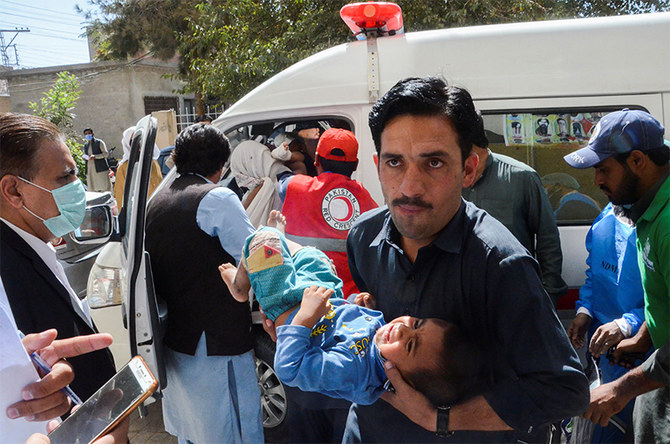
Director General of the Provincial Disaster Management Authoroty Naseer Ahmed told Arab News the rescue and relief operation was almost over, and many critically injured residents of Harnai had been airlifted to Balochistan’s provincial capital, Quetta, by army aviation helicopters.
“About 35 critically injured people had been brought to DHQ Harnai who were then shifted to Quetta for better medical treatment,” he said. “Nearly 150 individuals with minor injuries have already been discharged after initial medical care.”
A 25-year-old resident of Harnai, Noor Muhammad, brought his aunt to Quetta’s Civil Hospital after completing a four-hour journey.
“She was sleeping in her house when the quake struck,” he told Arab News. “An iron girder fell down on her which broke four ribs.”
Waseem Baig, who represents the provincial health department, said authorities in Balochistan had imposed emergency at the Civil Hospital, Quetta, where medical professionals were providing “quality treatment” to the quake victims.
“Initially, three women and an injured child were brought to the hospital,” he said. “But about 30 other people were later flown to the facility in military helicopters.”
A 73-year-old resident of Harnai, Sahib Muhammad, said he had lost everything in the quake.
“My home was completely destroyed and I have nothing left but the damage done to my property by the earthquake,” he said as a paramedic treated him at the DHQ Harnai.


![]()

Earthquake in southwestern Pakistan exposes poor health facilities
Short Url
https://arab.news/yu9ux
Earthquake in southwestern Pakistan exposes poor health facilities
- A 5.9 magnitude earthquake shook the country’s southwestern Harnai district on Thursday, killing at least 23 people
- Army aviation helicopters brought critically injured people from the quake-hit Harnai region to Civil Hospital in Quetta
Latest updates


Recommended



© 2026 SAUDI RESEARCH & PUBLISHING COMPANY, All Rights Reserved And subject to Terms of Use Agreement.