

Violent clashes with police in Islamabad as young doctors hold protests over licensing exam

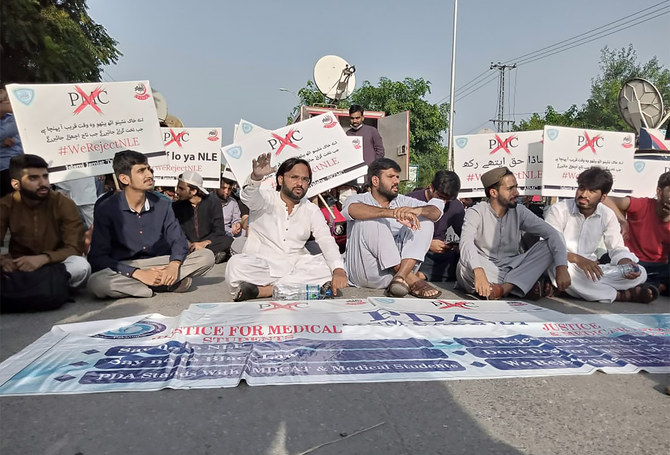
Young doctors protest outside Pakistan Medical Commission's office in Islamabad, Pakistan, on October 5, 2021. (Photo courtesy: @isbjamiat/Twitter)
Short Url
Updated 06 October 2021
Follow

Violent clashes with police in Islamabad as young doctors hold protests over licensing exam

  • The Pakistan Medical Commission made a comprehensive exam mandatory for graduates of medical institutions before practicing their profession
  • Young doctors, who have been resisting the policy, took their protest outside the PMC building on Tuesday where violence broke out

ISLAMABAD: A clash broke out on Tuesday between a group of young doctors protesting against the national licensing examination in front of the Pakistan Medical Commission (PMC) and the police deployed outside the building, reported the local media.
The PMC recently made it mandatory for graduates of medical institutions to take a comprehensive exam before getting themselves registered to practice medicine in the country.
However, the decision did not go down well with young doctors who raised their voice against it on Tuesday in front of the PMC building.
“The protest turned violent when the police resorted to baton-charge and fired tear gas at the demonstrators, prompting some of them to barge into the PMC building,” Dawn said in a news report. “Later, the police detained around 20 doctors and dispersed the remaining through the use of force, according to a statement from the Young Doctors Association (YDA).”
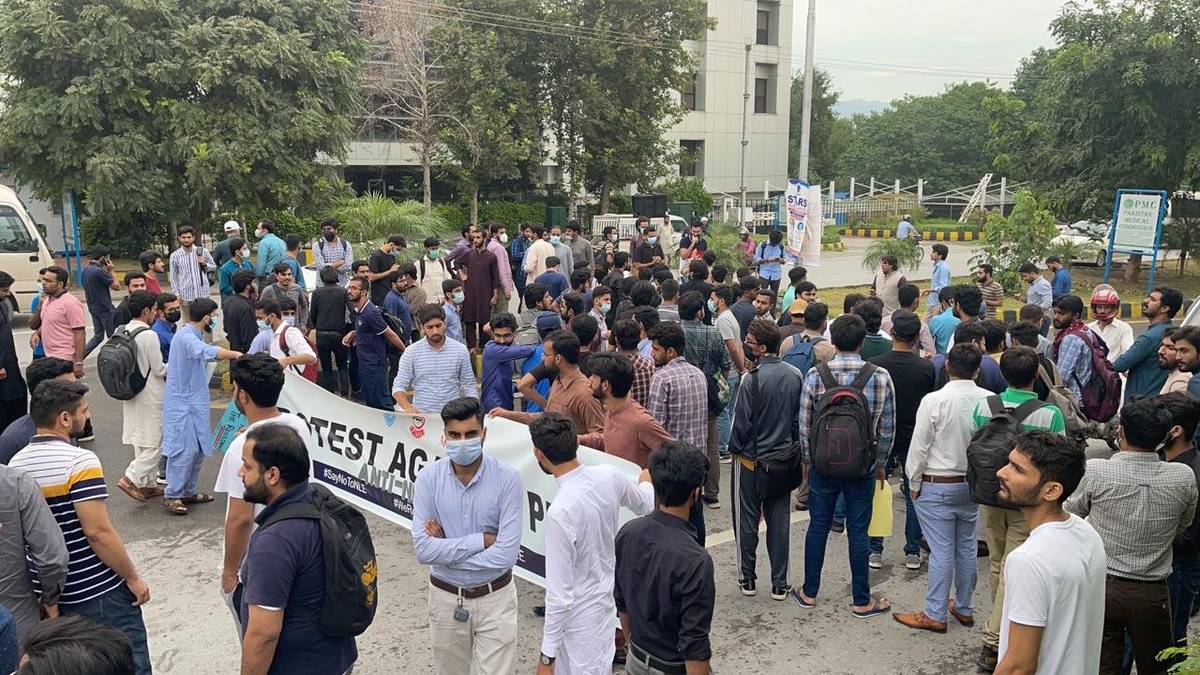


Young doctors protest gather Pakistan Medical Commission's office in Islamabad, Pakistan, on October 5, 2021. (Photo courtesy: @AamerGorsi/Twitter)

However, the police accused the protesters of trying to forcefully enter the building and said the doctors also threw stones at officials of the law enforcement agency.
The young doctors later called an emergency meeting at the Pakistan Institute of Medical Sciences (PIMS) wherein they threatened to go on a nationwide strike if their colleagues were not released by the police.
PMC officials have emphasized the significance of the exam in recent weeks, saying it would help deliver standardized health care in the country.

UN says 270,000 Afghans have returned from Iran, Pakistan this year

Updated 4 sec ago
Follow

UN says 270,000 Afghans have returned from Iran, Pakistan this year

  • UNHCR says 110,000 Afghans returned from Iran while 160,000 returned from Pakistan since start of 2026
  • Return numbers seem to have risen since Gulf war erupted on Feb. 28, says UNHCR official in Afghanistan

GENEVA: Some 270,000 Afghans have returned to their country from Pakistan and Iran so far this year, the UN said Tuesday, warning that the escalating Middle East war risked pushing the numbers higher.

UNHCR, the United Nations’ refugee agency, said that 110,000 Afghans had returned from Iran and another 160,000 had returned from Pakistan since the start of 2026.

And the numbers seem to have risen since the Middle East erupted on February 28, with the United States and Israel unleashing a barrage of strikes on Iran, and Tehran responding with drone and missile strikes on Israeli and US interests across the region.

Since then, there have been some 1,700 returns from Iran to Afghanistan each day, Arafat Jamal, UNHCR’s representative in Afghanistan, told reporters in Geneva.

Speaking from Islam Qala, on the Afghan-Iranian border, he said the situation there was “deceptively calm.”

“Returns are orderly but freighted with tension and apprehension,” he said, adding that with the hostilities elsewhere escalating, “I do fear there is more to come.”

“We are preparing for massive returns.”

He pointed out that Afghanistan was “facing the ramifications of what is happening with Iran,” while clashes have erupted along the Afghan border with Pakistan.

The new Middle East war, he warned, was “layering itself on top of an existing war on another frontier,” Jamal said.

UNHCR highlighted that the latest crises came after returns to Afghanistan had already been “exceptionally high” in recent years.

More than five million Afghans had returned from neighboring countries in the past two years, including 1.9 million returning from Iran last year alone.

Jamal warned that “many Afghan families are now facing cycles of displacement: first forced to flee Afghanistan, later displaced again inside Iran due to conflict, and now returning once more to Afghanistan.”

“And upon return in Afghanistan, the triply-displaced enter a spiral of precarity and uncertainty.”
Returns from Pakistan had meanwhile stabilized in recent weeks, as the main crossing point at Torkham remained closed due to the tensions there, Jamal said.

But he warned that “movements could increase sharply once the border reopens.”

UNHCR and the UN children’s agency UNICEF said Tuesday they were working to strengthen their capacity to operate at the borders and within Afghanistan.

But “given the scale of returns and the financial constraints facing humanitarian operations, additional support will be needed if arrivals increase,” UNHCR said, without specifying the amount needed.