

Canadians, Germans to participate in Pakistan’s first winter sports festival this December — minister

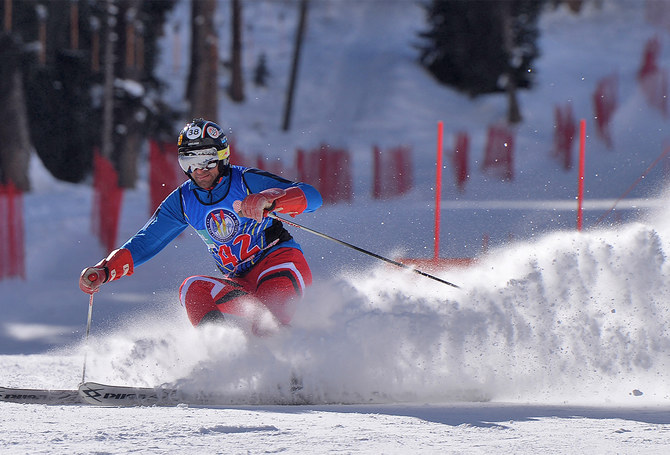
Azerbaijan skier takes part in the CAS Karakoram International Alpine Ski Cup, at the Pakistan Air Force-owned and operated Naltar Ski Resort, some 25km north of Gilgit, Pakistan, on January 29, 2019. (AFP/File)
Short Url
Updated 05 October 2021
Follow

Canadians, Germans to participate in Pakistan’s first winter sports festival this December — minister

  • Events include ice hockey, ice football, snowboarding, skiing, ski jumping, river rafting, and a cold desert rally 
  • Canadian and German athletes confirm participation, confirmation awaited from Austria and other nations, tourism minister says 

KARACHI: Pakistan’s mountainous Gilgit-Baltistan region will host its first formal winter sports festival from December this year to attract foreign visitors and showcase the country’s tourism potential, a top government official said, adding that athletes from Germany and Canada had already confirmed participation.

Gilgit-Baltistan is home to the Himalayas and the world’s second highest mountain K2. In 2018, it was listed by Forbes among the 10 “coolest places” to visit. The region’s economy is largely dependent on tourism and was severely hit last year as outbreaks of COVID-19 and travel curbs deterred tourists from flocking to the area’s glacial lakes, valleys and 8,000-meter-plus peaks.

This year, the government is banking on the arrival of a large number of domestic and international tourists on account of fewer coronavirus infections and the loosening of local travel restrictions as well as visas on arrival for 65 nationalities. 

As a “sort of advertisement” for what is planned this winter, an informal winter festival was held last year “to introduce the potential of our winter sports to the world,” Raja Nasir Ali Khan, the minister of tourism and sports for Gilgit-Baltistan, told Arab News in an interview. “The informal events were attended by thousands.”

Khan said this year’s festival, which will kick off in December and go on until March 2022, would attract “hundreds of thousands of people.” 

Ice hockey, ice football, snowboarding, alpine skiing, downhill skiing, ski jumping, river rafting, and a cold desert rally are some of the major sports events to be held during the festival. 

Khan said a Canadian team had been invited to guide the tourism department on how to execute the festival and he had personally talked to the Canadian High Commission to provide “relevant equipment and training and display their activities.” 

“Canadian have also assured us that they will support us in the winter sports activities,” he said. “They will be participating for the first time in Pakistan’s winter sports.” 

The Canadian High Commission did not respond to repeated requests for comment by the time of filing.

Athletes from Germany would also participate in the festival, Khan said, while Austria and other countries had also been approached and their confirmation was awaited. 

Khan said he hoped the winter season would be better than the summer months when many prominent events and hundreds of group expedition bookings had to be canceled due to the coronavirus pandemic. 

“This year the events could not take place in summer due to COVID-19,”’ he said, naming a few prominent canceled events, including the Deosai marathon, Rama polo festival, Shandur polo festival, and a cold desert rally.


Pakistan says economy stabilizing as it looks to 2026 growth

Updated 4 sec ago
Follow

Pakistan says economy stabilizing as it looks to 2026 growth

  • Inflation averages 5 percent, remittances hit $16.1 billion as government cites signs of recovery
  • IT exports, industry and development spending highlighted as focus shifts to next year’s targets

ISLAMABAD: Pakistan’s economy has shown signs of stabilization in the first half of the current fiscal year, Planning Minister Ahsan Iqbal said on Thursday, as the government looks ahead to sustaining growth momentum into 2026 after several years of economic volatility.

Briefing the media on economic performance through November, Iqbal said key indicators including inflation, industrial output, exports, remittances and fiscal revenues had improved, creating what he described as a more stable base for forward planning.

Pakistan has spent much of the past two years navigating high inflation, external financing pressures and fiscal tightening under an IMF-backed reform program. While growth remains modest, officials say recent data suggests the economy has moved out of crisis mode and into a consolidation phase.

“During July to November of fiscal year 2025–26, stability has returned to Pakistan’s economy,” Iqbal said, adding that average inflation during the period stood at around 5 percent, compared with 7.9% last year, easing pressure on households and businesses.

Large-scale manufacturing posted growth of 4.1 percent, which Iqbal described as “clear evidence of recovery in industrial activity.”

The planning minister said government revenues also improved, with Federal Board of Revenue collections reaching Rs4,733 billion ($16.9 billion) during July–November, reflecting a 10.2% increase.

External inflows remained resilient, with workers’ remittances rising 9.3% to $16.1 billion, while IT services exports increased 19% to $1.8 billion over the same period, he said.

On the public investment side, Iqbal said Rs196 billion ($700 million) were released under the development budget during the quarter, of which Rs92 billion ($329 million) had already been spent. He added that cost rationalization in development projects between July and October saved Rs3.3 billion ($11.8 million) billion in public funds.

In November, the planning minister said, the Central Development Working Party approved 10 development projects, while six major schemes were referred to the Executive Committee of the National Economic Council.

Iqbal said the approved projects were expected to create 994 immediate jobs, with nearly 24,859 direct and 40,873 indirect employment opportunities projected overall.

Looking ahead, he said all future development schemes would be required to comply with green building codes to ensure environmental protection and sustainable growth.

He also highlighted skills and innovation initiatives, saying that under the “Uraan Pakistan” program, partnerships with Oxford and Cambridge universities were being pursued to promote research, technology and innovation.

Under an IT industry revival plan, he said more than 20,000 young people were being trained in advanced technologies, with over 14,000 new jobs expected to be created.

The government has said maintaining macroeconomic stability while gradually lifting growth remains its central challenge as Pakistan moves into 2026, with officials emphasising disciplined spending, export growth and job creation as key priorities.