BAGHDAD: Hundreds of Iraqis marched in the center of Baghdad on Friday to mark two years since mass anti-government protests erupted in the Iraqi capital and southern provinces calling for reforms.
Around 1,000 protesters took part in the event, including a significant number of women, many carrying photos of loved ones who were killed by security forces during the protests.
“When will we see the killers behind bars?” and “No to corrupt parties, no to corrupt politicians,” said placards carried by the demonstrators, who included women dressed in black.
The commemoration comes a week before Iraq plans to hold early elections, which had been a key demand of tens of thousands of protesters who thronged the streets and public squares from October 2019 until early 2020.
Demonstrators, mostly young people, had camped out in the capital’s Tahrir Square for months, decrying endemic corruption, poor services and unemployment.
The movement petered out owing to the government’s heavy-handed response and the coronavirus pandemic. Over 600 people died as security forces used live ammunition and tear gas to disperse crowds.
One of those taking part, Ibrahim, said he was doing so “in memory of the martyrs” and “the massacres committed by the government against young pacifists.”
The 20-year-old, who like many Iraqis prefers not to give his full name when discussing politics, said he would not vote.
“The election will reproduce the same corrupt system, and the same corrupt parties. Only the names and faces change,” he said.
In the southern city of Nasiriyah, a hotbed of the 2019 protests where 128 people were killed in related violence, hundreds attended a commemorative rally.
“It’s a historic moment to remember the demonstrations and the confrontation with the forces of corruption, to remember the deaths and the criminal behavior, and the silence of the government about all of it,” said demonstrator Ali Al-Shamkhawi.
Now, many among the protest movement are calling for a boycott of the elections scheduled for Oct. 10, convinced that nothing will change. They are protesting, in particular, a string of targeted killings against civil society groups and outspoken activists for which no one has been held accountable.
“I am against participating in these elections because they are meaningless. It’s the same parties in power and nothing will change,” said Walid Al-Madani, a 39-year-old civil servant taking part in Friday’s protest.
Hundreds of riot police and federal policemen fanned out in Baghdad ahead of the planned march.
“We don’t want a paradise, we want a nation,” read one of the banners carried by protesters who gathered at Fardous Square and marched toward Tahrir Square, the epicenter of the October 2019 protests.
Another banner read: “You will not silence the voice of Tishreen,” Arabic for October, as Iraqis refer to the protests after the month they broke out.
Observers are predicting a record low turnout among the 25 million voters.
A new electoral law increased the number of constituencies and opted for a single-member constituency system supposed to favor independents and community-based candidates.
But experts say the same major political blocs are likely to dominate the next parliament.

Hundreds of Iraqi protesters march in Baghdad ahead of vote
https://arab.news/9kwmq
Hundreds of Iraqi protesters march in Baghdad ahead of vote
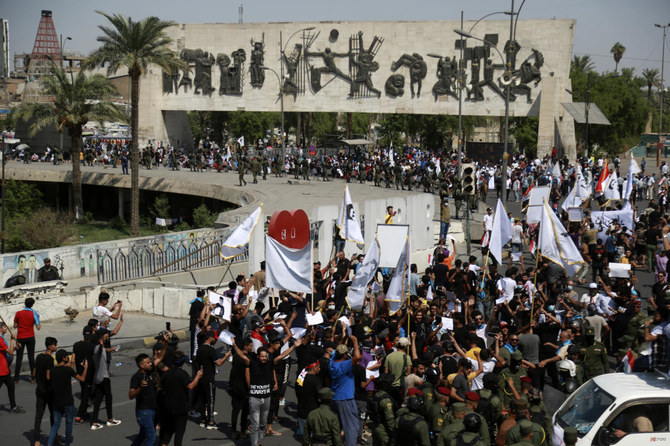
- Around 1,000 protesters took part in the event, including a significant number of women
- The commemoration comes a week before Iraq plans to hold early elections
Syria, Kurdish forces race to save integration deal ahead of deadline
- Discussions have accelerated in recent days despite growing frustrations over delays
AMMAN/RIYADH/BEIRUT/ANKARA: Syrian, Kurdish and US officials are scrambling ahead of a year-end deadline to show some progress in a stalled deal to merge Kurdish forces with the Syrian state, according to several people involved in or familiar with the talks.
Discussions have accelerated in recent days despite growing frustrations over delays, according to the Syrian, Kurdish and Western sources who spoke to Reuters, some of whom cautioned that a major breakthrough was unlikely.
The interim Syrian government has sent a proposal to the Kurdish-led Syrian Democratic Forces (SDF) that controls the country’s northeast, according to five of the sources.
In it, Damascus expressed openness to the SDF reorganizing its roughly 50,000 fighters into three main divisions and smaller brigades as long as it cedes some chains of command and opens its territory to other Syrian army units, according to one Syrian, one Western and three Kurdish officials.
’SAVE FACE’ AND EXTEND TALKS ON INTEGRATION
It was unclear whether the idea would move forward, and several sources downplayed prospects of a comprehensive eleventh-hour deal, saying more talks are needed. Still, one SDF official said: “We are closer to a deal than ever before.”
A second Western official said that any announcement in coming days would be meant in part to “save face,” extend the deadline and maintain stability in a nation that remains fragile a year after the fall of former President Bashar Assad.
Whatever emerges was expected to fall short of the SDF’s full integration into the military and other state institutions by year-end, as was called for in a landmark March 10 agreement between the sides, most of the sources said.
Failure to mend Syria’s deepest remaining fracture risks an armed clash that could derail its emergence from 14 years of war, and potentially draw in neighboring Turkiye that has threatened an incursion against Kurdish fighters it views as terrorists.
Both sides have accused the other of stalling and acting in bad faith. The SDF is reluctant to give up autonomy it won as the main US ally during the war, after which it controlled Islamic State prisons and rich oil resources.
The US, which backs Syrian President Ahmed Al-Sharaa and has urged global support for his interim government, has relayed messages between the SDF and Damascus, facilitated talks and urged a deal, several sources said.
A US State Department spokesperson said Tom Barrack, the US ambassador to Turkiye and special envoy to Syria, continued to support and facilitate dialogue between the Syrian government and the SDF, saying the aim was to maintain momentum toward integration of the forces.
SDF DOWNPLAYS DEADLINE; TURKEY SAYS PATIENCE THIN
Since a major round of talks in the summer between the sides failed to produce results, frictions have mounted including frequent skirmishes along several front lines across the north.
The SDF took control of much of northeast Syria, where most of the nation’s oil and wheat production is, after defeating Daesh militants in 2019.
It said it was ending decades of repression against the Kurdish minority but resentment against its rule has grown among the predominantly Arab population, including against compulsory conscription of young men.
A Syrian official said the year-end deadline for integration is firm and only “irreversible steps” by the SDF could bring an extension.
Turkiye’s foreign minister, Hakan Fidan, said on Thursday it does not want to resort to military means but warned that patience with the SDF is “running out.”
Kurdish officials have downplayed the deadline and said they are committed to talks toward a just integration.
“The most reliable guarantee for the agreement’s continued validity lies in its content, not timeframe,” said Sihanouk Dibo, a Syrian autonomous administration official, suggesting it could take until mid-2026 to address all points in the deal.
The SDF had in October floated the idea of reorganizing into three geographical divisions as well as the brigades. It is unclear whether that concession, in the proposal from Damascus in recent days, would be enough to convince it to give up territorial control.
Abdel Karim Omar, representative of the Kurdish-led northeastern administration in Damascus, said the proposal, which has not been made public, included “logistical and administrative details that could cause disagreement and lead to delays.”
A senior Syrian official told Reuters the response “has flexibility to facilitate reaching an agreement that implements the March accord.”


