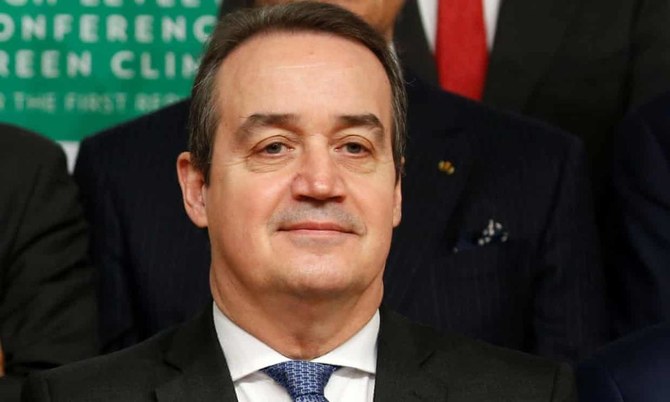
KUALA LUMPUR: Rich countries must deliver on a promise to channel $100 billion a year in climate finance to developing nations, otherwise they may jeopardize November’s critical negotiations to limit global warming, said the head of the UN-backed Green Climate Fund.
The call by Yannick Glemarec comes as about 50 climate ministers meet in Milan, Italy, on Thursday to hammer out details and tackle differences on the pace of green transition and who pays for it, ahead of the COP26 climate summit.
Those talks, from Oct. 31-Nov. 12 in Scotland, have been billed as the last chance to galvanize the collective effort needed to limit global warming to 1.5 degrees Celsius above pre-industrial times, the lowest goal in the 2015 Paris Agreement.
But with a month to go, UN officials say they have yet to see ambitious enough action, including fulfilment of an overdue pledge to channel $100 billion a year from 2020 to help poorer nations adapt to global warming and adopt cleaner energy.
“The $100 billion is critical to catalyze much larger financial flows,” said Glemarec, the executive director of the multi-billion-dollar Green Climate Fund (GCF), speaking in an interview from its headquarters in South Korea.
“It’s also critical for establishing a climate of trust — you have no successful negotiation without trust,” he told the Thomson Reuters Foundation.
The GCF was set up under UN climate talks in 2010 as one of the main global funds to support developing-country efforts to tackle climate change, and started allocating money in 2015.
Glemarec said the latest figures — showing climate finance for vulnerable nations at just under $80 billion in 2019 — were a “disappointment” and could undermine the COP26 talks.
“It’s very difficult to trust parties when we have been telling you since Copenhagen COP15 (in 2009) that we will be mobilizing the $100 billion,” he said.
“So it’s really important to deliver on this commitment.”
US shortfall
The pre-COP26 summit in Milan this week is the last major UN meeting before negotiators head to Glasgow.
Thousands of young activists have converged on the Italian city to demand leaders match rhetoric with action and stump up the billions of dollars needed to wean the world off fossil fuels and onto cleaner energy, while adapting to a warmer world.
Glemarec said delivery of the $100 billion — some of which flows through the GCF — was important to ensure the fund has enough money in its coffers to disburse to developing countries.
The GCF board meets next week and will consider approving $1.2 billion for 13 new climate projects — from improving water security for communities in Kenya to enhancing early warning systems against floods and cyclones in East Timor.
If they all get the green light, the fund will have used up its available resources before COP26.
Glemarec joked that the GCF would have “just enough money in our bank account to pay for electricity bills” by the time he heads to the talks in Glasgow.
“If we want to be able to meet the needs of some developing countries, we need to be capitalized — and our capitalization comes from this $100 billion,” he stressed.
Securing a backlog of US contributions to the GCF, which were halted by former President Donald Trump, a climate-change skeptic, would be “significant,” Glemarec said.
The new Democratic US government has thrown its support behind the GCF again, with President Joe Biden requesting about $1.2 billion for the fund in the coming fiscal year’s budget, according to his climate envoy John Kerry in April.
But the Biden administration’s spending plans have hit a standstill in Congress.
“I will not venture a guess on what will be the final result but a stronger replenishment from the US will enable us to maintain a very ambitious level of programming in 2022 and (going) forward,” said Glemarec.


![]()

COP26 climate talks ‘difficult’ without promised finance, says UN fund head
Short Url
https://arab.news/y59tg
COP26 climate talks ‘difficult’ without promised finance, says UN fund head
- COP26 talks, from Oct. 31-Nov. 12 in Scotland, have been billed as the last chance to galvanize the collective effort needed to limit global warming


Latest updates





© 2026 SAUDI RESEARCH & PUBLISHING COMPANY, All Rights Reserved And subject to Terms of Use Agreement.