

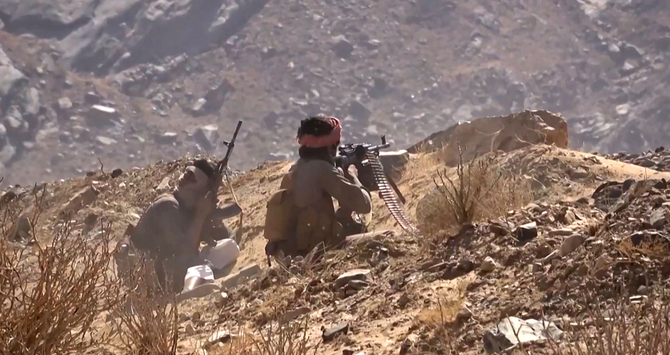

AL-MUKALLA: More than 150 Houthi and Yemeni government troops have been killed in fierce clashes outside the central city of Marib.
Rashad Al-Mekhlafi, a military official at Yemen’s Armed Forces Guidance Department, told Arab News from Marib that the army troops and allied tribesmen have engaged in clashes with the Houthis in different locations south of the city, including Harib, Jouba and Jabal Murad.
“Hundreds of Houthis have been killed in the past 72 hours in clashes or in (precision strikes) by the coalition warplanes, compared to 50 deaths among our troops,” Al-Mekhlafi said, while denying media reports that the Houthis have laid siege to the city of Marib.
Thousands of combatants and civilians have been killed in the area since the Iran-backed Houthis earlier this year renewed an offensive to recapture energy-rich Marib, the government’s last bastion in the north.
Last week, the Houthis rolled into new areas south of Marib after tightening their grip on two districts in neighboring Al-Bayda and Shabwa provinces.
The most serious Houthi advance that could threaten Marib is in the southern district of Harib, where the Houthis seized new areas, but the Yemeni army has dispatched troops and military equipment to push them back, Al-Mekhlafi said.
“The Houthis have moved most of their fighters from other fronts to Marib. Marib is an important battlefield for the Houthis and the Iranians,” he added.
Yemen army officials say that more than 40 armed vehicles and items of military equipment belonging to the Houthis have been destroyed in airstrikes in Marib province during the last 72 hours.
Despite suffering heavy losses in Marib, the rebels have pressed ahead with the offensive and rejected local and international calls to de-escalate and accept the UN-brokered peace efforts.
Aid organizations have repeatedly warned that Houthi attacks on Marib city, including missile and drone strikes, put hundreds of thousands of internally displaced people who live there at risk.
If the Houthis managed to capture the city of Marib, along with its oil and gas fields and power stations, the militia would get an important bargaining chip during talks about the future of the country, experts said.
Maj. Gen. Mufreh Buhaibeh, a Yemeni commander who was slightly wounded during the latest clashes with the Houthis south of Marib, said that the Yemeni army troops and allied tribesmen would keep fighting until the Houthis are defeated and are pushed out of the areas under their control. “We will fight to the last drop of our blood because we are defending our religion, our dignity, our homeland and everything,” Buhaibeh said.
Meanwhile, the Yemeni army and the Houthis on Wednesday swapped dozens of prisoners in the southern province of Taiz after successful mediation led by local tribal and social figures.
The Yemeni army released 70 Houthis in exchange for 136 army soldiers and civilians.
Abdul Basit Al-Baher, a Yemen army officer in Taiz, told Arab News by telephone that the latest successful prisoner swap was supposed to be carried out in May during Ramadan, but was delayed when the Houthis refused to release some of the prisoners.
“We agreed to release dangerous Houthi snipers in exchange for releasing some civilians who were abducted from the streets,” Al-Baher said.
“Some of the abductees are teachers or ordinary people who were seized by the Houthis while looking for (cooking) gas cylinders,” he said.
Wednesday’s exchange was the largest since October last year, when the government troops and the Houthis exchanged hundreds of prisoners.


