Israel PM Naftali Bennett calls for COVID-19 vaccination push in Arab communities

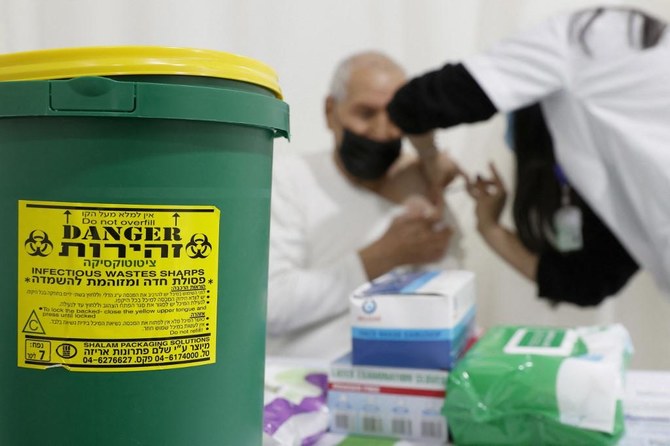
A healthcare worker administers a COVID-19 vaccine to a resident in the northern Arab Israeli city of Umm Al-Fahm on Jan. 4, 2021. (AFP)
Short Url
Updated 29 September 2021
Follow

Israel PM Naftali Bennett calls for COVID-19 vaccination push in Arab communities

  • Naftali Bennett says ‘the 40 ‘reddest’ communities in Israel are from the Arab sector’

JERUSALEM: Israeli Prime Minister Naftali Bennett called Wednesday for new efforts to promote coronavirus vaccination within Arab communities, which are now the leading hotspots of COVID-19 transmission.
Before leaving New York where he addressed the UN General Assembly, partly on Israel’s pandemic response, Bennett said “the 40 ‘reddest’ communities in Israel are from the Arab sector,” referring to transmission rates.
Bennett has faced criticism from some health experts over his refusal to reimpose lockdown restrictions despite persistently highly daily case counts.
But Bennett said his government’s policy was to keep Israel “as open as possible alongside focused work on the non-vaccinated and the centers of morbidity.”
“What will help is... going to the Arab sector, and persuading them,” he told reporters.
Israel’s Arab citizens, Palestinians who remained on their land after Israel’s founding in 1948, make up roughly 20 percent of the country’s 9.3 million population.
Zahi Said, a spokesman for the health ministry, said that 40 percent of all new infections in Israel — and a similar rate of hospitalizations and deaths — were within the Arab community.
Said attributed the high rates to a “lack of vaccination and non-compliance with health ministry instructions, such as distancing and wearing masks.”
He said the ministry was promoting vaccine awareness in Arab cities and towns, but that vaccine resistance has persisted.
Israel was in December among the first countries to launch a national vaccination campaign that brought infections down to a trickle and allowed the lifting in June of nearly all pandemic restrictions.
The emergence of the highly transmissible Delta variant caused infections to surge, but Bennett’s government has opted to rollout a third, or booster, jab of the Pfizer-BioNTech vaccine instead of a new lockdown.
Israeli data shows that those who have received a third shot are less likely to become seriously ill with COVID-19 than those who have received the required two shots.


Israel agrees to reopen Rafah crossing only for Gaza pedestrians

Updated 1 min 49 sec ago
Follow

Israel agrees to reopen Rafah crossing only for Gaza pedestrians

  • The announcement came after visiting US envoys reportedly pressed Israeli officials to reopen the crossing, a vital entry point for aid into Gaza

JERUSALEM: Israel said Monday it would only allow pedestrians to travel through the Rafah crossing between Gaza and Egypt as part of its “limited reopening” once it has recovered the remains of the last hostage in the Palestinian territory.
Reopening Rafah, a vital entry point for aid into Gaza, forms part of a truce framework announced by US President Donald Trump in October, but the crossing has remained closed since Israeli forces took control of it during the war in the Palestinian territory.
Visiting US envoys had reportedly pressed Israeli officials to reopen the crossing during talks in Jerusalem over the weekend.
World leaders and aid agencies have repeatedly pushed for more humanitarian convoys to be able to access Gaza, which has been left devastated by more than two years of war and depends on the inflow of essential medical equipment, food and other supplies.
Prime Minister Benjamin Netanyahu’s office said on Monday that Israel had agreed to a reopening “for pedestrian passage only, subject to a full Israeli inspection mechanism.”
The move would depend on “the return of all living hostages and a 100 percent effort by Hamas to locate and return all deceased hostages,” it said on X.
It remained unclear whether the reopening would allow medical patients to leave Gaza for treatment in Egypt or other countries.
The Israeli military said it was searching a cemetery in the Gaza Strip on Sunday for the remains of the last hostage, Ran Gvili.
“Upon completion of this operation, and in accordance with what has been agreed upon with the US, Israel will open the Rafah Crossing,” said Netanyahu’s office.
The announcement came after Gaza’s newly appointed administrator, Ali Shaath, said the crossing would open “in both directions” this week.
“For Palestinians in Gaza, Rafah is more than a gate, it is a lifeline and a symbol of opportunity,” Shaath said at the World Economic Forum in Davos on Thursday.
Israeli media had also reported that US envoys Steve Witkoff and Jared Kushner had urged Netanyahu to reopen Rafah during their Jerusalem talks.
Before the war erupted in October 2023, Rafah had been the only gateway connecting Gazans to the outside world and enabling international humanitarian aid to enter the territory, home to 2.2 million people living under Israeli blockade.

Last hostage

A spokesman for Hamas’s Ezzedine Al-Qassam Brigades, Abu Obeida, said on Sunday that the group had “provided mediators with all the details and information in our possession regarding the location of the captive’s body,” referring to Gvili.
Obeida added that “the enemy (Israel) is currently searching one of the sites based on information transmitted by the Al-Qassam Brigades.”
Except for Gvili, all of the 251 people taken hostage during Hamas’s October 7, 2023 attack on Israel have since been returned, whether living or dead.
A non-commissioned officer in the Israeli police’s elite Yassam unit, Gvili was killed in action on the day of the attack and his body was taken to Gaza.
The first phase of the US-backed ceasefire deal had stipulated that Hamas hand over all the hostages in Gaza.
Gvili’s family has expressed strong opposition to launching the second phase of the plan, which includes reopening Rafah, before they have received his remains.
“First and foremost, Ran must be brought home,” his family said in a statement on Sunday.
The Gaza war was sparked by Hamas’s October 7, 2023 attack on Israel, which resulted in the deaths of 1,221 people, according to an AFP tally based on official Israeli figures.
The Israeli retaliation flattened much of Gaza, a territory that was already suffering severely from previous rounds of fighting and from an Israeli blockade imposed since 2007.
The two-year war between Israel and Hamas has left at least 71,657 people dead in Gaza, according to the territory’s health ministry, figures considered reliable by the United Nations.