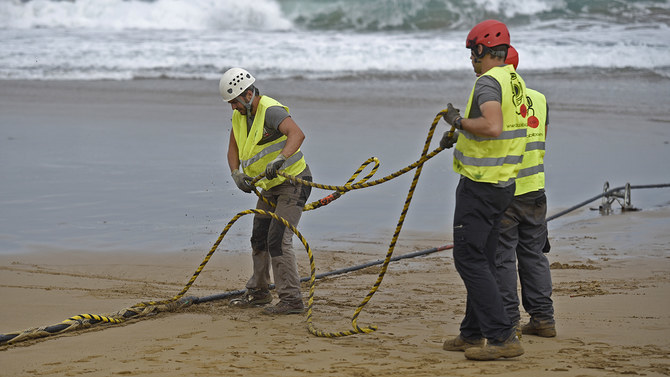

ISLAMABAD: The Facebook-backed 2Africa consortium will add a new segment to its submarine telecommunication cable system, extending it to the Arabian Gulf, Pakistan and India, Facebook said on Tuesday.
2Africa, a proposed international submarine telecommunications cable, is intended to circumnavigate the coastline of the continent of Africa to interconnect Europe and countries in Africa and the Middle East. It is funded by a consortium of companies comprising China Mobile International, Facebook, MTN GlobalConnect, Orange, Saudi Telecom Company (STC), Telecom Egypt, Vodafone and West Indian Ocean Cable Company (WIOCC).
The system is expected to go live in 2023-24.
“Today, we are thrilled to announce, along with regional and global partners, a new segment of subsea cable called 2Africa Pearls, which connects three continents — Africa, Europe, and Asia,” Facebook said on its website. “This extension will bring the total length of the 2Africa cable system to more than 45,000 kilometers, making it the longest subsea cable system ever deployed.”
The development is expected to increase Internet connectivity in Pakistan and the Arabian Gulf as well as India, which already ranks second on the list of countries with the highest number of Internet users in the world, according to Statista.com, a German firm that specializes in market and consumer data.
“With 2Africa, we had planned to increase connectivity to 1.2 billion people,” Facebook said. “With the addition of Pearls, the system will provide connectivity to an additional 1.8 billion people, totaling 3 billion people, or about 36 percent of the global population.”
A report published in Africanews said the cable would connect three continents, Africa, Europe and Asia terrestrially through Egypt, adding vital landing locations in Oman (Barka), UAE (Abu Dhabi and Kalba), Qatar (Doha), Bahrain (Manamah), Kuwait (Kuwait), Iraq (Al-Faw), Pakistan (Karachi), India (Mumbai), and a fourth landing in Saudi Arabia (Al Khobar).
“The new 2Africa branch joins recently announced extensions to the Canary Islands, the Seychelles, Comoros Islands, Angola, and a new landing to south-east Nigeria,” the report said.
As with other 2Africa cable landings, the consortium said, service providers in PEARLS landings would obtain capacity at carrier-neutral facilities on a fair and equitable basis, which would support healthy Internet ecosystem development by providing greatly improved Internet accessibility.
“The past 18 months have highlighted the importance of connectivity as billions of people around the world rely on the Internet to work, attend school, and stay connected to people they care about,” Facebook said. “We continue to invest in subsea cables in Africa and beyond as communities and businesses flourish when there is widely-accessible Internet … so that everyone can benefit from the economic, educational, and social advantages of a digitally connected world.”