Pakistani, Saudi state media to sign agreement within three weeks — Saudi envoy 

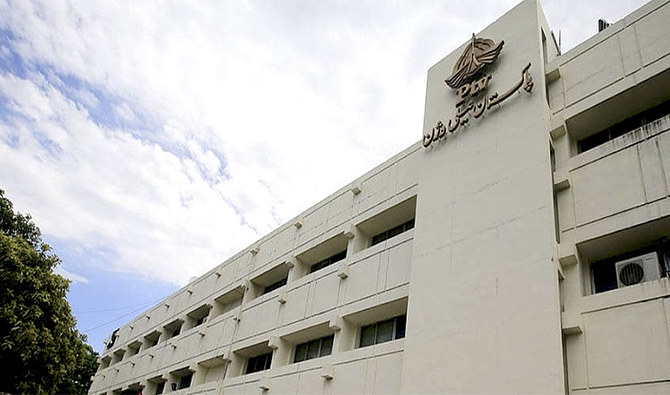
Exterior view of Pakistan state television headquarters building in Islamabad November 5, 2020. (AFP)
Short Url
Updated 28 September 2021
Follow

Pakistani, Saudi state media to sign agreement within three weeks — Saudi envoy 

  • Says the agreement between the kingdom and Pakistan will strengthen their close relations
  • Under the project, documentaries, news about each country to be broadcast in other to raise awareness

ISLAMABAD: Saudi Ambassador to Islamabad Nawaf Bin Said Al-Malki on Monday said an agreement between Pakistani and Saudi state media was in its final stages and would be finalized within three weeks, Saudi media reported. 
In an interview with Urdu News in Islamabad, the envoy said the agreement would be signed between Pakistan Television and Saudi broadcasters.
“This agreement between the kingdom and Pakistan will increase this [close] relation,” Malki said, adding that it would be finalized in the next two to three weeks. 
Aoun Sahi, an executive producer with PTV, said as part of the agreement, Pakistan would make a documentary on Saudi Arabia, which would detail how the kingdom had flourished and how it was changing. Documentaries featuring Pakistan would also be screened in Saudi Arabia, while the two countries would cooperate in news programming as well.
To a question about Pakistanis working in the kingdom, the Saudi ambassador said the people of Pakistan loved Saudi Arabia from the core of their hearts and had “high emotions” for the kingdom. 
“2.5 million [Pakistanis] work in the kingdom,” he said. “It’s very important, this community.” 
Acknowledging the role of Pakistanis in Saudi Arabia’s development, Ambassador Malki expressed his hopes that they would have a part to play in Saudi Arabia’s Vision 2030.
He said Pakistani Prime Minister Imran Khan’s last visit to the kingdom was successful, and saw the signing of many agreements, including one relating to the formation of the Saudi-Pakistan Supreme Coordination Council. 
In February 2019, Khan held a one-on-one meeting with Saudi Crown Prince Mohammad bin Salman in Islamabad, followed by the inaugural session of the Supreme Coordination Council, which was co-chaired by the two leaders. 
The high-powered council was proposed by the crown prince during a visit by Khan to Saudi Arabia in October 2018. The objective, as the Pakistani foreign ministry announced at the time, “was to put in place a high level institutional mechanism to fast track decisions in key areas of bilateral cooperation, and for close monitoring of their implementation.” 


Pakistan says Saudi help securing oil supplies as it vows to absorb price shocks amid Iran war

Updated 10 sec ago
Follow

Pakistan says Saudi help securing oil supplies as it vows to absorb price shocks amid Iran war

  • Petroleum minister says Riyadh, UAE assisting with vessels as Strait of Hormuz closure disrupts supplies
  • PSO says petroleum stocks sufficient for more than 20 days of normal demand despite regional disruptions

ISLAMABAD: Pakistan said on Tuesday it was working with Saudi Arabia and the United Arab Emirates to secure oil supplies and would try to absorb any further global price shocks to shield consumers, after a record fuel price hike triggered by the ongoing Iran war and disruptions to regional energy routes.

Petroleum Minister Ali Pervaiz Malik said the government had coordinated with Saudi authorities to arrange shipments from the Red Sea port of Yanbu, part of broader efforts to stabilize supplies as tensions in the Middle East roil global energy markets.

The conflict escalated after coordinated US and Israeli strikes on Iran late last month, followed by Iranian retaliation across the Gulf and the closure of the Strait of Hormuz, a key corridor through which roughly one-fifth of the world’s oil supply passes. The disruption has driven crude prices higher and raised fears of global supply shortages.

“With the prime minister’s support, and with the help of the Saudi ambassador, we coordinated with the Saudi government to arrange [oil shipments] from Yanbu, which is a port on the Red Sea,” Malik said in an interview with Geo News.

“They are providing tremendous assistance to us,” he added. “The UAE is also extending significant help. We are coordinating with Saudi Arabia, they are arranging ships for us, and they have also arranged a larger vessel. We are trying to have it dock in Oman and then transfer the cargo to smaller vessels, but we are not getting insurance to dock in Oman.”

Pakistan last week raised petrol and diesel prices by 55 rupees per liter, the largest single-day increase in its history, as the government scrambled to keep energy supplies flowing while managing a fragile economic recovery under an International Monetary Fund program.

Malik said authorities had tried to prepare for the crisis by building reserves where possible, though some fuels such as gas could not be stockpiled in the same way.

“These are extraordinary circumstances,” he said. “In this situation, one thing we have tried to ensure is that the public does not face any difficulty in supply in any way.”

He said the government had entered the crisis in a relatively better position after building reserves of several fuels, though the closure of the Strait of Hormuz had created new logistical challenges.

“Even today, you may see minor complaints here and there, and there will certainly be discomfort regarding prices, but at least the supply is available,” Malik said.

Malik said it remained unclear how global oil prices would evolve in the coming weeks but stressed the government would try to cushion consumers from further shocks.

“However, I can say one thing: the prime minister has certainly decided that if any increase does occur, the government will try as much as possible to absorb it so that it does not create additional difficulties for the public, while also ensuring that supply continues.”

SUFFICIENT FUEL STOCKS

Meanwhile, Pakistan State Oil (PSO), the country’s largest fuel supplier, said it had sufficient petroleum stocks to meet normal demand for more than 20 days despite regional supply disruptions.

In a statement issued on Tuesday night, the company said it had secured multiple cargoes of motor gasoline (Mogas) for March and early April through international tenders and government-to-government arrangements.

Two Mogas cargoes from Oman are scheduled to arrive this month, while another shipment has been secured from Saudi Arabia’s Aramco following coordination between Islamabad and Riyadh, it said.

The company added that it had also secured a Mogas cargo for early April and opened another tender for deliveries later that month.

PSO said its current high-speed diesel (HSD) stocks were also sufficient for more than 20 days of normal demand, though supplies from Kuwait Petroleum Corporation had been disrupted after the company declared force majeure due to the closure of the Strait of Hormuz.

The company said it was exploring alternative supply routes and additional cargoes to maintain stocks ahead of Pakistan’s upcoming agricultural season, when diesel demand typically rises.