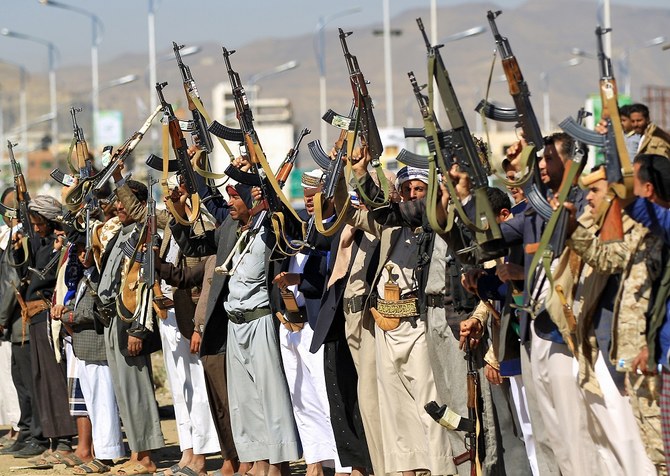
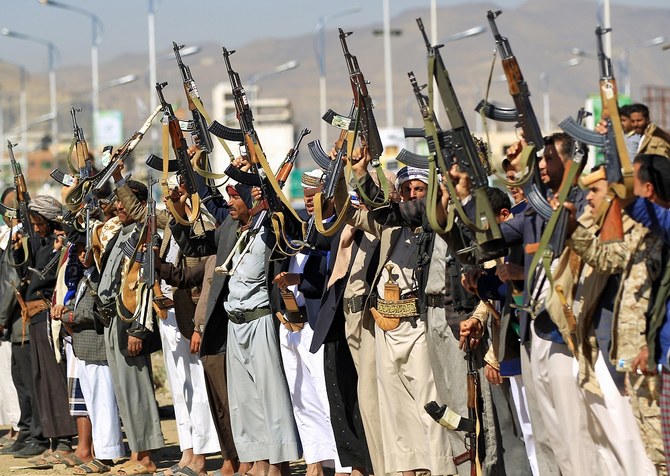
AL-MUKALLA: The Iran-backed Houthis have laid siege to thousands of civilians inside a government-controlled area in the central province of Marib.
Intensifying fighting for the energy-rich city of Marib has killed dozens of combatants during the past 24 hours.
Local government officials told Arab News on Monday that the Houthis besieged Al-Abedia area, south of Marib province, after their forces scored a string of territorial gains following a rapid assault on government troops, preventing people, including the sick, from leaving or entering the area.
“We have not been able to deliver humanitarian assistance to the 5,106 besieged families and children as the militias blocked roads and prevented them from even leaving for medical treatment,” Khaled Al-Shajani, the head of Marib’s office of the internationally recognized government’s Executive Unit for IDPs Camps, told Arab News by telephone.
He urged international organizations and powerful countries to pressure the Houthis to lift their siege and stop military operations to allow civilians to leave their homes.
The government official said that more than 1,043 families had also left homes in Hareb district, southeastern Marib, and sheltered in the city of Marib since earlier this month. This was adding more pressure to the large displacement camps in Marib that host more than 2 million people, he said.
Local military officials and media reports said on Monday that heavy fighting broke out between the Houthis and government troops in Al-Mashjah, Al-Kasarah, Hareb, Jabal Murad and Serwah as the Houthis escalated ground attacks and artillery fire on government troops defending the city of Marib.
Dozens of combatants, most of them Houthis, have been killed in the fighting or in airstrikes by Arab coalition warplanes.
“There are martyrs from the national army, but the Houthi deaths are much bigger,” a military official, who preferred to remain anonymous, told Arab News, noting that hundreds of Houthis have been killed since the weekend.
Yemeni officials say that they cannot put a number on Houthi deaths as most of the rebels are killed by the coalition’s warplanes behind the frontline or even before taking part in the fighting. The latest round of fierce fighting in Marib began in February when the Houthis renewed a major military offensive to seize control of the government’s last bastion in the densely populated northern half of the country.
The local authority in the northern province of Hajjah said that the death toll from the Houthi missile strike on a flame-lighting ceremony in Medi town on Saturday had risen to 12 people, including three military and security officials. The Houthis fired a ballistic missile on Saturday night at a gathering of government officials and civilians marking the 59th anniversary of the Sept. 26 revolution.
Another ballistic missile hit the city of Marib, destroying the house of the governor of Marib, Sultan Al-Arada.
The increase in fighting in Marib comes as government-controlled areas continue to record a high number of coronavirus infections.
The Aden-based national coronavirus committee on Monday announced 54 new cases, nine deaths and 42 recoveries in government-controlled areas, bringing the total number of cases to 8,988, including 1,703 deaths and 5,570 recoveries.


![]()
Houthis besiege thousands of civilians in Marib’s Al-Abedia
Short Url
https://arab.news/24cnq
Houthis besiege thousands of civilians in Marib’s Al-Abedia
- Local government officials told Arab News that the Houthis besieged Al-Abedia area, south of Marib province


Latest updates


Recommended


© 2026 SAUDI RESEARCH & PUBLISHING COMPANY, All Rights Reserved And subject to Terms of Use Agreement.