

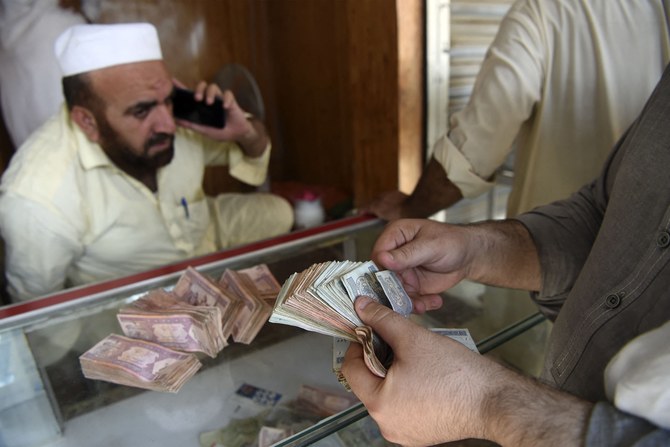

KARACHI: Demand for Afghanistan’s national currency has plummeted following the withdrawal of US-led foreign troops from the country, Pakistani forex traders say, as the Afghani has hit its record low.
The Afghani traded to 87.95 per United States dollar on Saturday, down sharply from about 80.84 on August 15, when the Taliban entered Kabul and took over Afghanistan as foreign troops were completing their pullout.
“Demand for the Afghani has subdued almost close to zero in recent days, after the withdrawal of the United States and coalition forces from Afghanistan,” Malik Bostan, chairman of Exchange Companies Association of Pakistan (ECAP), told Arab News.
“Afghanistan’s national currency at current changes hands only in Peshawar and Chaman and the volume is almost negligible mainly due to the uncertainty tagged with the economy and future of the government in Afghanistan.”
The currency plunge reflects concerns about the future of Afghanistan, but also the stop of greenback inflows and freezing of the country’s foreign reserve accounts by Western countries.
According to United States Institute of Peace data, the US Federal Reserve has frozen all of Afghanistan’s foreign exchange reserves in its hand, amounting to some $7 billion. The International Monetary Fund has also frozen the Afghan government’s access to its supplementary foreign exchange reserve assets.
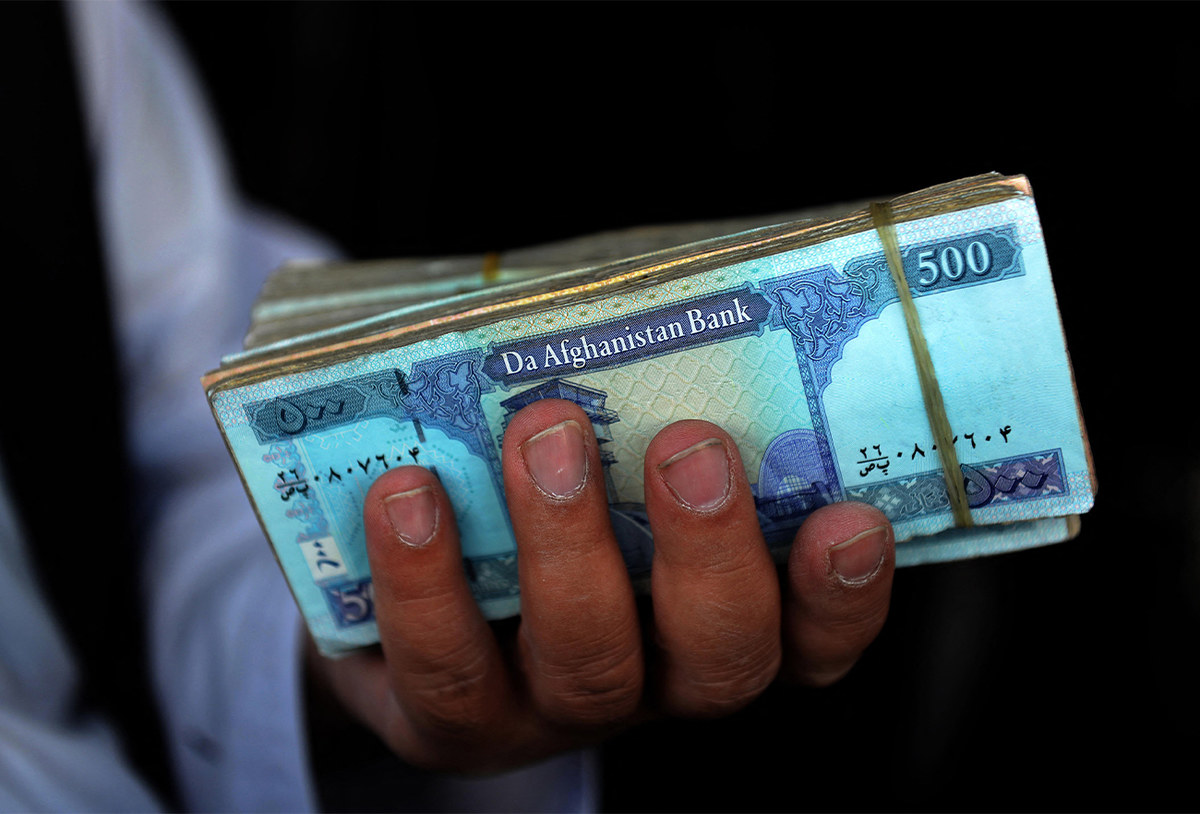
A money changer holds Afghani banknotes at a currency exchange market along a road in Kandahar, Afghanistan, on September 20, 2021. (AFP/File)
Donors such as Germany, the World Bank, and the Asian Development Bank have also suspended all their disbursements to Afghanistan, where international aid — that is now in doubt following the US military withdrawal — financed about 75 percent of public spending.
“The confidence on Afghani currency is at lower ebb at present and no trade is being done in Afghani as compared to the pre-US withdrawal,” Zafar Paracha, chief executive of Paracha Exchange, told Arab News.
Last week, traders said Pakistan’s trade with Afghanistan had declined by 50 percent since mid-August as they were not sure which currency had to be used to facilitate business activities between the two countries.
“No trade is taking place in Afghan currency due to its instability,” Paracha said. “Pakistan has proposed trade in Pakistani rupees which could boost the Afghani as well but still the mechanism is awaited as economic burden has shifted to Pakistan.”
Normalcy may, however, return in the next couple of weeks if the Taliban could effectively manage law and order, political and security expert Dr. Hassan Askari said.
“In transition periods such situations happen,” he told Arab News. “Economy thrives only when people get confidence that the normalcy has returned.”


