Interim PM outlines ambitions, challenges for newly free Sudan

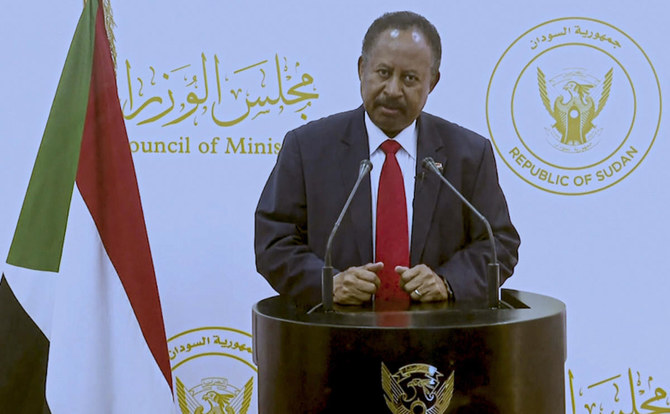
Abdalla Adam Hamdok, Prime Minister of the Sudan, remotely addresses the 76th session of the United Nations General Assembly in a pre-recorded message, Saturday Sept. 25, 2021 at UN headquarters. (AP)
Short Url
Updated 26 September 2021
Follow

Interim PM outlines ambitions, challenges for newly free Sudan

  • Abdalla Hamdok: Aim is to build ‘safe, stable’ country ‘where everyone lives in peace, prosperity, freedom, justice’
  • He thanked international partners, such as Saudi Arabia, who have provided assistance to Sudan’s fledgling government

NEW YORK: The prime minister of Sudan’s transitional government has outlined its plans for a “safe and stable” nation, and urged world leaders to work together to deliver more COVID-19 vaccines to developing countries.
“The transitional government in Sudan continues to implement policies aiming to lay the foundations for democracy and rule of law, and to promote human rights,” Abdalla Hamdok told UN General Assembly delegates.
“At the same time, it aims to tackle the chronic structural problems beleaguering our economy,” he said.
“These programs and these policies underpin a common goal — that is, building a safe and stable Sudan where everyone lives in peace, prosperity, freedom and justice, as expressed in the slogans of the glorious revolution of December.”
At the end of 2018 and into 2019, the Sudanese people overthrew Omar Bashir, bringing to an end 30 years of autocratic rule.
Since then, Hamdok said, “the reforms undertaken have had an effect on the most vulnerable people in our society. We’ve launched social protection programs … with the aid of regional and international partners.”
Among those international supporters is Saudi Arabia, which in May provided a $20 million grant to assist Sudan with servicing its debts to the International Monetary Fund. More investment by the Kingdom is expected.
But while Sudan’s revolution achieved its initial goal of establishing a civilian government, the country faces a plethora of systemic and economic challenges, including the coronavirus pandemic.
Hamdok said Sudan has witnessed an influx of refugees from neighboring countries, and it does not have the resources to effectively manage this.
“Host communities are the first providers of protection and solidarity to these people. They share their scant resources and don’t, unfortunately, receive the support they require,” he added.
“Conditions in refugee camps are better than those in many host communities. The international community needs to effectively contribute to the development of these communities as part of distributing the burden involved. More money is needed.”
Hamdok also urged regional countries to reach a lasting agreement on Ethiopia’s Grand Renaissance Dam, which has fueled tensions between Addis Ababa on one hand and Egypt and Sudan on the other because of the Nile’s critical importance to each country.
He commended the role of the World Health Organization in combating the pandemic, which he said has hit poor nations particularly hard.
“International cooperation and multilateral action” are required to ensure people in poor countries are able to access COVID-19 vaccines, he said.
A cooperative and global approach to ending the pandemic is “the only way to give true meaning to the slogan ‘no one is safe until everyone is safe’,” he added.

(With AP)


US presses missile issue as new Iran talks to open in Geneva

Updated 37 min 13 sec ago
Follow

US presses missile issue as new Iran talks to open in Geneva

  • New round of negotiations in Geneva comes after the US carried out a massive military build-up in the region
  • Iran’s president reiterates Tehran is not seeking nuclear weapons in line with policy

GENEVA: The United States and Iran are set to hold indirect talks in Switzerland on Thursday aiming to strike a deal to avert fresh conflict and bring an end to weeks of threats.
The new round of negotiations in Geneva comes after the US carried out a massive military build-up in the region and President Donald Trump repeatedly threatened to strike Iran if a deal is not reached.
In his State of the Union address on Tuesday, Trump accused Iran of “pursuing sinister nuclear ambitions.”
He also claimed Tehran had “already developed missiles that can threaten Europe and our bases overseas, and they’re working to build missiles that will soon reach the United States of America.”
The Iranian foreign ministry called these claims “big lies.”

Iran president says ahead of US talks not seeking nuclear weapon ‘at all’

TEHRAN: Iran’s President Masoud Pezeshkian reiterated on Thursday that Tehran was not seeking nuclear weapons in line with the policy set by the country’s supreme leader.

“Our Supreme Leader has already stated that we will not have nuclear weapons at all,” Pezeshkian said in a speech.

“Even if I wanted to move in that direction, I could not — from a doctrinal standpoint, I would not be permitted.” — AFP


The maximum range of Iran’s missiles is 2,000 kilometers according to what Tehran has publicly disclosed. However the US Congressional Research Service estimates they top out at about 3,000 kilometers — less than a third of the distance to the continental United States.
The dispute between the countries mostly revolves around Iran’s nuclear program, which the West believes is aimed at building an atomic bomb but Tehran insists is peaceful.
However the US has also been pushing to discuss Iran’s ballistic missile program, as well as Tehran’s support for armed groups hostile toward Israel.
Secretary of State Marco Rubio warned that Iran must also negotiate on its missile program, calling Tehran’s refusal to discuss ballistic weapons “a big, big problem” on the eve of the talks.
He followed up by saying “the president wants diplomatic solutions.”
Iran has taken anything beyond the nuclear issue off the negotiating table and has demanded that the US sanctions crippling its economy be part of any agreement.
‘Neither war nor peace’
Iranian President Masoud Pezeshkian said on Wednesday he had a “favorable outlook for the negotiations” that could finally “move beyond this ‘neither war nor peace’ situation.”
Foreign Minister Abbas Araghchi, who is leading the Iranian delegation at the talks, has called them “a historic opportunity,” adding that a deal was “within reach.”
In a foreign ministry statement that followed a meeting with his Oman counterpart, Araghchi said the success of the US negotiations depend “on the seriousness of the other side and its avoidance of contradictory behavior and positions.”


The US will be represented by envoy Steve Witkoff and Jared Kushner, who is married to Trump’s daughter Ivanka.
The two countries held talks earlier this month in Oman, which is mediating the negotiations, then gathered for a second round in Geneva last week.
A previous attempt at negotiations collapsed when Israel launched surprise strikes on Iran last June, beginning a 12-day war that Washington briefly joined to bomb Iranian nuclear sites.
In January, fresh tensions between the US and Iran emerged after Tehran engaged in a bloody crackdown on widespread protests that have posed one of the greatest challenges to the Islamic republic since its inception.
Trump has threatened several times to intervene to “help” the Iranian people.
Emile Hokayem, senior fellow for Middle East security at the International Institute for Strategic Studies, said that “the region seems to expect a war at this point.”
In January, there was “a big push by a number of Middle Eastern states to convince the US not to” strike Iran.
“But there’s a lot of apprehension at this point, because the expectation is that this time” a war would be “bigger” than the one in June.
Tehran residents who spoke to AFP were divided as to whether there would be renewed conflict.
Homemaker Tayebeh noted that Trump had “said that war would be very bad for Iran.”
“There would be famine and people would suffer a lot. People are suffering now, but at least with war, our fate might be clear,” the 60-year-old said.