

UN updates named death toll for Syria war

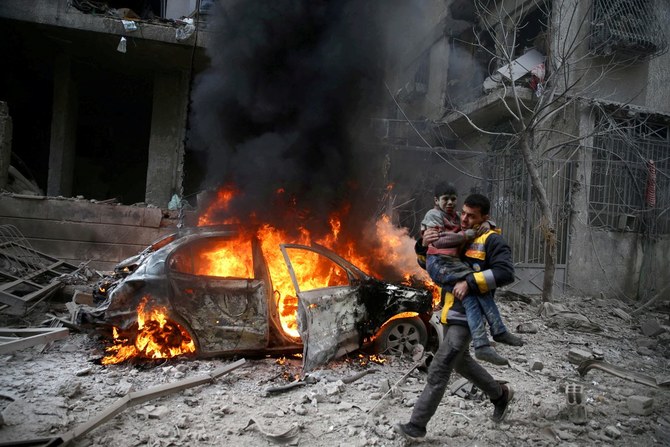
A Syrian Civil Defence member carries a wounded child in the besieged town of Hamoria, Eastern Ghouta, in Damascus, Syria January 6, 2018. (Reuters/File Photo)
Short Url
Updated 24 September 2021
Follow

UN updates named death toll for Syria war

  • OHCHR included only fatalities identifiable by a full name, with a place of death and an established date, from March 2011 to March 2021

GENEVA: The war in Syria has killed 350,209 fully identified individuals, according to a new count published Friday by the United Nations, which warned the real total of deaths would be far higher.

The Office of the High Commissioner for Human Rights (OHCHR) included only fatalities identifiable by a full name, with a place of death and an established date, from March 2011 to March 2021.

“We assess this figure of 350,209 as statistically sound, based as it is on rigorous work,” High Commissioner Michelle Bachelet told the UN Human Rights Council.

“It is not — and should not be seen as — a complete number of conflict-related killings in Syria during this period.

“It indicates a minimum verifiable number, and is certainly an under-count of the actual number of killings.”

The Syrian Observatory for Human Rights, the benchmark for counting victims of the conflict, published a report on June 1 raising the death toll to 494,438 since the start of the violent crackdown on anti-regime protests in 2011.

The Observatory revised up by 105,000 its previous death toll from March 2021, following months of investigation based on documents and sources on the ground.

UN rights chief Bachelet said more than one in 13 victims on the OHCHR count was a woman — 27,727 — while almost one in every 13 was a child — 27,126.

She said the greatest number of documented fatalities was in the Aleppo governorate, with 51,731 named individuals killed.

Other locations with heavy death tolls were Rural Damascus (47,483), Homs (40,986), Idlib (33,271), Hama (31,993) and Tartus (31,369).

Bachelet said OHCHR had received records with partial information which could not go into the analysis but nonetheless indicated a wider number of killings that were not yet fully documented.

“Tragically, there are also many other victims who left behind no witnesses or documentation,” she said.

OHCHR has begun processing information on those alleged to have caused a number of deaths, together with the civilian and non-civilian status of victims, and the cause of death by types of weaponry.

“Documenting the identity of and circumstances in which people have died is key to the effective realisation of a range of fundamental human rights — to know the truth, to seek accountability, and to pursue effective remedies,” said Bachelet.

The former Chilean president said the Syrian people's daily lives "remain scarred by unimaginable suffering... and there is still no end to the violence they endure.”

Bachelet said the count would ensure those killed were not forgotten.

“Behind each recorded death was a human being, born free and equal, in dignity and rights,” she said.


Refugees, migrants in Lebanon find rare sanctuary from Israeli strikes in Beirut church 

Updated 59 min 20 sec ago
Follow

Refugees, migrants in Lebanon find rare sanctuary from Israeli strikes in Beirut church 

  • Beirut church offers safe haven for displaced migrants, refugees
  • Many refugees lived through 2024 war, but are now more vulnerable

BEIRUT: When Israeli strikes began pummelling Beirut’s southern suburbs early on Monday, Sudanese refugee Ridina Muhammad and her family ​had no choice but to flee home on foot, eventually reaching the only shelter that would accept them: a church.
Eight months pregnant, Muhammad, 32, walked with her husband and three children for hours in the dark streets until they found a car to take them to the St. Joseph Tabaris Parish, which has opened its doors to refugees and migrants.
They are among 300,000 people displaced across Lebanon this week by heavy Israeli strikes, launched in response to a rocket and drone attackinto Israel by the Lebanese armed group Hezbollah.
Just 100,000 of the displaced are in government shelters. Others are staying ‌with relatives ‌or sleeping in the streets. But migrants and refugees say government ​shelters ‌were ⁠never an option ​for ⁠them, saying they were turned away during the last war between Hezbollah and Israel.
Muhammad’s oldest daughter, now seven, stopped speaking after the 2024 war.
This time, they are even more vulnerable: their home was destroyed in this week’s strikes and Muhammad is due to give birth at the end of the month.
“I don’t know if there’s a doctor or not, but I’m really scared about it because I haven’t prepared any clothes for the baby, nor arranged a hospital, and I don’t know where to go,” she told ⁠Reuters as her younger daughter leaned against her pregnant belly.
Muhammad ‌said she was registered with the United Nations’ refugee agency (UNHCR) ‌but had not received support.
“Us, as refugees, why did we ​register with the UN, if they are not ‌helping us in the most difficult times?” she said.
Dalal Harb, a spokesperson for UNHCR ‌Lebanon, said the agency had mobilized but reaching everyone immediately was extremely challenging given the scale and speed of displacement. The UNHCR operation in Lebanon is currently only around 14 percent funded, she said.
The Jesuit Refugee Service (JRS), which helped the church host displaced in 2024, is doing so again.
Michael Petro, JRS’ Emergency Shelter Director, said the church was ‌full within the first day of strikes, with 140 people from South Sudan, Ethiopia, Bangladesh, and other countries sheltering there.
“There are many, many more ⁠people coming than there ⁠were in 2024, and we have fewer and fewer places to put them,” he said.
Petro said he was told weeks ago that government shelters would be open to migrants if war erupted.
But when the strikes began and even Lebanese struggled to find shelter, the policy seemed to change, he said.
“We’re hearing from hotlines up to government officials and ministries that migrants are not welcome,” Petro said.
Lebanon’s Minister for Social Affairs Haneen Sayyed did not respond to a request for comment. On Thursday, Sayyed said Beirut shelters were full.
When Israeli strikes began, Othman Yahyeh Dawood, a 41-year-old Sudanese man, put his two young sons on his motorcycle.
They drove 75 kilometers (46 miles) from the southern Lebanese town of Nabatieh to St. Joseph’s, where they had sheltered in 2024.
“I know the area ​is safe and there are people who ​will welcome us,” he said.
“We don’t know where to go; there’s war there (in the south), war here (in Beirut), war in Sudan, and nowhere else to go,” he said.