


NEW YORK: “Inclusivity” is a buzzword this year at the UN General Assembly as it convenes on the third day of its 76th session. Unless “including” women, children, and the most vulnerable in all aspects of sustainable development, the world’s multi-faceted crises will continue to rage.
Inclusivity is of paramount importance also when it comes to the digital divide in the world between rich nations and developing ones.
UN Secretary-General Antonio Guterres, underscoring the growing importance of the digital economy to humanity’s future, has stressed the need for everyone to be able to work and study online. Lack of such ability will result in further marginalization of the most vulnerable sections of the population: women, the elderly, and people with disabilities.
Guterres’s roadmap calls for every adult to have internet access by 2030.
“Shaping an Inclusive Digital Age,” was the subject of discussion at a high-level event convened by the Digital Cooperation Organization, a recently-established global organization working towards achieving “digital prosperity for all.” DCO works with governments, the private sector, international and non-governmental organizations, and civil society in pushing for an inclusive digital transformation and growth of the digital industries.
The seven-member body includes Saudi Arabia, Bahrain, Jordan, Kuwait, Nigeria, Oman, and Pakistan. It accounts for a population of 480 million, 80 percent of which are under the age of 35. It said it is open to any new member that shares the same goals of “empowering youth, women, and entrepreneurs and leapfrogging the digital transformation.”
Thursday’s event highlighted DCO’s efforts in bringing together all the various stakeholders to “spur digital economic growth across member states, advance DCO members’ digital transformation, and address challenges related to a growing digital divide within and between countries.”
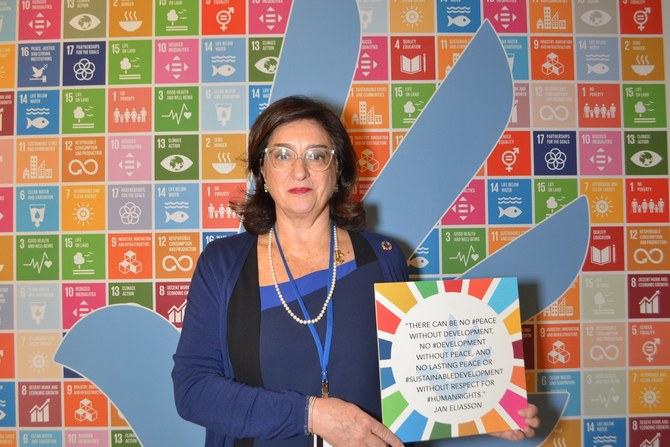
Representing the UN technology envoy office, assistant secretary-general Maria-Francesca Spatolisano encouraged multi-stakeholder cooperation between wealthy and developing countries. She said DCO’s goals can help push forward the UN’s roadmap and are in alignment with the UN Sustainable Development Goals.
In 2015, the UN General Assembly set forth 17 SDGs designed to achieve a better and more sustainable future for all. The SDGs were intended to be achieved by the year 2030.
“I welcome the Digital Cooperation Organization’s efforts to create an inclusive digital future for all, and efforts by member states Bahrain, Jordan, Kuwait, Nigeria, Oman, Pakistan, and Saudi Arabia to prioritize the digital economy in their countries’ agendas,” Spatolisano said.
Saudi Minister of Communications and Information Technology Abdullah Alswaha, a DCO chairperson, underscored the growing polarization resulting from digital exclusion, such as seen in the access to venture capital. Stressing that the COVID-19 pandemic has shown that the digital economy can be a catalyst for growth, he pointed to the 34 percent rate of female digital participation.
Helping shape the international debate around digital transformation, ministers for communication and technology from DCO’s membership, as well as Saudi Arabia’s permanent representative to the UN, Abdullah Al-Mouallimi, shared expert insight on ways to address the key challenge of the digital economy.
“The borderless nature of the internet means that global collaboration is not an abstract idea, but rather a practical reality,” DCO Secretary-General Deemah Al-Yahya said.
“While the digital economy is seeing exponential growth clustered within specific geographies and industries, we need to ensure that the digital divide does not widen as the digital economy progresses.”
She said the DCO has brought together countries representing 480 million people, 270 million of which are under the age of 25, and $2 trillion in combined GDP, in order to focus efforts on digital economic inclusion and bridge the digital divide.
“Our inclusive approach extends to creating impactful partnerships with the private sector to grow the digital economy,” Al-Yahya said. “Our member states comprise 6,300 digital and innovative start-ups and 46 million small and medium enterprises, meaning that public-private partnerships are essential to creating digital prosperity for all of our members.
“The DCO’s vision is aligned with the UN secretary-general’s roadmap for digital cooperation in advancing digital prosperity for all. If we are to ensure that digital technology offers a net benefit to society, we must take a proactive and inclusive approach. We must drive the global digital agenda. We call on every nation who shares these aspirations to join the DCO.”


